

A new, first of its kind, report by end of life charity Marie Curie estimates that up to 762,000[1] people across the UK are providing unpaid care for someone living with a terminal illness every year.
The report also reveals that a concerning 13-15% of end of life carers who live with the person they are caring for (at least 22,500) are believed to be living below the poverty line[2].
Up to three quarters of a million people across the UK provide unpaid care to terminally ill loved ones every year
Up to 15% of household end of life carers are believed to be living in poverty, with this number doubling in the year following bereavement
Alarmingly, this number sharply increases in the year following a bereavement (to 22%-32%, depending on the measure of poverty used[3]) with funeral poverty, loss of benefits and pensions, housing insecurity and impacts on employment being considered as contributing factors.
Ed Davey, Leader of the Liberal Democrats and a carer himself, said:
“Having cared for my mum as she battled terminal bone cancer, and then losing her when I was 15, I am determined that we do a better job of supporting people caring for loved ones at the end of their life.
“The truth is, unpaid carers are treated badly enough while they’re looking after a loved one, but it’s even worse once that person has passed away. Bereaved carers are too often forgotten and ignored completely by people in power.
“The scale of poverty among bereaved carers revealed by Marie Curie is truly shocking. The Government urgently needs to transform support for carers, whether it’s with their finances, housing or when it comes to juggling work with care.”
According to Marie Curie, the negative impacts on unpaid, end of life carers are overwhelming. Caring for someone at the end of life can harm caregiver’s physical and mental wellbeing, and deal them with unacceptable financial burden, as they may be forced to take unpaid leave, change jobs, or leave work entirely to cope with the demands of caring.
Marie Curie is urging the UK Government to extend Carers Allowance entitlement, from two months to six months after a bereavement. The charity is also calling on the UK Government to use its Employment Rights Bill to introduce a new statutory right to paid Carers Leave, to help unpaid carers balance their caring and employment responsibilities.
Additionally, Marie Curie is also proposing a State Pension-level of income guarantee for working-age people living with a terminal illness, to provide better financial support for them and their household at the end of life.
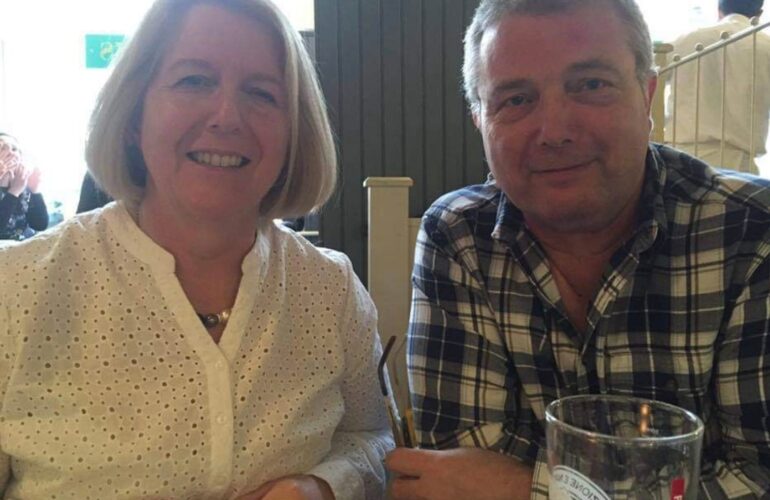
Audrey Buckham, 64, from County Durham, cared for her husband of 37 years, Eddie, when he was diagnosed with pancreatic cancer. She said:
“Before all of this, Eddie had a really good wage. I worked for the NHS full time, then went down to part time so I could look after him. He got PIP [Personal Independence Payment] and ESA [Employment and Support Allowance], and we had to both apply for Universal Credit, but because I was working, they took my wages off what he was getting, so he was only getting £39 a month.
“I didn’t have enough money to pay all the bills, and the credit cards and things, so that’s when I had to declare myself bankrupt. I tried to not burden Eddie about money, but sometimes you have to because you have to talk about things. One morning I said to him, ‘Eddie, I need to talk to you. We’re having problems with money, and I’m going to have to declare myself bankrupt.’ He got really upset and cried. Both of us cried together. Nearly three years on, I am still dealing with the consequences of going bankrupt. I have only now been able to get credit from some places to try and rebuild a good credit history.”
Dr Sam Royston, Executive Director for Research and Policy at Marie Curie, said:
“This report highlights the harsh reality of those who give up so much to care for the people they love at the end of their lives. Not only does evidence consistently show that the presence of an unpaid carer leads to better experiences for people at the end of life, it also reduces costs and pressures on wider health and care services.”
The research was carried out by the University of Sheffield, University of Leeds and Loughborough University and provides the first ever UK population level estimate of the number of end of life carers.
Marie Curie offers a range of support to unpaid carers both online and via its Support Line. Matt Williams, Associate Director of Information and Support, says they’ve noticed a worrying trend in the calls from people caring for a loved one:
“The majority of calls to our Support Line come from adults who are caring for their parents. Traditionally, calls centre around emotional and practical support, but increasingly we are seeing people calling with money worries, with advice on carers allowance being one of our most common enquiries.
“We can provide a range of support to unpaid carers from one time calls to our Support Line to weekly calls with one of our companion volunteers over the phone. Often talking about financial struggles can be difficult, some people find it easier to talk to someone who isn’t connected to their situation at all.
“We can also offer practical information, take them through our benefits calculator to look at what benefits they may be eligible to receive and arrange a call with one of our Energy Support Officers who can go through grants, supplier specific support for energy worries.”
For more information visit mariecurie.org.uk/support or call the Marie Curie Support Line on 0800 090 2309.
Cover photo –Audrey Buckham & her husband Eddie
For Marie Curie’s full Policy Briefing, email media@mariecurie.org.uk
Read the report summary here
References for statistics
[1] Using data from UK Household Longitudinal Survey (UKHLS) it is estimated there are between 150,000-180,00 household EOL carers in the UK annually, using data from Health Survey for England (HSE) this estimate rises to between 686,000-762,000 EOL carers in the UK annually.
[2] We used two measures of poverty: whether above or below a threshold of 60% of the median household equivalised income, as defined by the UK government to identify households in relative low income (DWP 2016). This measure was calculated both before and after housing costs. We also used the poverty index as defined by the Social Metric Commission (Social Metric Commission 2018, 2023) which takes account of other ‘inescapable’ costs such as childcare.
[3] After bereavement, using the Social Metrics Commission definition of poverty, carer poverty rates go from 15-22%. Using the main poverty measure currently used by the government, carer poverty rates go from 13-32%.

About Marie Curie
- Marie Curie is the UK’s leading end of life charity.
- The charity provides expert end of life care for people with any illness they are likely to die from, and support for their family and friends, in our hospices and where they live. It is the largest charity funder of palliative and end of life care research in the UK, and campaigns to ensure everyone has a good end of life experience. Whatever the illness, we’re with you to the end.
- If you’re living with a terminal illness or have been affected by dying, death and bereavement, Marie Curie can help. Visit mariecurie.org.uk or call the free Marie Curie Support Line on 0800 090 2309 or email support@mariecurie.org.uk
Whatever the illness, wherever you are, Marie Curie is with you to the end.
This research has produced the first population level estimates of the number of unpaid EOL carers in the UK. Using data from the UK Household Longitudinal Study (UKHLS) it is estimated there are between 150,000-180,00 household end of life carers in the UK annually. Using data from the Health Survey for England (HSE), this estimate rises to between 686,000-762,000 EOL carers [non household] in the UK annually.
Join us at the Marie Curie Research into Practice Conference to explore these findings further. The researchers will present their work during our session on Financial Insecurity at the End of Life, taking place on Friday, 14th February, from 10:00 to 12:00.
The University of Sheffield
The University of Sheffield is a leading Russell Group university, with a world-class reputation, ranked within the Top 100 universities in the world (Times Higher Education World University Rankings 2025). Over 30,000 students from 150 countries study at Sheffield and in a truly global community, they learn alongside over 1,500 of the world’s leading academics.
Sheffield’s world-shaping research feeds into its excellent education. Students learn at the leading edge of discovery from researchers who are tackling today’s biggest global challenges.
Driven by outstanding people, staff and students share a commitment to changing the world for the better, through the power and application of ideas and knowledge.
From the first documented use of penicillin as a therapy in 1930, to building Europe’s largest research-led manufacturing cluster, Sheffield’s inventive spirit and top quality research environment sets it apart.
Current research partners include Boeing, Rolls-Royce, Unilever, AstraZeneca, GlaxoSmithKline, Siemens and Airbus, as well as many government agencies and charitable foundations.
Sheffield was voted University of the Year in 2024 at the Whatuni Student Choice Awards – the largest annual university awards in the UK voted for exclusively by students. The award reflects a commitment to world-class education and an outstanding student experience. Its Students’ Union, which is home to more than 350 societies and clubs, was also named Best Students’ Union for the seventh consecutive year.
Over 300,000 Sheffield alumni from 205 different countries make a significant influence across the world, with six Nobel Prize winners included amongst former staff and students.
To find out more, visit: www.sheffield.ac.uk


Leave a Reply