

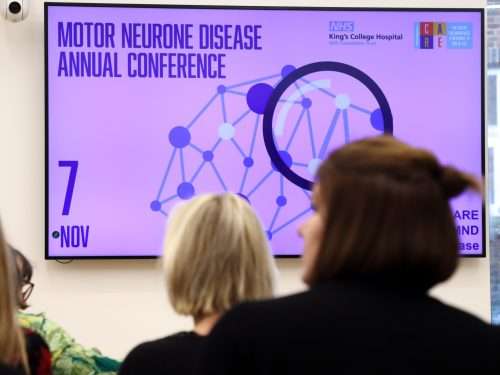
Experts and patients share fresh insights on treatment, ethics, and innovation in Motor Neurone Disease care.
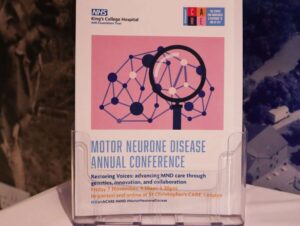
St Christopher’s and King’s College Hospital provided delegates with a packed programme of expert speakers to cover some of the most important issues affecting patients, at their 30thMND conference. Reviews of the latest research into how best to manage choking, feeding, twitching, ventilating and communicating as well as how best to assess capacity, were among the key topics.
Delegates heard two different perspectives of the right time for a gastrostomy, with speakers approaching this difficult decision from the point of view if a specialist ventilation unit – the Lane Fox Unit at Guys and St Thomas’ (GSTT), while Teresa Leahy from University Hospital in Galway and Dr Emma Hall, Consultant at St Christopher’s provided the palliative care perspective.
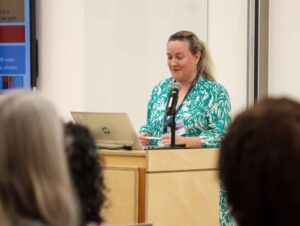
Dr Emma Hall, Consultant, St Christopher’s
Dr Michelle Ramsey, Respiratory Medicine Consultant and Senior Specialist Dietician, Angela Reddy, both from GSTT, explained their decision-making process that includes discussions with the consultants from gastro, respiratory and cardio, as well as the patient.
They raised the growing issue of extreme high and low body weight and how this increases the difficulty of the PEG procedure.
Patients who used Non-Invasive Ventilation for more than four hours a day, Michelle said, tended to have a higher survival rate with a PEG.
Teresa reported that she and her colleagues in Galway wanted to design an evidence-based guide for timely RIG insertions and to that end analysed the experience of 25 patients. The mean time between insertion and death was 11.6 months, she reported. Positively, all but three died in their preferred place of care.
A review of gastrostomies over the last three years at St Christopher’s showed similar findings, said Emma Hall who added that in addition to the MND MDT that has been established, open information sharing sessions with people considering tube feeding would be a positive next step.
The thorny issue of mental capacity was subject to a one-hour presentation by solicitor Henry Frydenson who provided delegates with several key takeaway messages.
Firstly, was being clear on the meaning of ‘mental capacity’. He emphasised that assessing someone’s capacity relates only to their ability to make a specific decision at a particular time.
In assessing someone’s capacity, there are two stages, functional and diagnostic and there are five basic principles:
- Start from the presumption that someone has capacity
- The person is entitled to support in making their decision
- Unwise decisions cannot be categorised as wrong decisions
- Always ask yourself if the best interests of that person are being deployed. This, Henry said was the very essence of the Mental Capacity Act. Ask yourself the acid test, if what you’re doing is in the person’s best interest and, if you have any doubt, then the answer is that you probably don’t
- Any intervention should have the least possible restriction.
Henry stressed the importance of record keeping to aid any defence, should there be litigation.
Being clear about the distinction between an Advanced Statement and an Advanced Decision was a further key takeaway. The former may provide useful information about a person’s wishes, but, like a DNAR and unlike an Advanced Decision (AD), it is not legally binding.
For that AD to be binding though, it must be signed, witnessed and specify that it applies even if the person’s life is at risk.
Dr James Bashford, NIHR Clinical Lecturer in Neurology at King’s, reported on a year-long research project to learn more about muscle fasciculations in people with MND and to establish if these could provide biomarkers to show progress of the disease and assist with drug development. He concluded that fasciculations could be used as a fast-track diagnosis tool and previewed an upcoming study that will use this to monitor the effectiveness of the drug Tofersen.
That led neatly into the update on clinical trials, provided by Dr Jemeen Sreedharan, Wellcome Trust Senior Research Fellow at King’s.
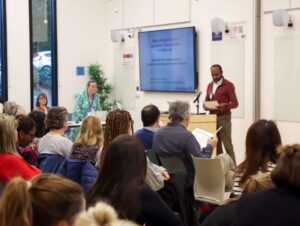
Nine patients are currently receiving Tofersen at King’s but, while it is approved in the US and EU, we’re still awaiting a decision in the UK, despite evidence it slows disease and prolongs life, Jemeen said.
There are a number of other trials in progress in the UK, being conducted faster and more effectively than previously, including one to measure neurofilament levels.
In terms of prolonged survival times, Dr Esther Hobson provided delegates with a review of her research into the effectiveness of Non-Invasive Ventilation (NIV). She described it as the most effective treatment – specifically in people who used it for more than four hours a day.
Effective communication of its benefits and ongoing monitoring and support are key to increasing the number of people using NIV, Esther added, breaking this down to three key actions: Enquire, Explain and Normalise. Providing people with a tangible goal which NIV could make more achievable is an effective way of helping people maximise what matters most to them.
For people to hear her authentic Cockney voice, was certainly amongst the things that matter most to Yvonne Johnson, a woman living with MND who, along with her devoted husband Orville, provided an emotive and compelling slice of lived experience.
The couple were invited to share their experience at the conference by Dr Richard Cave, Speech and Language Therapist – Co-Director of the Centre for Digital Language Inclusion at UCL’s Global Disability Innovation Hub.
Yvonne is one of a growing number of people using speech recognition technology pioneered by elevenlabs which, along with Centre for Digital Language Inclusion at UCL, is, Richard said providing people with the hope of maintaining their identity for longer. Rapidly, the centre has developed speech recognition tools in 10 African and five European languages which are capable of creating synthetic versions of people’s voices in under a minute.
Richard described this as ‘democratising technology’.
In terms of symptoms that affect a large proportion of people with MND, choking is right up there. According to Dorinda Moffatt, MND and Neurorespiratory Specialist Practitioner at Prospect House Hospice in Swindon, it affects 70% of patients.
Extraordinarily though, Dorinda added, an exhaustive search uncovered practically no research papers on choking. So, she, along with Dr Sara Mazzucco, Consultant Neurologist at Great Western Hospital, have embarked on a three-year research project funded by the Motor Neurone Disease Association with the expressed aim of identifying effective ways of helping people who do choke.
Dr Mazzucco said:
“We can categorically say that it is a neglected symptom despite being important to people living with MND, their carers and health care professionals.”
One theory for this, is the use of the word ‘choke’, Sara and Dorinda believe.
A clearly designed and widely disseminated guide is the desired outcome.
The conference’s final session focused on the individual not the disease, as Mandy Bruce, who leads the Psychological and Spiritual Care team at St Christopher’s, shared some of the work she and her colleagues have done with people with MND and their motivation.
“Being heard and valued is so important,” Mandy said. “Especially when identity is being lost. Art therapy can help people strengthen their inner resources to help hear the suffering.”
—————–


Leave a Reply