

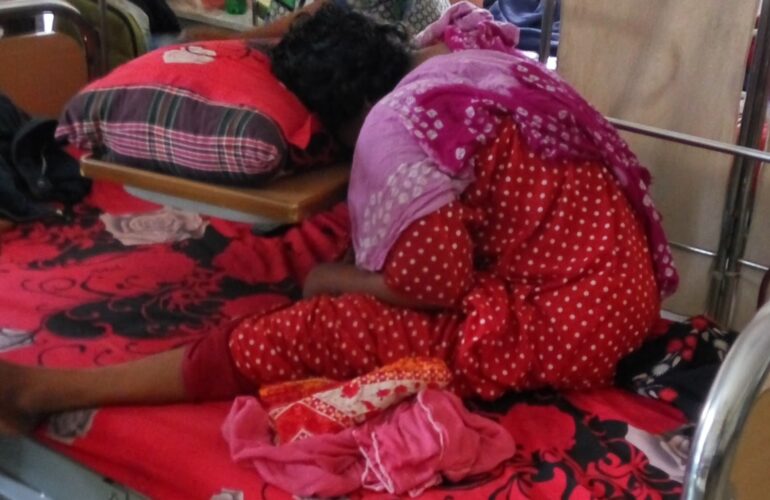
I was a young doctor in Bangladesh, newly graduated, newly appointed to the Palliative Medicine team at Bangladesh Medical University. Palliative care was not yet a language I fully understood. I knew pain scales, oxygen flow rates, and opioid doses. I did not yet know grief, abandonment, or the quiet violence of social exclusion.
Kobita was one of my earliest home-care patients.
She had advanced breast cancer, a fungating wound, and bilateral lung metastases. Her home was in Old Dhaka, where the lanes narrow until even sunlight hesitates to enter. The ambulance stayed on the main road. We walked the rest of the way.
The room where I first met her was dark and partitioned with hardboard. The smell reached me before she did. Rotting blood, necrotic tissue, infected discharge.
She welcomed me without words.
She sat upright, supported by pillows. She had not slept for four nights. Her breathlessness was so severe that even crying was fragmented. Pain, she said, was eight out of ten. Breathlessness, ten out of ten.
Her husband had died eighteen years earlier. She lived with her only son, his wife, and a grandson she called her whole life.
“I cannot lie down,” she whispered.
“I cannot breathe.”
I decided to admit her. It felt right. It was also against hospital rules.
There was no family member present. No consent. No paperwork. I did not understand the institutional risks. I understood only her suffering.
We brought her in.
I told myself admission would fix things. Morphine would work. Oxygen would help. Pain and breathlessness were clinical problems. I believed they would respond to clinical solutions.
They did not.
For six days, nothing changed. Despite escalating medication, her pain remained severe. Her breathlessness relentless. She still did not sleep. She still did not lie down.
I was distressed, angry with myself, ashamed. I had broken rules and failed to deliver relief. I stopped going home after rounds. I sat beside her bed.
And then I noticed something else.
No one came to see her.
On the third day, sitting silently beside her, she suddenly said one word.
“Johnny.”
I asked who Johnny was.
She broke down.
“My grandson,” she said.
“They took him away.”
Her daughter-in-law had left the house weeks earlier, believing the cancer was contagious. She had taken the child with her. Kobita said she had no anger toward them.
“But why my grandson?” she asked.
“He is my only companion. My reason to stay alive.”
She touched her chest and said quietly,
“Today my smell is unbearable to my own family.”
This was not pain recorded on a scale.
This was social death.
That evening, I went back to her case record and found her son’s phone number. I called him. Before saying anything else, I apologised. I told him that I had admitted his mother without his consent and accepted responsibility for that decision. I explained why I had done it, not as justification, but as honesty.
Then I made one request.
I asked if he could bring Johnny to the hospital, even for a short visit.
He refused at first. The fear was still there. The distance too wide. The next day, after hearing how unwell his mother had become, he agreed to come.
What happened next still unsettles me.
Johnny ran into the ward shouting “Dai” ( Grand- ma in local language). Kobita sat up straight. Her eyes lit up. They cried. They laughed. He brought her chocolates. They shared hospital food. She asked him if he liked chicken. She asked permission to go downstairs with him.
For nearly ninety minutes, she had no visible pain. No breathlessness. No distress.
She later asked,
“Doctor, can I live a little longer like this?”
We took her downstairs in a wheelchair. Oxygen remained on, but her body had changed. The woman who could not lie down for a week sat smiling in the afternoon light, holding her grandson.
For six days, medicine had failed.
In ninety minutes, love succeeded.
Where did the pain go?
Where did the breathlessness disappear?
What exactly had we been treating all along?
This encounter forced me to confront an uncomfortable truth: not all suffering is biological, and not all relief comes from medication.
Kobita’s pain was real. Her breathlessness was real. But they were entangled with abandonment, stigma, loss of role, and separation from the one person who still gave her meaning.
In global health, we often talk about symptom burden. We measure pain prevalence. We calculate morphine equivalence. We debate access to opioids. We train our eyes to see disease clearly, precisely, objectively.
Yet Kobita taught me that seeing is not the same as feeling.
We had eyes to see her pain, but for days we did not fully feel her loneliness. We had medicines to prescribe, but not the courage to ask who was missing from her life.
Her disease isolated her. Her smell marked her as untouchable. Her identity as a grandmother was stripped away. Reuniting her with her grandson did not cure her cancer. It restored her personhood.
When she said,
“He is my reason to stay alive,”
she was not being metaphorical.
Seventeen years later, these questions still follow me:
Are we truly connected to our patients, or only to their symptoms?
Is healing possible even when cure is not?
What is a doctor’s responsibility when suffering lies outside the body?
Does pain reduce because of medicine, or because someone feels seen?
In whose presence does breathlessness ease?
Global palliative care increasingly recognises these dimensions.
Yet health systems remain structured around efficiency, protocols, and biomedical outcomes. There is little space for relational care, family reconciliation, or meaning-making.
Kobita forces us to ask whether our models of care are adequate.
Thinking out of the box is not about innovation or technology.
It is about remembering that patients do not live inside guidelines.
Kobita taught me that palliative care is not only about managing symptoms. It is about restoring connections. About challenging stigma. About asking who is missing from the bedside.
She once said softly,
“Doctor, pain is easier when someone belongs to you.”
I still do not have all the answers. I continue to search for them, wearing the white coat, working in a world that prioritises cure over care.
Perhaps the answer is not found in medicine alone.
Perhaps healing begins where compassion is allowed to act.
And perhaps the real strength of palliative care lies not in what we give, but in whom we bring back.
————————

Rubayat Rahman


“For six days, medicine had failed.
In ninety minutes, love succeeded.”
What an experience you shared brother !!!
A most powerful story to share Rubyat..Thank you your article offers such reflective and critical questions for us to hold and explore.
The story teaches us that while a cure (recovery from disease) may not always be possible, healing (inner peace or comfort) is achievable until the very last moment. While a physician may not have the power to cure terminal cancer, they possess the opportunity to mend a broken spirit. A doctor’s responsibility extends far beyond writing prescriptions; it is about restoring the patient’s lost personhood.
Kobita once said, ‘Today, the smell of my own body has become unbearable to my family.’ This represents a form of ‘social death’ occurring long before physical death. A core mission of palliative care is to bridge this isolation. When society abandons a terminally ill patient, their physical suffering multiplies; in this case, the presence of her grandson shattered that wall of abandonment. This is precisely where the essence and ideological foundation of palliative care lie