
Over the past few years in Malaysia, there has been several articles in both printed and digital media attempting to explain: ‘What is palliative care and the difference between palliative care and hospice?’. The response to these explanations is important in that it may shape clinical practices and affect life changing situations.
Hence it is even more important to understand the context and potential outcome of the question and response.
The same words may carry different meanings when used by different people in different context. The term ‘hospice’ originated from the Latin ‘hospes’ which meant guest and host. It’s modern understanding is derived from the work of Dame Cicely Saunders and is focussed on the delivery of a medical service of symptom control and other measures to support patients and families approaching the end of life.
Dame Cicely established St Christopher’s Hospice in London to provide hospice care in a home like environment. She introduced the concept of ‘total pain’ where pain is recognised as a multidimensional issue, and that caring for a person with serious health-related suffering necessarily requires the address of the person’s total pain.
Dr Balfour Mount, who visited St Christopher’s Hospice established a similar unit in a Royal Victoria Hospital, Montreal but opted to use the term ‘palliative’ derived from the Latin ‘pallium’ which means to cover or cloak as the term hospice has negative connotation in French.
Since then, similar services have been formed across the world that at its core, provided care of patients and families approaching the end of life although some of the characteristics of such services may vary.
When organisations such as Hospis Malaysia, Hospice Klang, Perak Palliative Care Society and others were formed in the 1990’s in Malaysia, their aims were the same, whether they call themselves a hospice or a palliative care organisation as the term is synonymous. The term palliative care is mainly used to describe the approach and specialization process but the core principles remain as that of hospice care.
In later years, the term ‘supportive care’ became popular as a ‘better’ way to introduce palliative care into cancer treatment centres, as again some felt the term hospice had negative connotations.
Although there are many attempts to differentiate them, all these terms should be seen as similar care models. Their aims are to improve the quality of life of patients and their families. The practise of hospice or palliative care should very much be seen as the delivery of a service to firstly identify the needs of patients with health-related suffering and then address them.
The University of Edinburgh in 2019 developed an evidence-based tool – SPICT Tool to help clinicians identify the palliative care needs of patients.
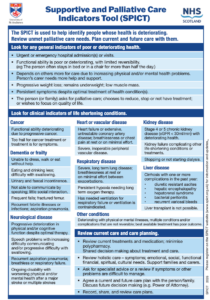
1. Link for Dr Ednin’s Article SPICT-2026
Why does this matter in Malaysia? For 2 reasons. Death is still very much a taboo topic to many in the community and a service that talks about end of life may seem confrontational to those who may not be ready to engage in such potential discussions.
Secondly, the improvements in medicine may lead to an over optimistic approach to advanced diseases such that some clinicians feel that recovery may still be possible and hospice or palliative care referral is not necessary. Though there are several screening tools to identify patients with palliative care needs, many physicians insists that such patients are “not ready to be referred”.
Early integration of palliative care brings significant benefit to not just patients and families but also utilisation of healthcare systems. Integration into cancer care may also have survivorship benefits.
Despite the calls for early integration of palliative care, the reality is quite different. A paper by Jordan R I et al Duration of palliative care before death in routine practice: a systematic review and meta-analysis. BMC palliative care 2020, showed that the median duration of palliative care was 18.9 days before death, weighted by the number of participants.
For cancer it was 15 days and 6 days for non-cancer. Thus, in a practical setting, the terms hospice, palliative care or supportive care does not matter as most patients are getting referred late, often at the very end of life. As a result, very little can be done to improve their quality of life, and all that can potentially be done is to honour their preferred place of death.
For many in the public, the terms hospice and palliative care conjure up issues not just surrounding end of life but also a perception of “giving up” as treatment for the disease is no longer possible.
However, early referral to palliative and hospice care has demonstrated remarkable improvement in end-of-life outcomes as explained by Tai-Chung Lam et al: “Integrative Palliative Care Service Model Improved End-of-Life Care and Overall Survival of Advanced Cancer Patients in Hong Kong: A Review of Ten-Year Territory-Wide Cohort”, J Palliat Med Sept 2021.
Hospis Malaysia has found some success in connecting with some clinicians in specialties such as neurology and geriatrics where patients are referred and jointly managed with community palliative care services at an earlier stage of illness.
So perhaps in Malaysia, one should look at responding to the question ‘what is the difference between hospice, palliative care and supportive care’ by asking ‘how is your illness affecting you and what solutions do you hope for?’ and the conversation begins…
———————
Hospis Malaysia recently rebranded itself to incorporate “Center of Palliative Care” in its name to enable the public to better understand that in our country and many other parts of the world, hospice and palliative care are one and the same. Let us not confuse ourselves with some other countries such as the USA where the terms are used differently and come with some conditions and requirements.
——————
ehospice is proud to help promote individual, local, national and international voices in Hospice & Palliative Care
We are on target to have over One Million page views this year.
To stay in touch with colleagues and news around the world subscribe to our free Newsletter


Leave a Reply