

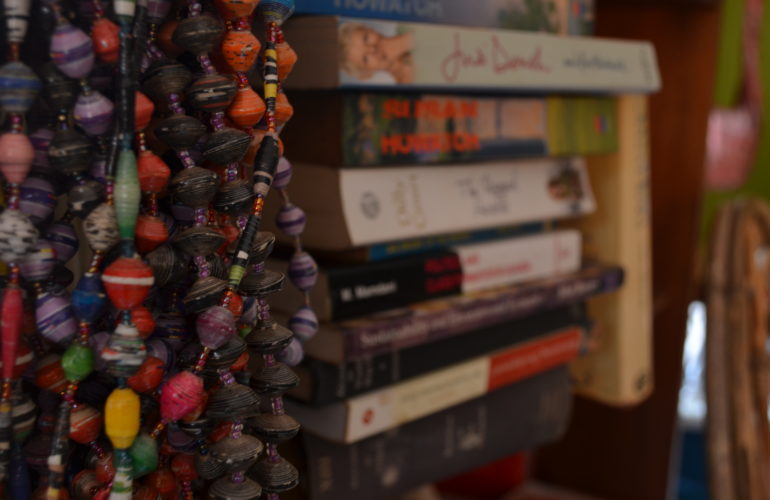
An incongruous collection of books sit on the shelves next to hand-made jewellery and other bits of bric-a-brac. I stand and flick through the books for a minute enjoying being out of the hot Kampala sun. As I rummage around looking for a bargain the shop assistant, Joy, begins to talk to me about her role at Hospice Africa Uganda.
Joy is one of a dedicated team of volunteers who make it possible for the hospice to carry on offering palliative care services to patients with Cancer and/or HIV/AIDS. Joy, a recently retired surgical nurse, is clearly someone who is driven by the need to help others. When I ask her why she gives up five days a week to help at the hospice she explains:
“After spending a long time with patients you see the help that they need. I give [my] heart for the patients here. I have seen how the day care here helps the patients. I am here to help them how I can.”
As she talks she continues to work busily sticking price labels on books piled up in front of her. Joy’s way of helping is to run the ‘Hospice Charity Shop’. The small room at the side of the hospice compound is a modest component of the hospice’s fundraising efforts. Joy explains to me the shops origins saying,
“We used to have a place at the [monthly] flea market but some days we would make very little money so we decided to create the shop.”
Last year the shop made an impressive 24 million Ugandan Shillings (approximately $9,250) in profit. This level profit is only possible because of the volunteers like Joy who staff the shop.
Now folding clothes, Joy starts to explain to me the ideas she has for the future. She talks of stocking sodas and snacks to encourage people into the shop. Just as nice shirt catches my eye she comments that:“Everyone who comes in can find something they want here.”
The shop is not just about fundraising. It also acts as a draw to encourage members of the public to visit the hospice.
There is still far too much stigma associated with many of the life-limiting illnesses that result in people attending the hospice. It is hoped that by people meeting and indirectly helping the patients through the shop it will help to break down some of the stigma.
Joy, now stacking plastic bags on top each other explains the depth of the problem saying,
“It is not just strangers. Many people have relatives who have given up on them. That’s why [some] patients come here, to feel wanted…Family worry things like: ‘What if I catch your AIDS’ and: ‘What if they give it to the community’…There is still so much stigma it makes it hard for people to be honest.”
After making this point Joy stops working for the first time in our whole conversation. She looks ahead and then slowly around the shop. Just as I am about to ask another question she looks directly at me and says:
“My brother has HIV and has too much stigma. He hides his ARVs [Antiretroviral drugs]. I talk to his kids and tell them to talk to him about it…but they do not talk.”
Joy’s reasons for working in the shop are deeply personal as well as professional.
I leave a small amount of silence after these comments unsure of what to say next. The silence is broken though by another volunteer entering the shop. Joy wastes no time in introducing Derek and soon I hear his story as well.
He works night shifts and comes and volunteers during the day. I ask Derek what motivates him to give up his time to help in the hospice and he responds:
“I want to help people who need my help.”
His answer held a clarity, simplicity and sentiment that I found replicated throughout the volunteers at the hospice.
In the day care centre that was holding an open day for patients I meet Perusi Zawedde, someone who has HIV but attends the hospice as a volunteer. I ask her what makes her want to volunteer and she answers:
“As someone who has passed through the situation, I think I am the one to help guide those who are still passing through the same situation…Sometimes a patient won’t listen to a doctor but they will listen to me.”
She sits with the warm afternoon sun flowing through the window behind her. In front of her sit a couple of patients who are learning the craft of making jewellery out of rolled slits of magazine paper. Perusi explains to me that these skills make the patient some money even if they don’t have the energy to get out of bed.
I attempt to join in and make some of the small beads and everyone laughs at my clumsy fingers. Perusi smiles and tries to show me again and produces a beautiful small bead. As the other patients and I watch her work I begin to see the circular and self supporting nature of hospice. Everyone has a role to play and everyone is there supporting each other.
I ask Perusi who buys the jewellery and she nods her head in the direction of the charity shop. On cue Joy puts her head around the door and smiles – just checking how everyone was getting on.
One of women smiling back at Joy who I assumed was a patient had a five year old boy on her lap. I was soon introduced to the five year old who was called Patrick. His mother had bought him here because he was getting treatment for what she referred to as ‘head cancer’. They were currently homeless and living off charity.
Palliative care is something that is too often just associated with the old and fragile. As Patrick sat on a mattress on the floor and played I thought about how age bared no relation on whether or not you needed physical and emotional support when diagnosed with a life-limiting illness.
I went to Hospice Africa Uganda to meet some of the patients and to hear their stories. People like Patrick and Perusi showed me the importance of the right to palliative care, something so often overlooked by governments and health professionals.
Visiting the hospice however also made me realise how important the army of volunteers like Joy are. Without people like Joy giving up their time and energy, those who currently benefit from palliative care provision such as that provided by Hospice Africa Uganda, would be left needlessly suffering.


Leave a Reply