


The Palliative Care Association of Uganda (PCAU) is pioneering initiatives to rebuild compassionate communities in Uganda. The initiatives are rooted in a health promotion approach to palliative care, aiming to support solidarity among community members.
The World Health Organization (WHO), in their new conceptual development model for palliative care worldwide, have emphasised the need for empowered people and communities. According to WHO, individuals, families, and communities must play their role as partners in the development of health and social services as well as in the engagement in shared decision-making about their health. It is this background that necessitates such an initiative that brings onboard nonprofessional palliative care actors to contribute to addressing the health and suffering in the community.
Rooted in African Heritage where the old pass on positive values to the young
As the lead organization advocating for the integration of palliative care into Uganda’s social services, the Palliative Care Association of Uganda (PCAU) recognizes that everyone has a role in alleviating the pain and suffering caused by life-limiting illnesses. PCAU has therefore initiated a compassionate community program that seeks to reawaken neighbours in communities to mind the plight of the sick, frail, and older persons around them. The initiatives by PCAU are culturally appropriate and rooted in our African heritage. The African context highlights the vital roles family members, neighbours, and the local community play during times of sickness, suffering, death, dying, and bereavement and in caring for older or frail individuals. However, as we continue to evolve as a society- experiencing migration, urbanization, and population growth- the support of extended families and immediate neighbours gradually diminishes.
This is happening when Uganda’s health service is still facing several challenges that impact meeting the expanding needs of citizens. The challenges include poor quality of health services, low hospital coverage, inadequate infrastructure in rural areas, and about 30-60 percent shortage of health workers and medicines. Moreso, as explained by Uganda’s Ministry of Health in the country’s Roadmap Towards Universal Health Coverage document 2021 -2023, the households’ out-of-pocket expenditure on health care is above 40 percent. While this is so, over 41 percent of Uganda’s population lives below the international poverty line. These lack several social and economic aspects of everyday human life. Amidst challenges of scarcity and deprivation, the need for palliative care continues to grow with the increase of incidence of non-communicable diseases (NCDs) and an aging population.
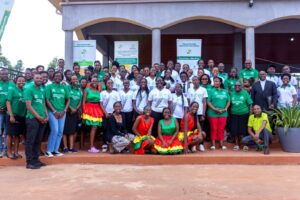 Through a public health palliative care approach, therefore, PCAU is empowering communities in Uganda to be close-knit and supportive of neighborliness. PCAU is harnessing the individual acts of kindness by ordinary people. This way, communities are not only supporting their own but also standing strongly together to advocate for their rights. There are more opportunities for education, awareness, information sharing, and improved referrals for the sick, those living with disabilities, and older persons in need of support.
The Compassionate Communities for Uganda Initiative was launched in October 2023 with the establishment of a high school palliative care club at Taibah International School. Watch the video for the launch of the initiative here.
The approach by the Palliative Care Association of Uganda
At the heart of efforts to rebuild compassionate communities in Uganda is the acknowledgment that sickness, death, dying, loss, ageing, and caregiving are contextual, social experiences that affect all human beings without exception. They are universal. PCAU recognizes that having strong social relationships with individuals and institutions within one’s community facilitates better life choices and helps alleviate pain and suffering during times of need. Conversely, loneliness, exclusion, discrimination, and stigma exacerbate the pain and suffering of individuals with illness and their families.
When starting the initiative in a new location, the first step by PCAU is to enter a partnership with a stand-alone hospice or palliative care team at the local hospital. Together with the local palliative care team, PCAU maps out a parish, or ward, as the implementation area. The target population for a mapped compassionate community is between 2,500 and 3,800 people in one area. A detailed assessment of the population in the area follows, including the mapping of key health-focused partners, resources, and institutions. The implementation of the initiative relies heavily on compassionate volunteers of the Village Health Team (VHTs) who are selected and trained.
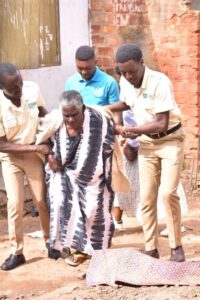 High School Students of the Palliative Care Club walking hand in hand with an older person in 2024. The Lweza Community Health Program (LCHP) was the first organization to partner with PCAU in implementing the Compassionate Communities for Uganda Initiative.
Based on the findings of the baseline assessment, the program team works with volunteers in drawing interventions with clear, measurable outcomes. As a twist, each implementing palliative care team works with primary or high schools in their reach to start children and youth palliative care clubs. PCAU’s experience has shown that children and youth clubs in schools are key catalysts of change in communities. The palliative care team members become key mentors to the palliative care clubs. The clubs conduct several activities such as essay competitions on acts of kindness, community awareness outreach, fundraising events, music dance and drama competitions themed with palliative care and compassionate messages, conducting home visits to the sick and older people, and appearing on radio and TV talk shows, among others. In all they do, the professional palliative care team members and the trained volunteers are always available to guide and support.
 Therefore, our approach enhances existing practical models of palliative care service delivery, not only by focusing on the individual with an illness and their family but also by significantly strengthening the networks of care surrounding them. In doing so, we improve the conditions in which people with life-limiting illnesses live and their access to resources, including referrals. In the same community, we also aim to enhance the social determinants of health.
“Taking care of others, helping others, ultimately is the way to discover your joy and to have a happy life.” Archbishop Desmond Tutu
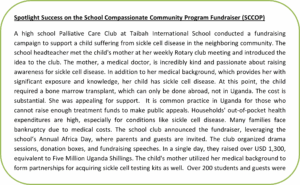
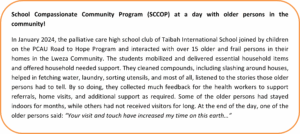

 Double Your Impact for Palliative Care in Uganda!
Would you like to support the Palliative Care Association of Uganda to continue advancing the spread of pain relief services in Uganda? Then this is the right time to contribute.
Thanks to a special donor, we are excited to announce a unique opportunity to double your support for their amazing work! When you give now, your contribution will be matched dollar by dollar, up to $75,000.
Please visit us through this link to donate: Double Your Impact for Palliative Care in Uganda! – PCAU Partnership


Leave a Reply