


The new Atlas of Palliative Care in Africa was launched in Gaborone, Botswana, in September during the 8th International African Palliative Care Conference presenting the findings of a study covering 54 countries led by the ATLANTES Global Observatory of Palliative Care at the University of Navarra and the African Palliative Care Association (APCA).
The map of palliative care development in Africa reveals that the continent is making significant efforts, but the results remain insufficient. Specialized services have increased by 38%, but that is still an average of only 0.06 services per 100,000 inhabitants. This figure is insufficient to meet the continent’s needs, where it would be desirable to reach at least 2 services per 100,000 people. This is the scenario shown by the new Atlas of Palliative Care in Africa, a study that provides the most comprehensive and rigorous information to date on the situation in the continent.
The research was led by the ATLANTES Global Observatory of Palliative Care, from the Institute for Culture and Society (ICS) at the University of Navarra, in collaboration with the African Palliative Care Association (APCA).
The atlas data, which update, expand, and improve on the previous edition published in 2017, were collected and analyzed using a rigorous methodology and applying the new conceptual framework of the World Health Organization (WHO), of which ATLANTES is a collaborating center. In addition, it involved the participation and support of 121 expert consultants from 50 African countries, trained by ATLANTES, who worked on the ground to collect and verify the information.
Urgent needs
 It is estimated that more than 17 million people face serious health-related suffering in Africa. Despite strong efforts to expand palliative care policies, the map reveals urgent needs. Only Uganda reaches the Advanced level, and just five countries —South Africa, Malawi, Kenya, Morocco, and Rwanda— have well-established systems. On the other hand, Angola, Burundi, the Central African Republic, Chad, Equatorial Guinea, Eritrea, Guinea-Bissau, São Tomé and Príncipe, and Somalia have no specialized services at all. Overall, more than half of the continent is still at an emerging stage in the development of palliative care.
Another worrying issue is the limited access to medicines for pain relief: in 76% of countries, oral morphine is available in less than 10% of urban primary care centers; this shortage extends to 85% in rural areas. Only in countries such as Mauritius, Morocco, Namibia, and Rwanda does urban availability exceed 70%. For children, there are only 102 specialized pediatric palliative care services across the entire continent —and more than half of them are concentrated in just three countries: South Africa, Zambia, and Uganda.
The study highlights marked inequalities between Anglophone and non-Anglophone African countries. The former consistently achieved better results in access to essential pain medicines —such as oral morphine—, in professional training, and in the availability of specialized services, including pediatric ones. Similarly, Anglophone countries published up to fifteen times more research than their non-Anglophone counterparts, leaving the latter with less evidence of their own to guide policies and with greater dependence on external models.
Progress
However, there are reasons for hope, as 10 countries already have independent national palliative care strategies; 25 have integrated them into broader health plans; and six are working on policies. Among these are Chad, Djibouti, Guinea-Bissau, Lesotho, and Niger, where they had never been considered before.
Furthermore, 26 African countries now have a national palliative care authority within their Ministries of Health (eight more than in 2017). Among them, Benin, Malawi, Rwanda, and Uganda have fully structured coordinating bodies. On the other hand, Equatorial Guinea, Lesotho, The Gambia, and Zambia have lost their national authority status, reflecting the fragility of these advances.
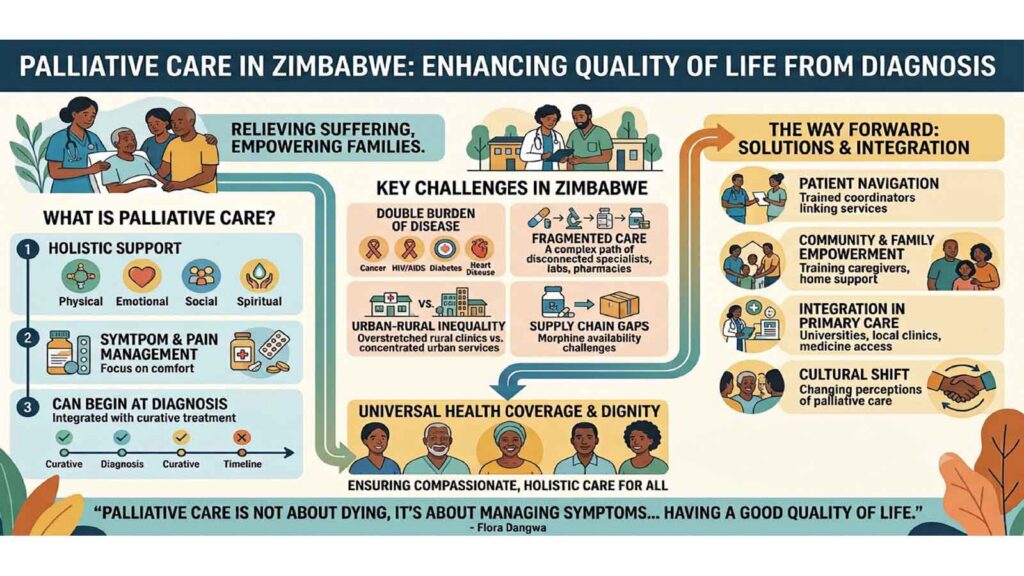
Uganda stands out as a benchmark for palliative care in Africa. This low-income country of more than 51 million inhabitants was one of the first to guarantee free, decentralized access to oral morphine and allows nurses to prescribe it. Uganda also leads in areas such as establishing indicators to assess the situation and integrating palliative care into universal health coverage. The country has also shown innovation by including palliative care in mandatory university training for health professionals. In this respect, it is also integrated in Malawi, Namibia, Zimbabwe, Kenya, Morocco, and Ghana.
A practical tool
The Atlas of Palliative Care in Africa aims to be a practical tool for advocacy and awareness-raising in all countries, and to contribute to the development of public policies, thanks to its visual design, which includes maps and infographics. It is freely available online, and can be downloaded on the ICS website.
This atlas is the third installment in a series of five publications that will, for the first time, bring together a global map of palliative care. Last April, the edition dedicated to the Asia-Pacific region was presented in Malaysia; in May, the European edition was released in Helsinki. Later this year, the volumes on the Americas and the Eastern Mediterranean will be published.
 Instituto Cultura y Sociedad
Communication Service: T +34 948 425 600, ext 805611 / 802545 lescalada@unav.es / nrouzaut@unav.es
www.unav.edu/ics


Leave a Reply