

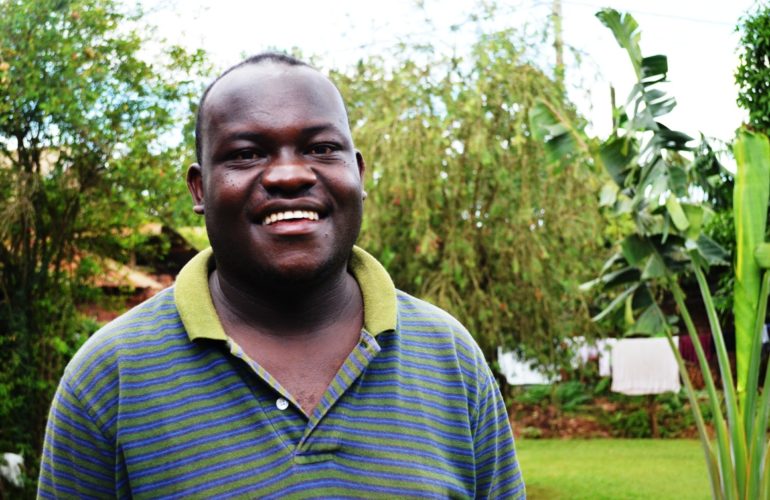
On the outskirts of Kampala, Mutagubya Bruno lives with his mother and father. A small alleyway leads to a neatly kept garden that is lined with palm trees and freshly hung clothes on a washing line. Bruno breaks the conversation he is having with his mother as a small delegation from Hospice Africa Uganda arrive through a side gate to their house.
In the living room, the three health care professionals sit in a line craning their necks to try and listen to Bruno’s father as he describes his pain. As Bruno’s father speaks, one of the nurses sorts through her case notes. She glances at the previous dosages of oral morphine Bruno’s father has received.
Throughout the conversation Bruno sits on the edge of a worn-out arm chair opposite his father looking on.
After the initial conversation with the delegation, Lawrence walks slowly with the nurses and a doctor into the back room for further examination. When they are out of sight and possibly out of ear shot, Bruno begins to open up about what life is like living with, and caring for, his father.
“He is getting better, even Lisa [the nurse] can testify to that.” Lisa sits opposite writing up her notes and nods in confirmation as Bruno continues, “At first he was so so down… you cannot be happy to see your dad suffering. He would spend the whole day in his room, not putting on clothes because he was in too much pain. We would pray but you cannot be settled. It was very bad for us to see him like that.”
Bruno’s father, however, represents a minority within Uganda who have access to both treatment and the medications necessary to help control severe pain. In the whole of Uganda, for example, there is only one radiation centre for the treatment of cancer.
Although the figures are disputed, it is thought that the majority of Ugandans go their entire lifetime without ever seeing a physician. For those living in the rural areas of Uganda, there is estimated to be one doctor for every 50,000 people.
Even though Bruno’s father has received both chemotherapy and pain control medicines, Bruno feels that they were not ‘lucky’ in any sense of the word. Talking about when his father was diagnosed with cancer he says, “It was, it was so so difficult… The time they told us he had cancer was so bad for us, the whole family.”
It is hard not to like Bruno. He is 28 years old and dedicates his time to looking after his parents. When asked what his biggest hopes and fears are, he answers with an honest simplicity:
“Of course, our biggest fear is to lose our dad and not just that but our mum as well… What I hope to happen is to see our dad and our mum recover and for us to start our own lives with our own families and to live well.”
As Bruno speaks it is clear how looking after his parents must limit how he leads his life. Bruno provides close to full-time care for his father whom he has lived with for nearly his whole life. Bruno is still young and although he would never say it, his father’s health must impact the way the way he spends his time.
Lawrence briefly reappears in the room. He comes and sits opposite Bruno and there is a short moment of silence. After sitting, almost as an afterthought, Bruno’s father excuses himself as he says he feels “very tired”. This is taken as a cue for others to stand up and to begin the exiting process.
Bruno follows the doctor and nurse outside and thanks them for coming. The handshake goes beyond usual Ugandan protocol of politeness. It is plain to see just how important not only the medications are to Bruno’s father but also the personal and emotional support his family receives.


Leave a Reply