

The Edmonton Zone of Alberta Health Services (AHS) covers a large geographic area of 11,800 km2 and has 1.3 million residents (Alberta Health Services, 2015). Palliative and end-of-life care
Palliative sedation in the home is an infrequent occurrence. However, although the circumstances surrounding it are somewhat difficult to predict, an order for palliative sedation requires swift and confident coordination. This includes confirming and clarifying the orders, calling the pharmacy to confirm delivery of the medication, obtaining the infusion pump, gathering supplies, faxing documents to the call centre for independent double check and confirming that the patient and family are ready for the sedation.
With a large staff complement spread over an extensive geographic area, home care nursing staff, educators and managers were finding it challenging to establish or sustain the complex,
Providing simulation to practise skills used during highly stressful health-care situations is more common than ever as a way to connect theoretical learning with practical application. The benefits of using simulation to improve skill sets in end-of-life care are widely supported (Kopp & Hanson, 2012; Leighton & Dubas, 2009).
The clinical nurse specialist (CNS) for palliative home care contacted the AHS eSIM program to discuss the opportunity to collaborate. This program provides oversight and assistance with simulation events to any patient care service requesting its help. It was determined that simulation would be an ideal way to focus on palliative sedation skills.
The CNS attended an eSIM workshop intended to introduce educators to simulation techniques and prepare them to design and run sessions and facilitate debriefs. Next, she collaborated with clinical nurse educators (CNEs) in home care to develop an implementation strategy and a realistic scenario. She obtained support from managers to allow nursing staff to participate in one-hour simulation sessions.
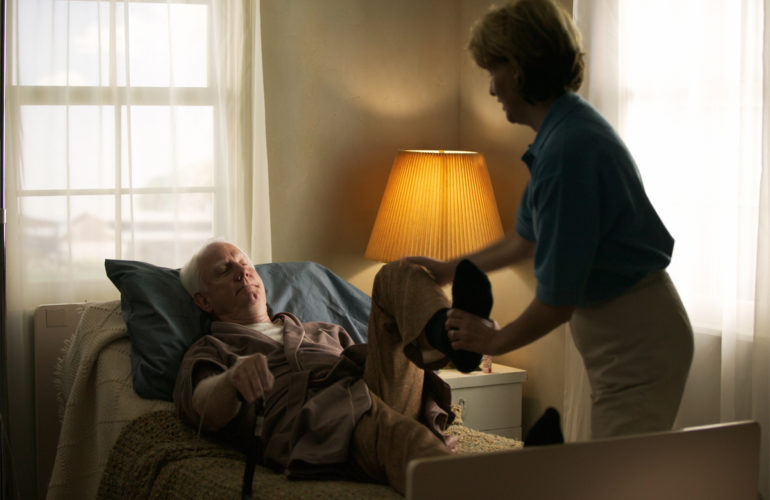
The simulation consultant responsible for the home care program helped with scenario development. She also booked an actor to play the part of a client, mentored the home care simulation leaders, played the part of the client’s daughter and offered advice when needed. Having an actor present would provide staff with the opportunity to identify and practise the appropriate communication skills with the client and family member.
For the full story visit Canadian Nurse.





Leave a Reply