

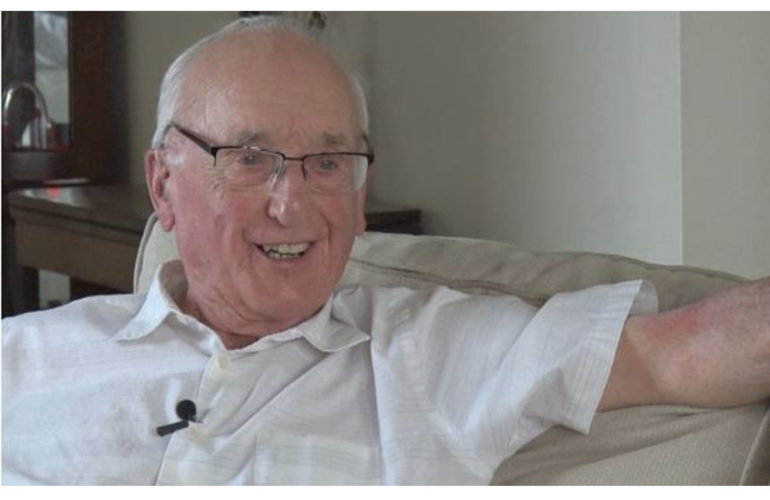
Caregiver #1: Donna
As Donna reflects on her experience of giving care to her husband Bill, she is grateful: “It was a gift to look after him. We talked more in the last six months than we did for 38 years.” Donna lives in the city of Saskatoon, is a mother of 3 and grandmother of 8. She cared for her husband after he was diagnosed with cancer and after a very short but intense period of care, Donna became a widow. To carry on in her grief, Donna has relied on happy memories, her faith, and steady support from family and friends. Becoming a widow meant that Donna had to learn to ask for help with everyday things that her husband usually took care of, such as oil changes. As she says, “it’s important to realize that you’re only one person in life and that you can’t do everything.”
Caregiver #2: Hope Tupper
When Hope Tupper’s husband Leigh passed away, she felt a loving sense of relief. “You could see that it wasn’t going to get better. It was going to get more intense. It was going to get worse.” Leigh was diagnosed with Parkinson’s in 2010, and Hope bravely took on the role of caregiver, assuring him that they were in this journey together. A sudden change in his health brought him to the end of life in 2014. At the time of his passing, Leigh and Hope had been married for 55 years. She looks back on her caregiving and sees it as a good experience, as she and her husband focused on their blessings towards the end of his life. In her bereavement, Hope was grateful to have encouragement from family and friends through phone calls, emails, visits, and cards that expressed fond memories of her husband. Another unique support for Hope came in the form of a funeral home employee who spent time reminiscing with her shortly after his death. Although she was strengthened by those close to her, Hope was sometimes hurt by less compassionate people that she encountered after her husband’s passing. In attending to all of the pressing legal matters that surrounded the death, Hope dealt with some employees who focused on the business side, rather than the human side, of their professions. For example, in one case she had to prove that she was indeed Leigh’s wife. “I know they were doing their job but there’s definitely room for showing caring and compassion.”
Caregiver #3: Sherrill Miller
“In life we have to reveal the unfolding mystery but you know what, we can’t solve it. There are things we do not know, we do not understand, and one just has to keep on moving ahead.” – Sherrill Miller
Sherrill Miller describes her caregiving journey as being very “serendipitous.” In the 1970’s, Sherrill began working at a new spinal cord injury unit in Vancouver. She was a nurse, and her position in the unit meant that she learned how to expertly care for paraplegic and quadraplegic indivividuals. She thrived in this role, but some years later decided to reinvent her career, turning to real estate. As Sherrill jokes, “if I could sell a quadraplegic man on the notion that his sex life wasn’t over, maybe I could sell a house.” After working in real estate for five years, she met her husband, world-acclaimed landscape photographer Courtney Milne. “He had a great sense of humour; he loved to tell stories. He was one of the most alive people that I think most people had ever met. His enthusiasm was contagious. His joy at being in the world and at doing what he did.” Sherrill and Courtney embarked on the journey of marriage, one that took them literally around the world. “We had a very exotic life. We travelled the world for many years: photographing, writing, researching – my job was a lot of that – and we produced many books and slideshows talking about the beauty, the glory, of sacred places around the world. So I was immersed in that all the time.”
In 2009 though, their journey took what Sherrill calls “a left hand turn.” Courtney was diagnosed with multiple myeloma in his spine and soon became paraplegic, coincidentally requiring the same highly specialized form of care that Sherrill had received years of training in. “I was surprised that it was so easy for me to slip back into that caregiver/nursing role which I’d given up 30 years ago. And I was amazed really how easily it came back to me. It’s like I just knew what to do.” Sherrill became his primary caregiver, coordinating with a homecare team and various medical professionals to attend to all of Courtney’s needs. “That was actually good for me in a sense because it helped me retain my sense of ability to accomplish things, ability to make things happen, just what I’d always done in all aspects of my life. The work we had done with beauty, with learning how to look at the world differently – what we used to call seeing with new eyes – was a perfect preparation for having to make this change in our lives.”
It was indeed serendipitous that Sherrill possessed the precise skill set that her husband needed, but it certainly did not mean her caregiving was easy. Sherrill and Courtney lived on an acreage 10 minutes from Saskatoon, and getting to and from medical appointments was an exhausting feat. “We had a small car and when he had to go for appointments, he had to do at least 6 transfers to get there: in/out of bed, into the car, into town, out of the car, and maybe some while he was there – up on a bed to be examined or whatever. And then back in the car, out of the car, and then back here and back in bed. So it was pretty hard on him, and on me. I was pretty strong, I could help him, but it was not always easy. And there were times when he wasn’t really well enough to be easily transferred. But the other thing about the travelling back and forth was the roads were bumpy, even in town the roads are bumpy. And he had a lot of pain at the site of his fractures and so even being in a heavy wheelchair in a heavy taxi, there’d be a lot of bumping and so he’d be really uncomfortable with that toing and froing. And so it wasn’t easy for him.”
Transportation was only one of many challenges Sherrill faced while caring for Courtney. “It was a very full time. I was busy the whole time. I got my hour long break when the nurses were here but the rest of the time I was pretty busy keeping things going, cooking, cleaning, shopping, looking after business. And I would not get to bed you know until 11:30 at night and then I’d have to set the alarm for 3 o’clock in the morning so that he could be turned because he couldn’t turn on his own. So I’d be awake until 3 or 3:30 and then back to bed and hopefully to sleep and then awake again at 7. So, after a couple years of that, I think I was getting pretty sleep deprived. And I had to be cautious. I had to be really aware of when I was tired and overwhelmed.”
Towards the end of his life, Courtney became more contemplative, and had time to converse about the mysteries of life. “I think it really helped him to, he had time to talk about that mystery, that inner working of some resolution about aspects of life. I think by the time he died he was ready to go. His work was done.” In 2010, Courtney passed away in the comfort of his home, in the company of his tireless wife Sherrill.
After her husband’s passing, Sherrill was offered information about many bereavement services, groups, and events, but did not feel the desire to pursue these kinds of supports. “Truthfully I wasn’t – I was not up for that. I felt like I was wanting to handle things in my own way. I guess I’m pretty independent that way.”
One major challenge in Sherrill’s bereavement was that she had not only lost her life partner, but her business partner as well. “I was grieving both things. For 25 years we had lived together and worked together, and suddenly I had to reinvent myself on a lot of different levels.” She was left with many items to organize, exhibitions to produce, images to prepare, and writing and interpreting to complete. “Suddenly I had to do this myself. I had to trust myself that I could do that well. It was overwhelming, a lot of things were overwhelming, and all the first steps that one has to deal with after somebody dies. The life insurance, the death insurance, the dealing with lawyers and accountants and whatever.”
Another challenge Sherrill faced was being inundated with what she calls the default question: “How are you doing?” The automatic, reflexive question that many posed to her could not be answered simply. “I felt it was impossible for me to say anything that was meaningful. It’s like either “I’m doing fine,” or the whole long story which I didn’t want to tell to just anybody. And I’m not sure anybody would want to hear it anyway. But they were just trying to be – to show their compassion. My process was much more of an inward process, of going inside and sifting through things, coming up with answers that worked for me.” Sherrill wished her loved ones might say instead “so great you could make it, lovely to see you, or I’m sorry for your loss,” the last statement being perhaps the most powerful of all.
Sherrill says that in her bereavement, she recognized that she needed to complete three essential tasks: reclaim, reinvent, and re-enchant her life. “First of all I needed to recognize who I still was, apart from our relationship that was no more. And I call that the reclaiming process – figure out who’s Sherill in all this. And then I realized that once I’d figured that out through this who this person still was, that I needed to reinvent that life – “what was that going to look like?” And then at some time after I realized that the third R – the big one – was to re-enchant that life. To find out what was meaningful to me and what made life worth living.”
Sherrill believes that her inner creativity has allowed her to continually reinvent her life after her loss. She now gives presentations on her bereavement journey, pairing her and her husband’s story with his beautiful images to give an immersive glimpse into her experiences. “When I discovered that creative aspect in myself, which I’d actually never really used before, to be able to put together shows like Courtney used to do, that was really my path of coming out of the bereavement. It was my re-entering into the world. And it’s given me a new focus, it’s given me a way to give back to people. It’s a way of continuing to give service. And it always inspires me as well.”
Caregiver #4: Dick Strayer
“He took me aside one day and he says ‘Dick, he says I hate to tell you’ he says, ‘I think Doreen has MS.’ Well that wasn’t the best news I ever had.”
In 1974, Dick Strayer’s wife Doreen received the life changing diagnosis of multiple sclerosis – a disease that, at the time, the medical field was just beginning to understand. Dick recalls his wife’s resolve to fight the disease from the moment the news was broken. She continued to curl at the local curling club for as long as her body allowed, and even went on cruises with Dick. “It was a slow process and as I say, she fought every inch of the way.” Despite Doreen’s unwavering spirit, eventually Dick had to assume caregiver responsibilities, such as putting guard rails up around their home. “I helped make the beds, I helped do the vaccuuming. And I helped do this and eventually I did that, and eventually a little more, eventually I started getting into the kitchen.” He took on even more tasks when his wife started using a wheelchair in the 1980’s. At the time, he held a full time job as a University professor in the faculty of Engineering. “Full -time job and essentially a full-time job at home. And many times I had to be in both places at once. Well that’s not possible. But that was one of the obstacles that – and I had to work around that and that was … I went through 3 or 4 years of that, which was pretty stressful.” Dick had to juggle a heavy load, but Doreen’s resolve to stay well helped him manage the hard work of caregiving. “She was a determined lady and it made my work a lot easier. I mean she was never a complainer.”
The losses that his wife experienced as a result of her disease were gradual, but eventually she was admitted to long term care. Over time, MS also affected Doreen’s control of her vocal muscles, and she suffered great difficulties speaking. One evening Doreen’s condition took a turn for the worst, and Dick and his children made the decision to keep her comfortable at home. She passed away peacefully in the arms of her husband. “The look on her face after she passed away was total calm – and she hadn’t had that look for years. But all the lines went out of her face, she wasn’t smiling but she just looked totally at peace. And I thought of that just so many times. And I think that kept me going.”
When Dick became bereaved, he quickly found out that there were no supports for family caregivers grieving a loss in his city of Saskatoon. “I mean I had family support. There was a lady who’d had MS for years and she’d written a book on her experiences and that was a big help. And her husband was kind of a role model for me because he was in the same boat as me. He taught at the University different college and he was a full-time caregiver, full-time job, just like me. And I was amazed how he handled his life. So yeah, there were those people who were great support but there was no group as such.”
After Doreen passed away, Dick was faced with the extraordinary loss of her presence from his life, as well as the loss of the full time caregiver role he had poured energy into for over a decade. “One problem that I had was a big hole in my life. You know, I’d visited her every day, gone over to the lodge and take the paper and read it to her and so on. All of a sudden …” In an effort to continue giving his time and care to others, Dick frequently volunteers at the lodge (playing the organ every Sunday) and helps host community forums that allow active and bereaved caregivers to meet and support one another. He started a local caregiver committee and was chair for many years. Dick has also been invited to speak to many different groups around Saskatoon about his caregiving experience, including nursing students and many community groups.
Looking back, Dick sees the time spent caring for his wife as a positive experience. “I look back on it and I have few, very few negative memories. A positive person does things because they want to, a negative person because they have to.” He has a profound belief in the power of positive thinking, and believes that it is perhaps the only way he managed to be a successful caregiver while remaining a loving husband. “A caregiver must view caregiving as a challenge, not as a job, not as a duty, not as a chore, not as an unwelcome intrusion on your time. You treat it as a challenge and I was eventually able to do that. I knew that if I was going to succeed that I was going to have to get my mind set and become positive. I would set a goal and say you know, I’m going to do my very best. I knew that I couldn’t improve her quality of life of my wife but I could certainly maintain it as much as I could and that was my aim. That’s what kept me going. And you know I used to brag to myself “Hey you know you’re doing a great job – nobody else can do that.” Well, I mean that’s craziness but it started off like that and kept me going. And you know I was a full-time caregiver for about 12 years and I couldn’t have possibly maintained that if I hadn’t achieved some level of being a positive thinker. And that’s the best advice I can give any caregiver from my own experience – is that have to develop and you have to work at it too.”


Leave a Reply