

Turning up the volume
Three years ago, I moved from providing palliative care in Malawi to consulting on global health issues from the UK. The shift in perspective has been unsettling. Headline narratives in global palliative care typically emphasize its lack, with opening paragraphs repeatedly reporting how many people have no access to palliative care, how many more children than adults have no access to care, how many people who need it for medical purposes can’t access morphine. Modelling studies pronounce rising burdens of serious health-related suffering in low- and middle-income countries (LMICs). If we look closely, this messaging is echoed across a variety of global health advocacy networks, with oncology, surgery and chronic kidney disease as recent examples. Data are useful for scene setting, but how effective are they when it comes to informing and inspiring audiences to stimulate change? Please understand me here: I’m not denying the current reality…just questioning the impact that repeated statements of lack have on achieving substantial change.
In this article, I hope to stimulate discussion around this topic, reviewing language used in palliative care internationally and proposing a framework for those turning up the volume in palliative care communication in order to engage those outside our own echo chambers.
Mind your language!
What do these terms make you think of? What are some alternatives?
- Resource-poor: Which resources? Money? Equipment? How do we recognize the many resources different settings have in terms of spirituality, traditions, and community?
- End-of-life care: We may comfortably use terms such as death, dying, terminal, end of life, and death literacy, but they remain taboo for many. Such terms are rarely uttered (or are spoken in hushed tones) in the corridors of power of the global health community, more comfortable with compelling narratives of ‘saving lives.’ Serious health-related suffering (SHS) is a useful alternative term. When I explained that palliative care reduces SHS in patients following stroke in Malawi, I was able to help a senior academic colleague see the value of including palliative care in a funding proposal. His demeanor and perspective entirely changed.
- LMICs: Although it is sometimes helpful to categorize groups using this World Bank classification, the term is pejorative, and the ranking of countries is historically linked to racism and colonialism.2 Recognizing that 85% of the world’s population live across these countries, the term majority world3 is becoming more widely used as a suitable alternative.
- Global health: Are we really talking about the whole globe or, rather, indicating a conversation about “the other” i.e., health in “not-high-income countries”? When is global truly global? Would using “international” be any better?
===============
6 Steps for Palliative Care Communication
1. Ask: Who is my audience? What do I want them to do?
Am I writing to policymakers, donors, or clinicians outside palliative care? Each audience has different knowledge, taboos, and capacities to act. Might they remain engaged and respond more positively if I write about health systems that integrated palliative care? The value of palliative care in NCD care? Strengthening health systems? Reducing poverty?
2. Ask: Am I adding anything new?
If I’m about to write “86% of people lack access to palliative care,” I should stop. It’s old news. What’s the fresh angle? New data? A surprising success story? A policy window opening?
3. Tell: Craft a message, minding your language.
Communicate clearly, avoiding euphemisms and counteracting myths and taboos.
4. Ask: Can I be more specific?
Using context, or actual examples, makes abstract problems real and solvable.
5. Ask for feedback.
Show your text to someone not in healthcare. Where do their eyes glaze over? What surprises them? What’s unclear? Their reactions can guide you.
6. Plan how to measure impact.
What do I want to happen: more funding, a policy change, a new partnership? Can I build ways to track response—a call to action, feedback mechanism, or follow-up conversation?
===================
This exercise is not a call to abandon urgency. Far from it. Rather, it is an appeal to elevate urgency into a language that can move us beyond the reactive, short-term, self-protective responses commonly heard during crisis situations.
Building on this, I’ve adapted a six-step framework4 we use in Malawi to teach healthcare students to break bad news (see list above). Although writing about global palliative care isn’t the same as breaking bad news, both require careful attention to audience, message, and response.
Communication skills are integral to palliative care. When working with patients and families we know that what we say matters—how we say it may matter even more.
The need for palliative care isn’t a crisis to be “solved” and then forgotten. It’s a fundamental component of health systems that will always be needed. Framing it as a crisis invites external, short-term, reactive thinking—the quick pilot project, the one-off training, the donor-dependent program that collapses when funding shifts to the next crisis.
For people on the ground to be appropriately informed and engaged in the day-to-day reality of global palliative care provision, stories are needed: stories from people on the frontlines, providing care, advocating for morphine availability, building coalitions, and changing hearts and minds. We must use engaging, appropriate, and respectful language that motivates and facilitates proactive and informed interactions with colleagues. I share one example here.
Don’t shout louder: speak differently
Here’s a challenge: take your next piece of writing—a funding proposal, conference abstract, policy brief, etc.—and remove every instance of “crisis,” “lack,” and “urgent need.” What remains? That’s where your real message lives.
Let’s turn up the volume on that.
Author’s note: Thanks to Helena, Claude, and Almi for their feedback and ideas.
Read Maya Jane Bates’s bio. Access her podcast, Palliative Care Matters.
References
1. A United Nations blog in July 2025, “It’s Time for the UN to Move Beyond the Language of Crisis,” says: “There is no question that crisis language can capture attention, signal urgency, and galvanize action, especially when time is short and stakes are high. But when used constantly and indiscriminately, it can also produce diminishing returns: Repeated warnings lose their impact or give a sense that they can be ignored.”
2. Khan T, Abimbola S, Kyobutungi Cm Pai M. Editorial: How We Classify Countries and People—and Why It Matters. BMJ Glob Health 2022; 7(6): e009704.
3. Out of 223 countries classified by the World Bank, 20 are low income, 50 are lower-middle income, and 55 are upper-middle income. Although still widely used, the term “low- and middle-income” (or low- and middle-income country/LMIC) is pejorative, potentially obscuring the fact that 85% of the world’s 8.2 billion people reside outside of high-income countries, also known as the minority world.
4. The “Ask Ask Tell Ask Ask Plan” is described in: Kwaitana D, van Breevoort D, Mnenula M, Nkhoma K, Harding R, Bates MJ. Improving Person-Centred Care for Older Persons with Serious Multimobidity in LMICs. Africa J Primary Health Care Family Med 2024; 16(1).

Maya Jane Bates
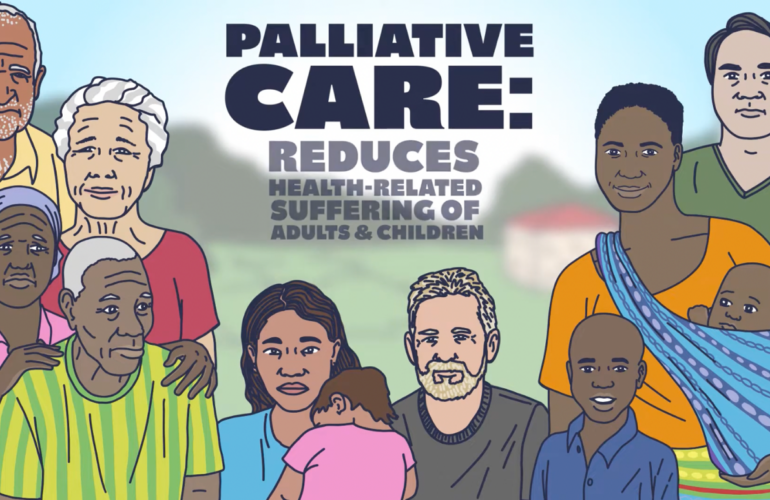
Leading image: This image is from a YouTube video by Dr. Maya Jane Bates on palliative care and poverty reduction—an engaging example of effective communication.
ehospice.com is pleased to be working with the IAHPC to help promote their news, blogs, articles as widely as possible.
https://iahpc.org/what-we-do/communication/pallinews/2025/december-4/is-crisis-the-right-word/


Leave a Reply