


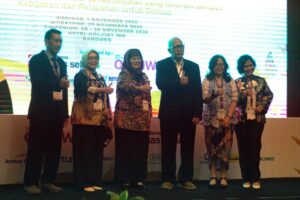
The first national congress of PERDOPIN—Perhimpunan Dokter Paliatif Indonesia (the Indonesian Palliative Physicians Association)—held on 28–29 November 2025, marked an extraordinary milestone in the development of palliative care in Indonesia. As a newly established professional organisation, PERDOPIN successfully brought together health professionals from across the country for the first time, creating a shared space to strengthen knowledge, build networks, and accelerate progress in palliative care practice.
As someone working daily in paediatric palliative care (PPC), I felt honoured to be part of this historic moment. The congress arrived at a time when palliative care is increasingly recognised in Indonesia, yet services remain uneven and not fully integrated into the national healthcare system. This gathering was more than an academic meeting; it represented hope, direction, and unity for a field that is still growing.
Setting the Vision: Improving Competence and Building a Sustainable Ecosystem
The congress adopted two core themes: Advancing Practical Competence in Palliative Care and Building a Sustainable Palliative Care Ecosystem Aligned with Policy and Universal Health Services. Together, they reflected the dual mission of strengthening clinicians’ everyday skills while also supporting long-term system development at national and policy levels.
The opening session set a warm and inspiring tone. Professor Ghauri Aggarwal, President of the Asia Pacific Hospice Palliative Care Network (APHN), emphasised the urgency of collaboration and the importance of building national standards. This was followed by an address from the president of PERDOPIN, who highlighted the significance of this first congress as a foundation for future unity and multi-professional growth.
A highly anticipated keynote presentation came from Dr. Yanti Herman, Director of Referral Health Services Development at the Indonesian Ministry of Health. She spoke about the role of palliative care in improving quality and cost efficiency within the National Health Insurance system. Her presentation offered hope for stronger integration of palliative care into national policy and provided a realistic picture of the current gaps and opportunities.
A Truly Multidisciplinary Symposium
One of the most remarkable aspects of the congress was its genuinely multidisciplinary design—something that mirrors the nature of palliative care itself. Instead of separating disciplines into parallel tracks, the congress intentionally brought professionals together, allowing each session to reflect the complex and collaborative needs of patients with life-limiting conditions.
Experts from anaesthesiology, oncology, surgery, psychiatry, rehabilitation medicine, and other fields shared their insights. Pain sessions led by anaesthesiologists explored both pharmacological and non-pharmacological approaches, while presentations from gynaecology and medical oncology demonstrated how early integration of palliative principles can enhance patient journeys. . Psychiatrists discussed the emotional transitions experienced by patients and families, emphasising that alleviating suffering must include mental and emotional wellbeing..
Plastic surgery specialists discussed wound and stoma challenges, and rehabilitation medicine teams highlighted the importance of physical therapy, dysphagia management, and lymphedema rehabilitation in preserving daily function. Other clinicians presented practical strategies for managing nausea, vomiting, breathlessness, delirium, and decreased consciousness—symptoms that profoundly shape the final stages of life. Even palliative surgery and radiotherapy were represented, showing how technical interventions can still align with comfort-focused goals when guided by patient-centred decision-making. A highlight for me was the dedicated session on paediatric palliative care. As a PPC physician, seeing children’s needs explicitly acknowledged was deeply encouraging.
The breadth of topics and the seamless integration across specialties conveyed a powerful message: palliative care succeeds only through collaboration. No single profession can meet the multidimensional needs of patients and families. Compassionate, holistic care arises from the shared efforts of many disciplines working toward the same goal.

A National Step Forward
The congress also provided fertile ground for building national networks. Participants from large cities, remote islands, and district hospitals exchanged their challenges and discussed feasible solutions adaptable to different settings. For a country as diverse as Indonesia, these conversations are crucial in creating a unified language and common vision for palliative care.
Many attendees expressed gratitude for finally having a professional home through PERDOPIN. The organisation is expected to play an important role in advancing education, developing competency standards, strengthening advocacy, and promoting interdisciplinary collaboration in the years to come.
A Personal Reflection
For me personally, attending this first PERDOPIN Congress was meaningful and motivating. Being part of this historic milestone reminded me that palliative care in Indonesia is progressing step by step, region by region. I left the congress with renewed commitment to continue developing PPC services, including the home-visit programme I am building and the community-linked palliative centre in our hospital.
I believe this congress is only the beginning. With stronger collaboration, increased visibility, and united effort, palliative care in Indonesia can grow into an accessible, compassionate, and integrated service for all who need it. I am grateful to have been part of this special moment—a milestone that marks not only progress but also hope for the future.
About author :
Lianda Tamara is the Head of Pediatric Palliative Care and a key leader in the development of the Jang Seng Ie Life Center, Husada Hospital Jakarta- Indonesia.
Lianda can be contacted at tamaralianda@gmail.com


Leave a Reply