

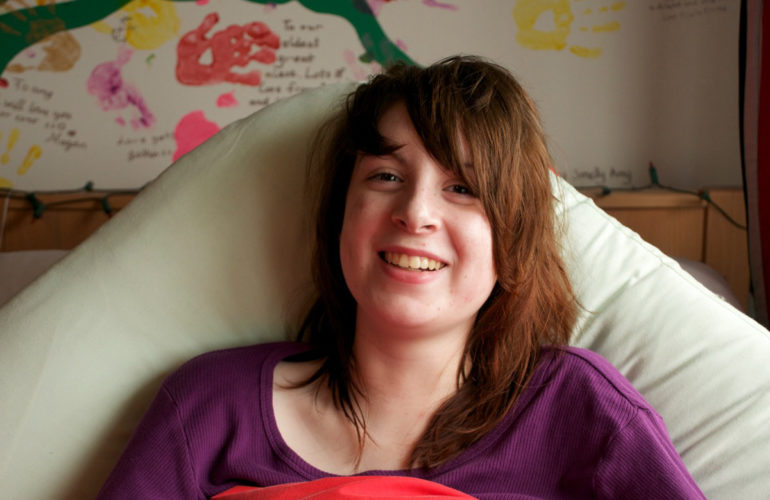
“Your child is now palliative”: this is a sentence that most people go through life without ever having to hear. But in my world, it’s a sentence that many people dread.
When I turned twelve, it was a sentence that was uttered to me and my parents. To be honest, at the time I didn’t even know what the word Palliative meant; two days later I googled the word and discovered the meaning- I told my parents I knew there was nothing more the doctors could do, and we spent the next few weeks in a haze of shock, sadness and uncertainty. There were a lot of tears.
What I didn’t know at the time is that being diagnosed as Palliative would open up a world of possibilities and opportunities for me, my family and friends. I would acquire many honorary family members, and my friendships and family ties would be tested, and would become stronger then ever.
Palliative care is not just a medical service; sure, they keep my symptoms under control, and they sort out all my medical problems, but more importantly than that, they enhance my quality of life. We believe that quality of life is better than quantity; I’ve learned that it’s not the dates on your gravestone that matter, it’s the dash in between.
Through a mixture of hand holding, hugs, determination, good listening skills, alternative therapies, tough love, organisation and strong drugs, I have built myself a life worth fighting to the death for.
The people who helped me build my extraordinary world are my Palliative care consultant, Jo, my specialist nurse, Lynnette, and all the staff and families at Ty Hafan children’s hospice. These people are honorary members of the Davies family; they’ve stuck with us through some of the worst times, some of the scariest moments and some of the fragile moments. They’ve been there holding our hands, feeling our feelings and crying our tears. But they’ve also been there to applaud me and my achievements when things are going well, and to be a part of many of our happiest memories. They recognise the immense achievement in what may seem such a small thing to a huge proportion of the population, such as sitting four of my GCSE exams.
These people throw their all into helping myself, my family and friends. Because of these people and their love and support, I have the oooommph, the determination, and the will power to live my life to the full; I have a bucket list, otherwise known as The List of Things I Want to Do before I Kick the Bucket!
The Bucket List consists, currently, of two hundred and fifty things that I want to do in my life time; the numbers go up and down a lot. I wrote my list to encourage myself to do all the things I want to do, to experience everything, and to get the most out of life. The items range from the everyday to the amazing; I want to watch a sunset, I want to stay up all night and star gaze, I want to swim in the sea in all my clothes. I want to fall in love, I want to ride a motorbike, I want to own an Austin Martin vantage. I want to meet the cast of Twilight, I want to read the entire works of Jane Austen, I want to pass my GCSEs. I want to own a pair of Jimmy Choos, I want to see Jack’s Mannequin in concert, I want to sing in a karaoke bar. I want to bounce on a bed in a bed shop, I want to write a book, I want to slow dance standing up at my prom.
A year ago, there were moments that my parents thought I would never leave Ty Hafan. I was in and out of the hospital and Ty Hafan every few weeks, and I spent most of my time in bed.
In the last few months, I sat my GCSEs, I won Prom Queen and slow danced standing up at my Prom, and I went to a festival and got to see The Feeling in concert. I have also been dressed five days out of seven for the past few weeks and months 🙂
Palliative care is not just about medical care; it about treating your symptoms, supporting you, and giving the patient a better quality of life. It’s a partnership that works on the basis of trust, belief in each other, and an awful lot of hope.
Quality education is the only way to ensure that more children with a life limiting or life threatening condition receive the holistic support that palliative care provides. Children attended to by a health professional trained in the principles of palliative care will experience a better quality of life, better pain and symptom control and the appropriate care at the time of death. Consider helping children like Amy access palliative care by giving to the ICPCN Christmas Appeal 2016. This project will help fund ICPCN training and education programmes. Click here to donate.
© Touching Rainbows, ICPCN, 2012
ICPCN publication Touching Rainbows can be purchased via the ICPCN website


Leave a Reply