

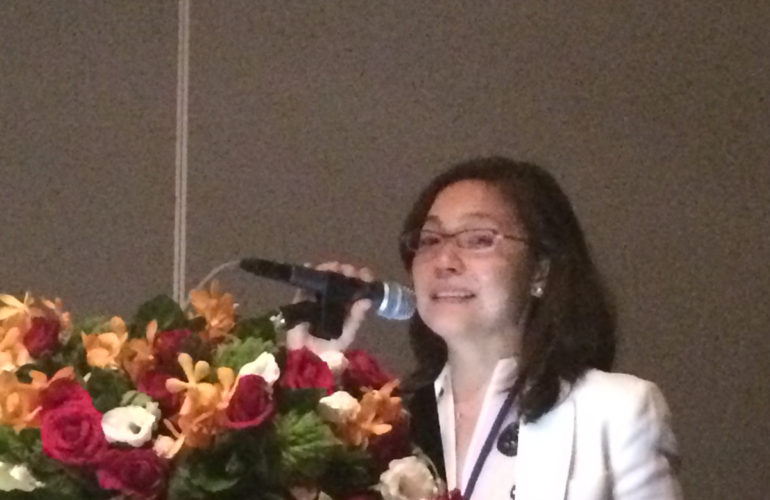
The final day plenary session of the Asia Pacific Hospice Conference in Taipei focused entirely on palliative care for children with two excellent presentations from Dr Ross Drake, Paediatric Palliative Care and Pain Medicine Specialist at Starship Children’s Hospital in New Zealand and Prof Julia Downing, Director of Education and Research for the International Children’s Palliative Care Network (ICPCN) and Palliative Care Consultant.
Dr Drake’s presentation looked at symptom control in children’s palliative care. He asserted that children’s palliative care was a little like a magpie, which ‘stole’ the shiny things from adult palliative care but also had challenges that were unique to the field, not least of which being their changing physical and intellectual levels of development.
Using a case based approach, he spoke knowledgeably on the often high burden of symptoms in children with life limiting conditions (LLC) and the frequently unrecognised symptoms of depression and anxiety. He made the point that when these are addressed, physical symptoms like pain may be reduced.
Professor Downing spoke passionately about the ‘forgotten’ group of patients between the approximate ages of 18 and 35 who are too old for children’s services but still too young for adult services. She looked at their needs as they journey through adolescence and into young adulthood and how these differ from both younger children and the elderly. She particularly looked at the challenges of those who had been accessing children’s services and had to now ‘cross the bridge’ into the adult based services.
She reminded the audience that just because an adolescent and young adult had a LLC, it did not mean they were not experiencing the same confusing and often chaotic emotions and hormonal changes as their peers. She also made the important point that all palliative care practitioners, whether in children or adult palliative care, should acquire the skills which would enable them to communicate effectively with this group of patients.
The presentation ended with a glimpse of an interview that Prof Downing had filmed with 21-year-old Lucy Watts, ICPCN’s Youth Ambassador. Lucy lives with Ehlers-Danlos Syndrome as well as multiple related conditions and in the interview spoke so eloquently about the need for hospices which catered to the needs of patients her age. Those present were very moved by her appeal to all governments to consider developing and funding appropriate services for this age group.
Breakaway sessions
During the breakaway session, Dr Ross Drake spoke on prognostication and made the point that doctors seldom got this right. He said that there were always patients that would prove you completely wrong with some patients going on to live weeks and sometimes even years after being expected to pass away within days. In his experience, giving parents the most honest prognosis did not lead to them giving up hope for their child. However, hope would often need to be reframed as the disease progressed.
Dr Poh Heng Chong from StarPALS gave an interesting overview of children’s palliative care in Asia. He talked in detail about the various service models in Asia, which includes mixed adult and children’s palliative care services, hospital based care with and without outreach services and only one dedicated children’s hospice within the region. This mapping of services had been collated through a short survey and the information can now be found on the Asia Pacific Hospice Network website under the heading Paediatric Palliative Care. He did mention limitations of this method of gathering information from the area, mainly as a result of language differences.
Dr Poh Heng highlighted the poor buy in from paediatric specialists as one of the greatest challenges faced in Singapore.
The final presentation by Lynna Chandra, founder of Rachel House in Indonesia, was on caring for children with HIV within their outreach service. Poverty and difficult circumstances meant that many of the HIV positive children were cycling in and out of care and were often lost to their service as they moved into a different geographic region. Grandmothers were often left to care for orphaned children and many were sadly neglected as a result.
She gave some heart-breaking examples of children who were at least given some love, attention and dignity just prior to and at the time of their deaths through the compassion of the Rachel House nurses.
In his plenary, Dr Ross Drake expressed gratitude to the organisers and chairs of this year’s Asia Pacific Hospice Conference for the inclusion of a substantial amount of time devoted to children’s palliative care within the programme.
The next Asia Pacific Hospice Congress is set to take place in Singapore in 2017.





Leave a Reply