

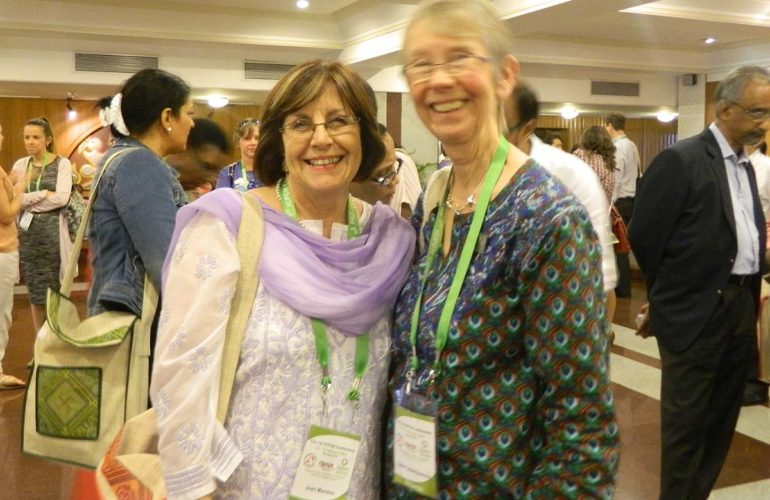
On the first day of the ICPCN Conference taking place in Mumbai, India, a gathering of close to 250 delegates from 32 countries around the globe were given a traditional, warm welcome by their Indian hosts. Early morning on the opening day of the conference, the reception area was abuzz with joyous cries of greeting as old friends were reunited and new friends introduced to one another.
The friendly welcomes continued as the conference was opened by Barbara Gelb, Co-Chair of the ICPCN, Joan Marston and Prof. Mary Ann Muckaden, Conference Co-Chairs and Prof. Julia Downing, the Scientific Chair. Delegates were then treated to the singing of a song by a young boy, calling the blessing of the gods upon the conference and the lighting of the traditional lamp by the chairs.
Sister Frances Dominica gave the opening address, where she shared her inspiring story of opening the first children’s hospice, Helen House, in Oxford in the United Kingdom. In her address, she spoke of the need for those who provide care to ‘walk the walk’ alongside the children and their families and to learn the skills that the families use to care for their child, suggestion adaptations where necessary. She said that carers were needed who would be courageous enough to remain alongside the family ‘into that place of unknowing.’ In her words, children’s palliative care is “about living life to the full as long as that is possible; to make the most of what life there is and to always keep the family in the very centre of the care provided.”
Dr John Collins, Head of Service at the Department of Pain Medicine and Palliative Care Service at the Children’s Hospital at Westmead (NSW Australia) then gave an insightful overview of the educational needs in Paediatric Palliative Care today. Drawing on the wisdom of Gandhi, he spoke of the need for a basic education (in children’s palliative care) for all who work with life limited children and reminded delegates that knowledge and work are not separate, that education is lifelong and holistic.
Key points of his talk were that target groups need different levels of education; those who learn should be judicious about the available resources; collaboration and sharing are vital to the development of the specialty as is evidence based research. It is also important that education is used to create competencies within the students.
He borrowed the closing words of his talk from Mandela who said: ‘Education is the most powerful weapon which you can use to change the world.’
The rest of the day was spent in a number of interesting and inspiring break-out sessions and applied workshops and ended with an entertaining Inaugural Ceremony in the evening. The remainder of the conference promises to be just as interesting. You can also keep up to date by following us on Facebook and Twitter with Twitter feeds that use the hashtag #ICPCN2014


Leave a Reply