

Authors: Dr Kiran Shrivastava; Dr Archana Iyengar
Dr Kiran Shrivastava is a Mumbai, India based Neonatologist and Paediatrician with special interest and expertise in Perinatal & Neonatal Palliative Care; She can be contacted at: kiranshrivastavadr@gmail.com
Dr Archana Iyengar is a Hyderabad, India based Paediatric Palliative Care Consultant and Mentor; she can be contacted at: drarchanaravikiran@gmail.com
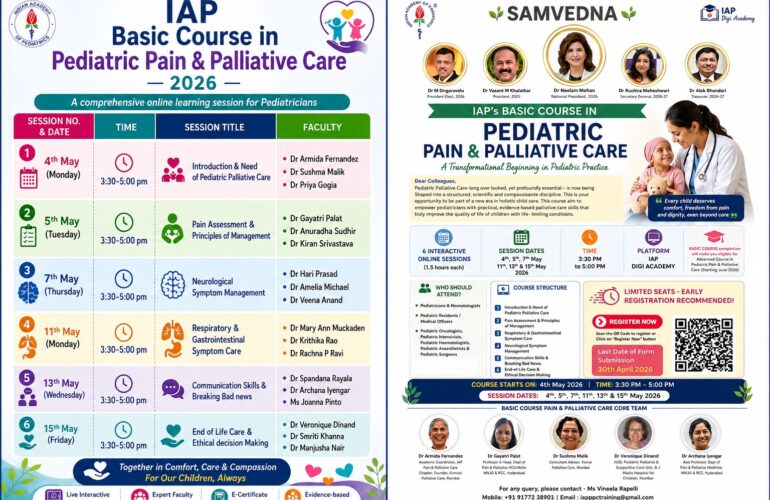
The medical management of pain and palliative care in children is a known critical gap in care especially in LMICs that needs structured training of all medical professionals that work with children. This May, the Indian Academy of Paediatrics (IAP) ran another online Basic Course in Paediatric Pain and Palliative Care, drawing close to 450 clinicians from across the country.
Run over six 90-minute sessions between 4 – 15 May 2026 on the IAP Digi Academy platform, the course was designed to give paediatricians and paediatric sub-specialists a practical grounding in caring for children living with serious, life-limiting and life-threatening illness. Completing it makes participants eligible for the advanced programme that follows.
Why the course matters
The astounding response to the course flyer points to a gap many pediatric clinicians recognise in their practice. There is growing awareness that pain and comfort in children get minimal to no attention, often for the simple reason that these skills were never formally taught.
Most participants were practising consultant paediatricians, joined by residents, paediatric intensivists, anaesthetists, neonatologists and oncologists – doctors who see children with chronic pain, neurological impairment, advanced cancer and other chronic conditions in their everyday practice. That so many logged in session after session, around busy hospital schedules, is a fair measure of the demand.
For IAP, commissioning the course signals a clear priority. Under National President Dr Neelam Mohan, the IAP has backed an area of child health with real scope to improve comfort, dignity and quality of life for children whose conditions cannot always be cured.
Feedback from the course underscored this need. Of the clinicians who responded, roughly two-thirds said they had started the course with no formal training in palliative care, or with
nothing more than some basic idea of palliative care in children. Only a small minority described it as part of their regular practice.
What the course covered
The programme was built around the questions paediatric physicians grapple with daily.
It opened with the need and scope of paediatric palliative care, then moved through overviews of pain assessment and management, neurological symptom control, respiratory and gastrointestinal symptoms, communication skills and breaking bad news, and finally end-of-life care and ethical decision-making.
Each session was anchored in clinical case discussions spanning from assessment at presentation to holistic symptom and psychosocial management. This was followed by an extended question-and-answer discussion with the participants. The case-based format was appreciated repeatedly in feedback from participants as what made unfamiliar material easier to retain.
The teaching was led by some of the pioneers of paediatric palliative care in India. The core organising committee included Dr Armida Fernandez, Dr Sushma Malik, Dr Gayatri Palat, Dr Veronique Dinand and Dr Archana Iyengar, working alongside a wider faculty of experienced clinicians drawn from across the country.
What participants took away
The feedback from participants was strongly positive. More than nine in ten respondents said they would recommend the course to a colleague, and around seven in ten gave it the highest possible rating.
One participant described a shift in outlook that several others echoed:
“This is a subject I used to resist, because I felt it was very depressing. The sessions and the faculty made it genuinely interesting. Thank you.”
Others valued how grounded the teaching was:
“It wasn’t about complicated things. It was basic and very well discussed – exactly what we need for daily practice and real situations.”
“Structured, focused sessions with experienced faculty giving practical insight beyond the textbook, and a good balance of clinical management, communication skills and ethics.”
The case discussions and faculty drew the most praise. As one clinician put it, the format allowed everyone to “understand the patient as a whole, rather than discussing a disease and its burden.”
What comes next
The overwhelming response from participants was a request for more. The large majority asked for further training, with specific interest in deeper case work, real-world ethical dilemmas and more time with the practical tools introduced during the sessions.
Towards that end IAP has now commenced its second Advanced Course in Paediatric Pain and Palliative Care in July 2026, building on the basic programme for paediatricians who want to take their skills further. Together, the two courses are steadily putting paediatric palliative care on the radar of routine clinical practice and equipping paediatricians to ease suffering for children and their families.
As the course’s guiding line puts it: every child deserves comfort, freedom from pain and dignity, even beyond cure. For participants of the course, that is a little more within reach.


Leave a Reply