

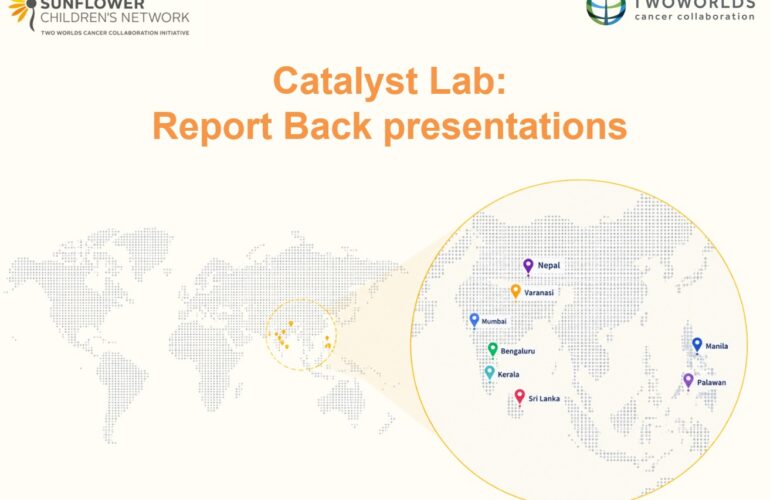
The Catalyst Lab, led by the Sunflower Children’s Network, an initiative of Two Worlds Cancer Collaboration, is a two-year leadership development program for emerging leaders in children’s palliative care. The program is designed to help participants translate leadership potential into sustainable, on-the-ground impact by strengthening and expanding children’s palliative care at regional and national levels through a health systems approach.
The program recently surpassed an important milestone with its Report Back Presentations. The session brought together 19 participants across 8 teams from India, Nepal, the Philippines, and Sri Lanka, along with their mentors, to pause, reflect, celebrate achievements, along with sharing challenges and learnings that are shaping each team’s journey.
Different projects, shared challenges
The projects presented were as diverse as the contexts in which the teams work. While some projects were service delivery oriented (focused on establishing, strengthening or integrating palliative care within institutions), some focused on education and workforce development (building knowledge and skills among healthcare professionals and creating pathways for wider learning), while others focused on leadership, policy and systems-level change (influencing practice beyond a single institution). Together, they demonstrated the use of various strategies to strengthen children’s palliative care. The recently published interim report offers further details about the teams and their projects.
While most programs celebrate success, the Catalyst Lab deliberately makes space for something equally important: that learning comes from uncertainty, setbacks, and challenges. Teams spoke openly about what worked, what did not, the barriers encountered, the decisions made, and learnings along the way. This honesty created a space where challenges were not seen as failures, but as an important part of the leadership and change process.
Realising that one isn’t alone
As each team shared its experience, common challenges began to emerge despite differences in geography, institutions and project focus. Teams recognised that several issues they were navigating, such as engaging stakeholders, building institutional support, influencing systems and managing change, were also shared by others.
The session therefore became more than a series of presentations. It became a space for cross-pollination of ideas, learnings, and experiences, as a solution developed in one setting prompted another team to think differently about their own challenge. A difficult experience offered reassurance to another facing a similar situation. An approach that had worked elsewhere became a possibility to explore now.
As the session progressed, participants realised that in addition to presenting to one another, they were also learning with one another. The cohort’s diversity became the cohort’s collective strength.
Mentors as partners in the journey
The session was strengthened by the participation of the mentors of Catalyst Lab, who joined to support the teams and reflect on their progress. Mentors shared feedback on their team’s work, recognised their team’s evolution and highlighted achievements, along with reflections on their own mentorship journey.
The mentor’s participation reinforced an important part of the Catalyst Lab approach: leadership development is relational and does not happen in isolation. It is strengthened through relationships, reflection, feedback, and the willingness to learn from others.
Building leadership through doing
The Report Back session is one part of a broader learning journey. The Catalyst Lab has included three synchronous online learning sessions so far and seven asynchronous activities, each of which has been deliberately designed to provide knowledge and tools along with encouraging participants to apply learnings to real-world challenges.
Through the activities, teams have been developing their projects while simultaneously strengthening skills such as stakeholder engagement, communication, systems thinking, advocacy, etc.
The project therefore serves both as an outcome and a tool for experiential learning through deliberate practice of leadership by working on issues that matter to the teams and to the children and families they serve.
As the Report Back session drew to a close, what stood out was the sense of possibility across the cohort despite the diversity of projects, countries, and contexts.
The session was inspiring because teams demonstrated courage to keep moving forward, learn from challenges and share their experiences with others, despite not every journey being easy.
The Report Back presentations also offered a glimpse of what can happen when emerging leaders are given the opportunity to learn together, experiment, reflect and support one another.
Perhaps that is the real promise of the Catalyst Lab: to nurture a connected community of leaders who can learn from one another and become catalysts for change, instead of only developing individual projects.
The projects will continue to evolve. So will the teams of the Catalyst Lab.




Thank you for the so much refined summary of f the teams activity.
Yes. It was a great learning experience and all the teams got really empowered through our so much of cross interactions.
Direct meeting with mentors, analysing another teams project, presentation on the common plat form.
All these methods were really new to us.
Thank you all the leaders and mentors for the world class training and your support through out the journey.
PPC is all about supporting and encouraging one another. We learn – unlearn and Relearn together. We positively criticize and learn from our own and others mistakes and short comings.
We came together. We are moving together. We will succeed together 🙏