

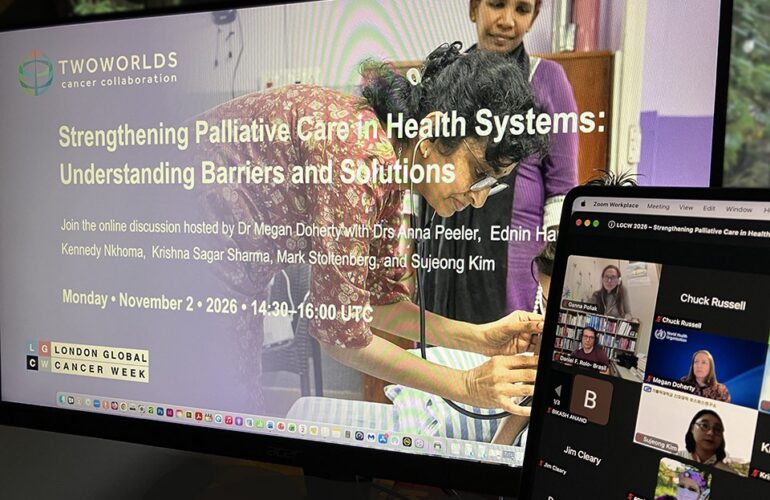
Speakers at London Global Cancer Week 2026 shared evidence and country experience on how health systems can close the palliative care access gap for people living with cancer.
By Anna Peeler, Kennedy Nkhoma, Sujeong Kim, Krishna Sargar Sharma, Ednin Hamza, Mark Stoltenberg, Megan Doherty
Palliative care is essential across the whole continuum of cancer care, not only at the end of life. Yet most people with cancer who need it, particularly in low- and middle-income countries, still cannot access it. That was the starting point for “Strengthening Palliative Care in Health Systems: Understanding Barriers and Solutions”, an online session held on Monday 2 November as part of London Global Cancer Week 2026.
Opening the session, Dr Megan Doherty noted that more than 73 million people need palliative care each year, and very few receive it. The benefits are well established: better symptom control and quality of life for patients and families, and lower acute care use and costs for health systems.
“The question is no longer whether palliative care belongs in cancer control, but how to integrate it, using WHO tools and frameworks and building on existing experience and partnerships.”
The session was organized around three themes, each pairing a global perspective with a country example.
Theme 1: Primary care integration
Dr Anna Peeler (King’s College London) argued that primary care offers a scalable and equitable way to expand access, as serious health-related suffering is projected to nearly double by 2060, with the greatest increase in low- and middle-income countries. Her team’s research identified five models of primary palliative care in these settings, from multidisciplinary clinic and home-based teams to volunteers and specialists working in primary care. Key barriers include palliative care being treated as an add-on, curative-focused national benchmarks and limited training for generalists. She highlighted WHO PEN (Package of NCD Interventions for Primary Care), which includes palliative care as a core service with essential medicines and referral pathways.
Dr Kennedy Nkhoma (King’s College London) presented an integrated palliative and oncology care model tested at Zimbabwe’s two national public cancer centres. The model combines clinician training, a co-designed referral pathway, monthly mentorship, joint oncology–palliative care consultations and a focus on what matters most to each patient: oncology with palliative care, not oncology then palliative care. It proved feasible and acceptable, with 73% of patients with advanced cancer still in follow-up at ten months. Patients reported feeling listened to and more hopeful. In Uganda, the children’s palliative care outcome scale (C-POS) has now been completed by more than 3,700 children and endorsed by the Ministry of Health. Dr Nkhoma stressed that even the best pathways fail without reliable access to essential medicines, particularly opioid analgesics.
Theme 2: Training and empowering the cancer workforce
Dr Sujeong Kim (The Catholic University of Korea) described a training gap as large as the service gap. Few countries recognize palliative medicine as a specialty or require palliative care teaching in undergraduate curricula. She outlined WHO’s tiered, competency-based approach, in which every healthcare provider, from community health workers to specialists, receives training matched to their role. She also called for training in health system literacy, so frontline workers know when and where to refer, and for evaluation that measures practice change rather than satisfaction alone. Her message: cancer care “doesn’t end at discharge”.
Dr Krishna Sagar Sharma (B.P. Koirala Memorial Cancer Hospital) shared Nepal’s experience, where a nationally endorsed training manual for children’s palliative care is linked to the national palliative care strategy. Education succeeds when it is tied to policy, service delivery and human resources, and when institutions have dedicated staff and a regular supply of essential medicines.
Theme 3: A health system approach
Dr Ednin Hamzah (Hospis Malaysia) reminded participants that most people with cancer in low-resource settings are diagnosed late, and that palliative care reaches fewer than 14% of those who need it. Treatments and technologies attract attention and financing, while palliative care is chronically underfunded. The WHO “house” model and its 14 national indicators help countries see their strengths, gaps and next steps across policy, medicines, education, research, community empowerment and service provision. “No culture asks its people to suffer,” he said, urging countries to develop their own cultural narratives while learning from global experience.
Dr Mark Stoltenberg (Harvard Medical School) introduced COMPASS, an innovative longitudinal technical support program led by the WHO Palliative Care Working Group. COMPASS supports 13 country teams, supported by regional advisors, countries assess their national palliative care situation, build national consensus and develop an implementation plan to take the next steps for palliative care integration in their country. The program brings together 128 country team members from 13 countries as well as 52 advisors from 24 countries, built on local adaptation and learning in both directions.
Looking ahead
Across all three themes, speakers agreed that integration depends on the whole system working together: policy, a trained workforce, reliable access to medicines and services rooted in communities. The tools to do this exist. What is needed now is the commitment to use them.
Participants were invited to take WHO Academy’s free, self-paced course, Palliative Care Service Planning with WHO’s SPDI Platform, which helps planners assess needs and design palliative care service packages for universal health coverage.
Watch the session recording or shorter videos on each of the key themes here.


Leave a Reply