

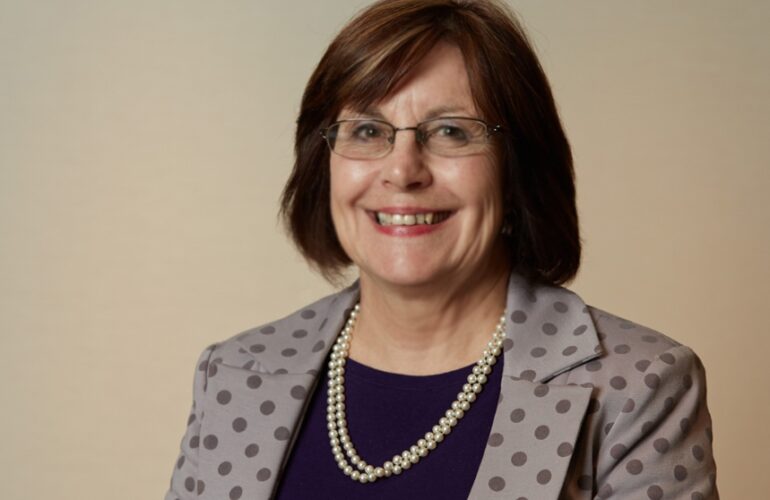
Joan Marston, Global Ambassador, former Steering Group Chair and Chief Executive of ICPCN.
2025 marks the 20th anniversary of the ICPCN and we will be publishing a series of stories from some of those who have been involved in establishing and ensuring the continued success of the global network for children’s palliative care.
This first story comes from Joan Marston, ICPCN’s founding Chief Executive with contributions from Peter Ellis, former Chief Executive, Richard House Children’s Hospice and Chair of the Association of Children’s Hospices and Barbara Gelb, former Chief Executive, Association of Children’s Hospices and Co-Chair of the ICPCN.
“Children and young people with life-limiting conditions have very specific palliative care needs which are often different to those of adults. If these children and young people’s physical, emotional, social, spiritual and developmental needs are to be met, their carers require special knowledge and skills. We ask that the voice of these children and young people is heard, respected and acknowledged as part of the expression of palliative care world-wide.”
Founding Statement of Korea, 2005
When representatives from 15 countries met at the 2nd Global Summit for National Hospice and Palliative Care Associations in Seoul, South Korea, in 2005 and decided on active development of the International Palliative Care Network (ICPCN), they were building on earlier collaborative initiatives that began in the 1970s, and flourished in the 1980s and 1990s. Initiative such as Children’s Hospice International pioneered by Ann Armstrong-Dailey who led 24 annual international conferences from 1983; the first national association ACT set up by Sr Frances Dominica, Prof David Baum and Robert Woodward in the UK in 1988; global meetings initiated by Charles Corr and complementary work of the European Association of Palliative Care led by the Fondazione Maruzza; international workshops run by Dr Tomasz Dangel in Poland. Alongside these initiatives was a growing understanding that palliative care for children was similar but different to palliative care for adults. There was growth in children’s hospice and palliative care programmes in different countries; formal and informal education, literature and research. All this was strengthened by the World Health Organisation definition of palliative care for children in 2002.
In 2003 children’s palliative care champions attended the 1st Global Summit on Hospice and Palliative Care and decided that an international children’s hospice and palliative care network was needed to develop the field and advocate specifically for children. ACT, The Association of Children’s Hospices (ACH) and Help the Hospices worked together on this over the next two years so the time was ripe at the meeting in Seoul in 2005 to put words into action and establish an International Children’s Palliative Care Network – the ICPCN.
Despite all this activity, children were still often the “implied” or forgotten group in international meetings; and when Barbara Gelb, Peter Ellis and myself were invited to the Summit we discovered that there was no mention of children on the agenda, although we were told they were “implied”. As we knew that “implied” often meant “forgotten”, we fought for dedicated time on the programme and ended up with 3 sessions where wonderful children’s hospice and palliative care practitioners and advocates from 15 countries decided the time for action had arrived! A decision was taken to write the Founding Statement of Korea which was presented to the conference in the final session and received everyone’s approval and support.
After the conference ended Peter, Barbara and I remained behind in Seoul, to both enjoy the city and discuss setting up the ICPCN. Something we still laugh over was that when looking for a hotel in Seoul that was central, clean and reasonably priced, due to a lack of understanding of Korean, we booked into a lovely little hotel which we later found out catered for sex-workers and their clients on an hourly basis! But as it was central and clean, with lovely staff and wonderful rooms (and coffee) – we stayed on and this is where many discussions on setting up the ICPCN took place! One decision we made was to drop “Hospice” from the name and focus on strengthening understanding of palliative care.
“I remember it was a long way there and back to the second global summit for Hospice and Palliative Care in Korea! The Korea Declaration on Hospice and Palliative Care was agreed which emphasised the need for equitable access to palliative care for all including vulnerable populations – yet children and young people were overlooked. I sat there and thought we need something similar for CPC. Barbara Gelb, Joan Marston and I were having the same thoughts and I remember us sitting in the middle of the main auditorium drafting a declaration for children’s palliative care. The statement was announced at the conference. This of course led to the formation of the ICPCN. So, despite it being a long way to get there we had started something that has made a big difference and led the way towards work for children and young people across the globe.
Peter Ellis, former Chief Executive, Richard House Children’s Hospice and Chair of the Association of Children’s Hospices
“In Seoul Joan, Peter and I were the lone voices for children and between us we recognised that we needed to change things and do something much more concrete and tangible for children. After the summit the three of us stayed on and we conceptualised things. Joan was really thinking big about getting philanthropists and celebrities involved! We really had to fight to get recognition for a separate voice for children’s palliative care and we had to work hard to retain our commitment to that vision. We put a huge amount of work into ICPCN. It was collaborative, with Sabine Kraft, Sue Fowler-Kerry, Ruti Kiman, Maryann Muckaden, Ross Drake, Delia Birtar, Sharon Baxter who were all deeply committed. There were groundbreaking moments, with ICPCN supporting and mentoring people in different countries to bring children’s palliative care to come to the fore for the first time. ICPCN’s achievements are incredible.”
Barbara Gelb, former Chief Executive, Association of Children’s Hospices and Chair of the ICPCN
[i] The Association of Children’s Hospice was renamed Children’s Hospices UK and in 2011 merged with ACT to form Together for Short Lives




Leave a Reply