

Authors: Dr Nisha Jyoti Shrestha & Bandana Adhikari
Children’s Palliative Care is one of the newest additions to the subspecialty care at Kanti Children’s Hospital (KCH) in Kathmandu. As the only tertiary paediatric hospital in Nepal, KCH is a national leader in shaping child health. KCH provides sub-specialty care in paediatric medicine and surgery, and this now includes outpatient and inpatient palliative care. Beyond clinical care, KCH also focused on providing specialized paediatric training including: paediatric nurses (short term course), Bachelor in Critical Paediatric Nursing (3-year program), and a variety of specialized training opportunities for physicians.
When palliative care services were initiated at KCH, services were limited to the oncology unit. Since palliative care was a new topic for most health care professionals, many clinicians assumed that palliative care was only needed for children with cancer. However, over the past few years, we have been working to correct this misconception and expand access to palliative care for children with other serious or life-limiting conditions throughout the hospital.
In January 2025, we were excited to be accepted into the second cohort of the Children’s Palliative Care Leadership program, an exciting leadership training program for clinicians and program staff from across South Asia. We travelled to Hyderabad, India for a leadership workshop in January and returned to Nepal with plans to focus our leadership project on building palliative care knowledge and skills among paediatric clinicians.
In our leadership project we planned a series 3-day workshops on children’s palliative care, aiming to reach 100 clinicians in total. We planned to include participants from key health facilities in the Kathmandu valley, to expand knowledge of key palliative care concepts beyond KCH.
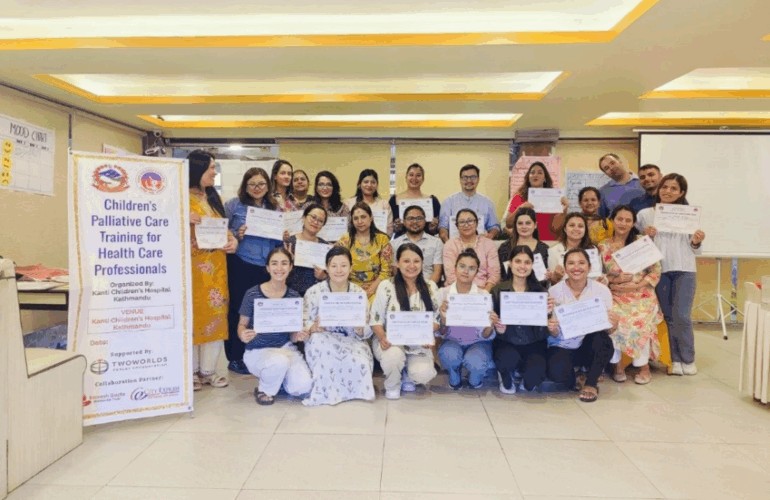
The project started with an inception meeting with our hospital administration with director, matron (chief nursing officer), finance staff, and heads of department. With their support, we held our first training workshop on May 19-21, 2025. The workshop trained 25 participants- 16 nurses, 8 doctors (medical officers, paediatrician, surgeons, anaesthesiologist, psychiatrist), and 1 social service staff member. To evaluate each workshop, we planned to administer pre- and post- tests to assess participants’ knowledge and attitudes towards palliative care.
With the success of the first training, we excitedly started planning the second training. In addition to nurses and doctors, the second training included one physiotherapist from the local rehabilitation centre. As the workshop faculty become more experienced and familiar with the content, we began to make the training more interactive, using role plays and interactive sessions instead of simply delivering lectures.
Fundraising and financial sustainability were emphasized as important topics in the Leadership Program, and we needed to incorporate these into our leadership project activities. To do this, after the second workshop, we began trying to raise funds locally for the project. This was a huge challenge for us, as technical people, at first, we were uncomfortable asking for money. We worked on our “elevator pitch”, and we finally were able to secure support from City Xpress Money transfer and Ramesh Gupta Memorial trust. These funds allowed us to conduct the third workshop. We enhanced the third training by inviting a neonatologist to present about perinatal & neonatal palliative care, strengthening engagement with this important specialized area.
Some of the key lessons we have learned from the training include: inviting partners to participate as faculty and learners to build stronger relationships and better coordinated clinical care, adapting training to participants’ needs, and keeping the formalities portion of training short to maximize the learning period. As leaders, we also learned how to guide faculty to work together, streamlining pre-training preparations, onsite technical troubleshooting, and post-training tasks. We practiced key strategies including dividing up our tasks, seeking help from mentors, and having a “growth mindset”. In growth mindset involves believing that through dedicated effort, learning, and persistence, we can improve our skills, in this case, to deliver palliative care training.
Now we are preparing to conduct the fourth and final training workshop. We are already seeing the impact of the training- by planting the seeds of “palliative care” in the trainees, they are starting to understand that care is possible even when cure is not.
We are looking forward to sharing the complete results of our leadership program when we return to Hyderabad, for the final leadership workshop in February 2026.


Leave a Reply