

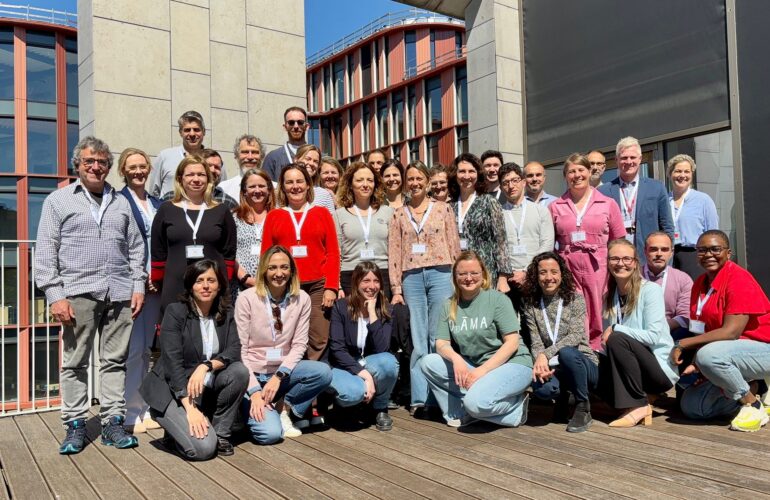
During the week of 5th May, researchers and clinicians from across Europe came together in Copenhagen for the 2nd General Assembly meeting of the PALLIAKID project. The meeting was hosted by the children’s palliative care team at Rigshospitalet.
The 5-year project kicked off in December 2023. It’s an interdisciplinary project aiming to evaluate the feasibility, effectiveness and cost-effectiveness of novel interventions for children and young people (CYP) with palliative and end-of-life care needs in different healthcare systems across Europe. It focuses on the factors that influence a child or family’s active engagement. The project is being coordinated by San Joan de Deu Hospital in Barcelona, working with a consortium of 19 organisations from 10 European countries.
The project will develop and test the following interventions
- An early detection system (EDS) to enable identification of CYP with palliative and end-of-life care needs
- A ‘PALLIAKID’ intervention that includes 1) A tool for comprehensive assessment of CYP and families’ needs (HexCom) 2) An Advance care planning tool (IMPACT) 3) A digital platform to provide a comprehensive and personalised interdisciplinary care plan across the family’s journey (Patient Journey Platform)
Alongside this CYP/Family-facing intervention an XR-based capacity building programme will be developed to support practitioners to use the tools.
Attendees at the meeting heard about the experiences of the five clinical sites in Barcelona, Riga, Florence, Helsinki and Copenhagen who are providing input from practitioners and young people/families and the progress that has been made across 8 Work Packages:
WP1: Programme Management
This WP, led by SJD is concerned with overall management of the programme, ensuring milestones are met and reports provided to the funding body. A Publications Committee has been set up to coordinate submission of papers and conference presentations.
WP2: Young People and Family Advisory Boards
SJD is also leading this WP which has set up Young People and Family Advisory Boards aiming to ensure the engagement and empowerment of patients (12–17-year-olds) and caregivers to contribute to the project. The Boards have been involved in three focus groups, looking at protocol design, development of the patient-facing documents and review of the clinical scales. The next focus groups will look at the protocol for the EDS. A key deliverable from this WP will be a good practice manual that captures the experiences of the clinical sites in engaging young people and families in the research.
WP3: Development of the Early Detection System
The first phase of this WP is for the team at SRDC to develop the EDS software and machine learning that can be tested in the prospective study which follows. The variables have been identified (eg diagnoses, procedures etc) and retrospective data has been collected for 40,000 cases (3,000 of which were positive). The next step is to develop the clinical protocol for each of the sites as they will have different ways of integrating the software into their systems. There was discussion of the ethics considerations for this and whether the EDS would be considered a medical device that impacts on the treatment of a child.
Another element of this WP is to evaluate different clinical scales that can be used to identify the need for PPC. Three scales were identified by the team at HSJD and PaPAS was recommended due to its usability and capacity to stratify results, for example whether a child has palliative care needs that need referral to specialist support straight away.
WP4: Co-creation of the Palliakid Intervention and XR Capacity Building Programme
There are various elements to this Work Package which together will form the ‘Palliakid’ Intervention:
- Hexcom tool: This tool aims to support the assessment of complex needs. It has come from an adult perspective but has had some use at the SJD Barcelona Children’s Hospital. It was chosen as an appropriate tool to adapt to a children’s version because it has strong content and face validity. It is being developed by the team at IDIAP Jordi Gol and will be finalised by the end of May. The team at KVC have conducted interviews with children, parents and professionals to feed into the development of the needs assessment tool.
- IMPACT tool: This element of the intervention is being developed by UMC Utrecht and its focus is on Advance Care Planning. Feedback on the IMPACT tool has been the need to be sensitive with communication elements, for example balancing hopeful with realistic language and having separate interfaces for different family members, in particular ensuring that the specific needs of siblings and extended family are included. Healthcare professionals would like guidance included on how to support people from different cultural backgrounds and to have a version in English but also in other languages. It is important that language is carefully considered as death is discussed differently in different cultures. The tool must be family-centred, giving more agency to families and should also support professionals to improve face-to-face communication as well as link in digitally.
- Patient journey digital tool: This is being developed by ARTEMIS. It has 3 interfaces for children, caregivers and doctors, with an additional interface for siblings being planned. There was discussion about how to make this safe, useful and practical particularly for family caregivers, so it’s a tool they can have ‘in their pocket’ that could help them with issues such as keeping track of symptoms or appointments
- XR-based capacity-building programme: This WP is developing an ‘extended reality’ programme to enable professionals to train and develop skills, for example in communicating with families at different points in their journey. The Metropolia team have spent two days with each of the five clinical sites conducting ‘Living Labs’ with the aim of co-creating, testing and developing the Palliakid intervention and XR training in real-life settings with a range of stakeholders (patients, parents, health professionals, IT teams from hospitals). The team have run training on the co-creation process, which had some challenges due to the need to develop the training materials in 5 different contexts and give consideration as to how to sensitively introduce the tools to children and families. Findings from the first round of co-creation fed into the second, with the focus of the first round on general understanding and content of the tools and the second focused on the digital intervention itself.
WP5: RCT Intervention Protocol
This WP, led by Polibienestar Research Institute at UVEG is developing the next phase of the Palliakid project which will be the RCT to test the three tools that have been developed (HexCom, IMPACT and the Digital Platform). So far, the team have developed and revised the RCT protocol and the documentation to be used. The plan is to allow 12 months for recruitment to the trial and 12 months for the intervention to be tested. The next step will be to prepare the documentation for the ethics committees at each of the clinical sites.
WP6: Formative and Summative Evaluation
The team at Erasmus MC have developed and submitted an outcome measurement framework for the RTC, looking at effectiveness, cost-effectiveness, feasibility and engagement. They have also developed the evaluation framework for the EDS which will measure how well it detects cases, whether costs could be saved by earlier detection and the experience of HCPs in using the EDS.
WP7: Communication and dissemination
The EAPC team are leading this WP which is focussed on policy recommendations and knowledge transfer. They have developed a wide-ranging communications strategy with a project website, internal newsletter, webinars etc. Towards the end of the project ICPCN will have an important role in developing a strategy for the scale up and transfer of the Palliakid intervention.
WP8: Ethics and data management (CHINO)
This WP, led by CHINO is giving consideration to the complex issue of ethics, privacy and data management related to the project.
The meeting was an excellent opportunity to catch up on all the different Work Packages and see the linkages between them. Thank you to the team in Copenhagen for hosting the meeting and taking such good care of all the delegates.


Leave a Reply