

In Kinyarwanda, there is no phrase for “end of life.” The closest idea is “life until the end,” and palliative care itself translates as “being present.” That message, shared by Rwanda’s Dr. Christian Ntizimira, set the tone for the COMPASS (Collaborative Movement for Palliative Care Access and System Strengthening) pre-Congress workshop on October 6th, the day before the Montreal International Palliative Care Congress (MIPCC).
Hosted by Drs. Mark Stoltenberg (Harvard Medical School), Zhimeng Jia (University of Toronto) and Justin Sanders (McGill University), the morning session was open to all Congress participants. At its heart were the Botswana and Ghana country teams, just beginning their work in COMPASS, a global program led by World Health Organization (WHO) Collaborating Centres to strengthen palliative care integration within national health systems.
Dr. Zippy Ali from Kenya opened with an overview of palliative care development in Africa. Dr. Luciana Crispino (Chile), Dr. Diah Martina (Indonesia), Dr. Christian Ntizimira (Rwanda), Dr. Fernando Elhordoy (Uruguay), and Dr. Dingle Spence (Jamaica) then shared practical lessons on workforce education, research, community engagement, national policy and access to opioids

COMPASS workshop attendees, speakers, and facilitators at MIPCC 2026.

COMPASS workshop hosts and guest speakers.
Sharing Lessons to Open Doors
Three key lessons emerged: Legislation is a catalyst, not a guarantee; training must be mandatory and reach every level; and evidence must be adapted, not transplanted, with learning flowing between countries.

Dr. Mark Stoltenberg facilitating the COMPASS Workshop at MIPCC 2026.
From Listening to Commitments
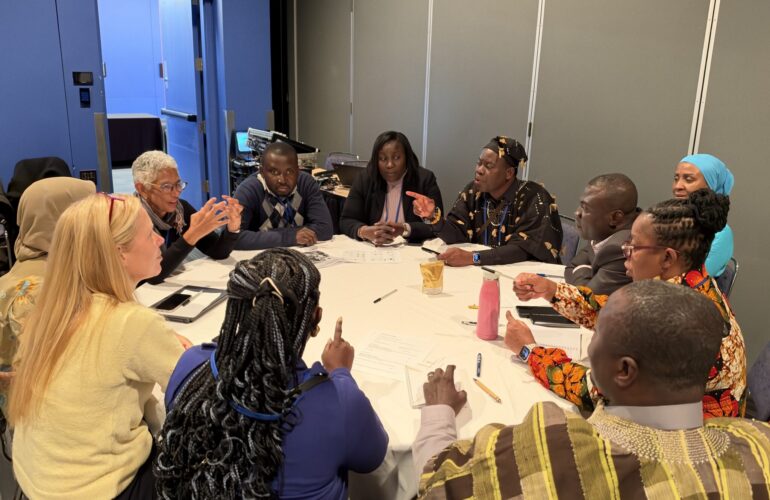
In the afternoon, the country teams engaged in facilitated discussions on the morning session’s lessons. At the end of the Congress, the Botswana and Ghana teams presented on what they learned and their planned next steps.
Ghana is building on a foundation of strong community based palliative care, existing health infrastructure, and an early-stage national palliative care strategy. The team committed to completing that strategy, linking new trainees to clinical posts, and developing palliative care standards within existing licensing infrastructure.
Botswana is building on Ubuntu, the principle of togetherness, and an exemplary nurse-led model proven in its HIV program. At Princess Marina Hospital, Dr. Babe Gaolebale and two nurses reach palliative care patients nationwide by phone and WhatsApp. “If I don’t do it, who will?” she said. The team committed to defining palliative care in local languages, strengthening training, and planning for succession.

Ghana team discussing important lessons learned during the COMPASS workshop.
About COMPASS
COMPASS is a two-year program that pairs national teams with global mentors. It spans 13 country teams, 128 participants, and 52 advisors from 24 countries across all six WHO regions.
COMPASS uses the WHO conceptual model for palliative care development as its framework. Year 1 works through each domain in didactic sessions and country workshops. Year 2 transforms that learning into country-specific strategic plans. The program describes its role as a guiding compass, not a defined roadmap, promoting global exchange as we all work toward the same goal of advancing palliative care.
Advancing Collective Action
Global Partners in Care (GPIC) is a supporting partner in COMPASS. GPIC Program Manager, Lydia Thomas, helped deliver the Montreal workshop and provides broader support to COMPASS. As part of our approach to collaboration, we connect people who are working on the same challenges in different places to allow innovative ideas to travel in each direction. MIPCC put this into practice: a Jamaican approach sparked ideas for Ghana, and an Indonesian research model raised questions that apply in Botswana.
As an organization, we remain committed to leading and supporting work that promotes equitable collaboration and mutual respect. COMPASS’s innovative approach exemplifies this and elevates different forms of expertise and experience from across the globe. By doing this, new approaches to advancing palliative care emerge, and leaders from across the globe become more connected and knowledgeable of what one another is doing.
At MIPCC 2026, GPIC also presented a poster on Collaborating for Global Impact: Driving Innovation through Collective Action and Shared Impact. This work shaped how GPIC operates: as a connector and collaborator, bringing people together around advancing palliative care. Our engagement in Montreal reinforced an important principle: progress happens faster when countries, communities, and experts learn from each other and collaborate to advance shared goals.

GPIC Program Manager Lydia Thomas presenting the Collaborating for Global Impact Poster at MIPCC 2026.
———————-
This article was first published on the Global Partners in Care website and is republished here with permission.
===============
ehospice is proud to help promote individual, local, national and international voices in Hospice & Palliative Care
We are on target to have over One Million page views this year.
To stay in touch with colleagues and news around the world subscribe to our free Newsletter


Leave a Reply