

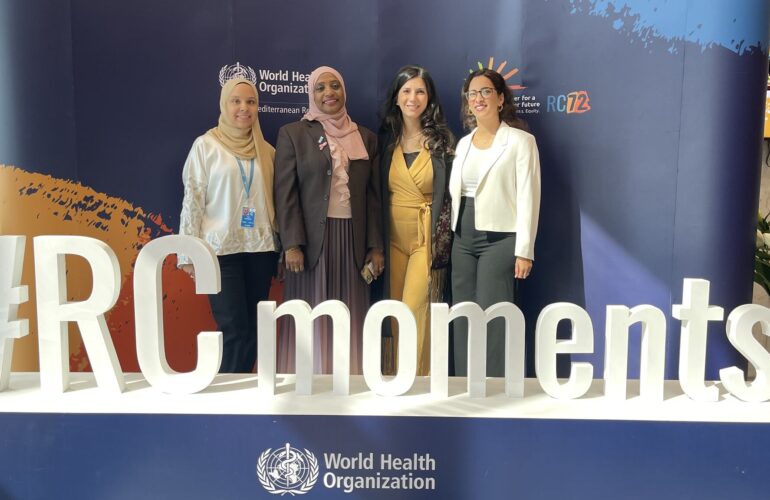
A region-wide commitment to prevent avoidable suffering. On 16 October 2025, the World Health Organization (WHO) Regional Committee for the Eastern Mediterranean Region (EMRO) unanimously adopted resolution EM/RC72/R.4 on palliative care, advancing a comprehensive, system-wide approach to relieve serious health-related suffering across the Region.
Ministers of Health and nominated delegates from all 22 countries in the region recognized the public-health imperative to expand access to palliative care.
Several countries shared powerful testimony about unmet palliative care needs, while also highlighting innovations and progress, and pledging concrete national actions and a commitment to regional partnership.
“Palliative care is not a challenge but a solution”
said Dr Lamia Mahmoud, who presented to the committee on the resolution and is a regional advisor for noncommunicable disease prevention for WHO EMRO.
Grounded in the technical paper, Palliative care in the Eastern Mediterranean Region: from challenges to solutions, the resolution calls on Member States to:
- Integrate palliative care into primary health care and benefit packages
- Ensure reliable access to essential palliative care medicines (including controlled medicines for pain relief)
- Build workforce capacity through pre-licensure and in-service education; and
- Strengthen data, quality standards and community-based services.
The resolution tasks the WHO Secretariat with targeted technical support and monitoring. Financial notes indicate a five-year implementation horizon (2026–2030), with an estimated US$10 million Secretariat budget requirement to backstop the rollout.
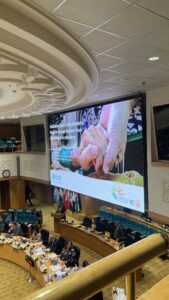
The Resolution follows a decade of work since the 2014 World Health Assembly Resolution (WHA67.19), which recognized palliative care as not only ethical responsibility of health systems but also an essential component of care under Universal Health Coverage. It explicitly recalls WHA67.19 and translates its principles into regional actions, particularly around integration into primary care, safeguarding access to essential medicines, and investment in training and service models adapted to fragile and humanitarian settings.
“The integration of palliative care presents a profound win-win: it directly relieves patient suffering by attending to all dimensions of need, while simultaneously forging a more effective and resilient health system” said Nahla Gafer, the lead author of the technical paper, a clinical oncologist, and consultant in palliative care for WHO EMRO. “Making this the standard of care across the EMR is an urgent priority.”
The technical paper and speakers during the regional committee meeting highlighted stark gaps in access to palliative care while welcoming the Region’s shared path forward. The Regional Director’s closing remarks noted that RC72 adopted five critical resolutions overall, reflecting strong consensus to accelerate universal health coverage despite compounding emergencies across the Eastern Mediterranean Region.
As countries begin translating the resolution into policy and practice, advocates stress the importance of sustained financing, regulatory reforms that balance access and control to controlled medicines, and robust training pipelines to equip health workers to reach patients needing palliative care, not only in hospitals, but also at home and in community clinics.
With the resolution now adopted and Member States voicing unanimous commitment to expand access, the Region has a clear framework to prevent unnecessary suffering and uphold dignity at the end of life.
To read the technical paper and the resolution in their entirety, visit the WHO EMRO website: https://www.emro.who.int/about-who/rc72/documentation.html
————————-


Leave a Reply