

A policy perspective on integrating palliative care into Bangladesh’s primary healthcare system: Learning from the UK’s 2026 Palliative Care Report. Palliative care is not a luxury reserved for wealthy countries, nor should it begin only when curative treatment ends. It helps people living with serious illnesses manage pain, receive psychological and social support, preserve dignity and maintain quality of life.
Yet, access remains severely limited in Bangladesh. Marie Curie’s Measuring Unmet Need for Palliative Care report, published in February 2026, offers important lessons for policymakers. Although focused on the United Kingdom, its central message applies to Bangladesh:
health systems must identify unmet needs and organise services around patients rather than leaving families to navigate fragmented care.
Understanding unmet need beyond the number of patients
Drawing on the DUECare project, the Marie Curie report estimates that nearly one in three people in England die with unmet palliative care needs, equivalent to approximately 170,000 people annually. Unmet needs include unaddressed symptoms and concerns, inadequate general practitioner support, delayed assessment, poor coordination, insufficient follow-up, gaps in professional competence and a lack of dignity and empathy.
Bangladesh faces the additional challenge of establishing equitable access. Estimates cited by the Palliative Care Society of Bangladesh and published research suggest that approximately 600,000 people may require palliative care annually, while fewer than 4,000 access services. These figures are estimates, not definitive national measurements. The Asia-Pacific Atlas of Palliative Care 2025 also identifies weaknesses in policy, workforce development, primary-level services and access to essential medicines.
A 2025 multicentre study of 301 patients with incurable illnesses in Bangladesh found unmet needs in doctor–patient communication (89.4%), discussions about goals of care (78.1%), spiritual support (77.4%) and caregiving (66.4%). Although not nationally representative, these findings demonstrate that patients need more than pain relief: they also need clear information, involvement in decisions, emotional reassurance and support for caregivers.
Integrating palliative care into primary healthcare
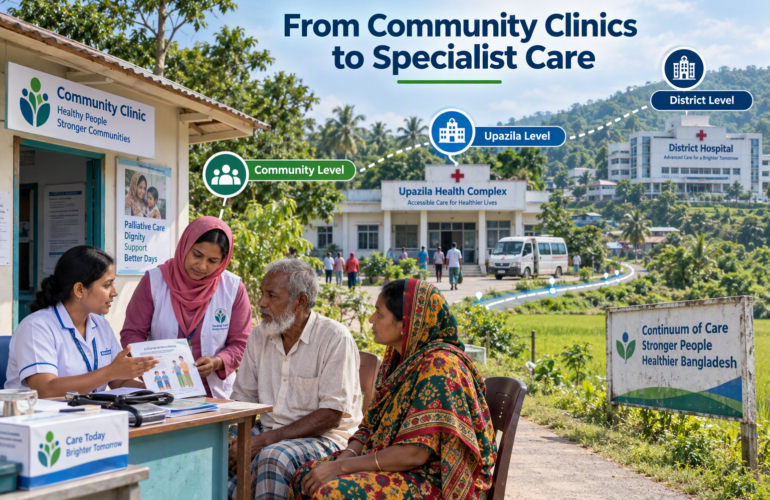
Palliative care should become a routine part of community healthcare rather than remain concentrated in specialist hospitals. Bangladesh should integrate services into Upazila Health Complexes, community clinics and appropriate district-level facilities. Community Health Care Providers, nurses and medical officers can be trained to recognise needs, assess common symptoms, provide basic support and arrange timely referrals. Patients with complex symptoms should receive specialist consultation.
A tiered model would be practical: basic care at community level, additional clinical support at Upazila Health Complexes and specialist teams at designated district and tertiary facilities. Existing initiatives, including the Compassionate Narayanganj experience, offer opportunities to examine how community-based services can be embedded in local health systems and expanded using evidence.4
Establishing a national framework with measurable targets
Bangladesh needs a nationally coordinated palliative care strategy with a dedicated implementation plan, budget, responsible authority and measurable indicators. The Asia-Pacific Atlas of Palliative Care 2025 reports that Bangladesh introduced a national palliative care guideline in 2018, while a comprehensive national policy and implementation framework remain under development. Gaps in monitoring and evaluation also persist.
The Directorate General of Health Services, under the Ministry of Health and Family Welfare, should lead a coordinated effort to incorporate palliative care into health-sector operational plans, primary healthcare service packages and universal health coverage priorities. Baseline data should identify who needs care, where they live, what services they receive and why their needs remain unmet.
Bangladesh should develop a locally validated assessment framework covering symptoms, access, continuity and person-centred care. Patient-reported assessments, bereaved-family surveys and routine health information could help establish the national picture. UK estimates should not be directly transferred because healthcare structures, social circumstances and data systems differ.
Ensuring essential medicines are available
Palliative care cannot succeed without effective medicines for pain and other distressing symptoms. In Bangladesh, access to immediate-release oral morphine remains a particular concern, especially outside Dhaka. The Asia-Pacific Atlas of Palliative Care 2025 identifies restrictive regulatory arrangements, limited prescribing knowledge and weak availability at primary care facilities as barriers.
The government should review procurement, distribution and prescribing arrangements to ensure that authorised facilities and eligible patients can obtain medically necessary opioid analgesics without avoidable delays. Prescribing guidelines, professional training, secure storage, record-keeping and safeguards against misuse must accompany improved access.
Financial protection is equally important. A 2026 multicentre cost study of hospital-based palliative care for patients with cancer in Bangladesh reported substantial out-of-pocket expenditure relative to household income, with medicines among the major cost contributors. Essential palliative medicines and basic supportive services should therefore be considered in public financing and healthcare benefit packages.
Building a competent and compassionate workforce
Palliative care should be incorporated into medical, nursing, midwifery and relevant paramedical education, alongside continuing professional development. Training should cover symptom assessment, pain management, communication about serious illness, psychosocial and spiritual support, family counselling and referral pathways.
A phased programme in selected districts, supported by specialist mentors, referral hospitals and teleconsultation, could help bridge workforce gaps. Success should be measured by improvements in care at patients’ bedsides and homes, not simply by the number of professionals trained.
Family caregivers also need information, emotional support and practical guidance. Culturally sensitive care should respect religious beliefs and family structures while ensuring that patients remain involved in decisions to the greatest extent possible.
Developing coordinated and responsive community services
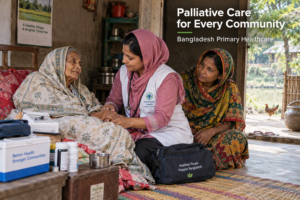
Although fully staffed 24-hour specialist teams in every community may be unrealistic initially, Bangladesh can adopt a phased approach. Participating districts could establish palliative care contact points supported by referral protocols, telephone advice, scheduled follow-up and urgent symptom assessment arrangements.
Implementation should begin in selected districts representing different geographical and socioeconomic settings. Independent evaluation should measure symptom relief, patient experience, caregiver burden, avoidable emergency visits, medicine availability and household expenditure. Hospital admission rates should not be used alone to judge success, as necessary hospital care must remain accessible.
A policy choice grounded in dignity and equity
The UK report’s value lies in demonstrating how unmet need can be identified, measured and translated into policy action. Bangladesh should move from scattered initiatives towards a financed, accountable and measurable national programme integrated into primary healthcare. Government leadership, supported by medical institutions, professional associations, civil society, researchers and community organisations, will be essential.
Palliative care is not only about supporting people in their final days. It is about helping people live as well as possible while facing serious illness and ensuring that families do not have to navigate suffering without support. Bangladesh need not reproduce the UK healthcare system; it must adapt relevant lessons to local realities.
Ultimately, success will be measured not by another guideline or specialist centre in a major city, but by whether someone living with serious illness in a remote village, a low-income urban settlement or an underserved district can receive timely pain relief, compassionate communication and appropriate care without financial hardship. That is the standard against which Bangladesh’s palliative care policy should be judged.
—————–
Author Bio: Sumit Banik is a prominent Bangladeshi public health activist, trainer, and development professional specializing in community-based palliative care. Over a decade of public health experience, he has emerged as a leading voice advocating for universal health equity, social justice, and the recognition of end-of-life care as a fundamental human right in Bangladesh. A writer and columnist, he explores public health, preventive healthcare, child welfare, and compassionate communities through analytical and evidence-informed writing for national and international audiences.
================
ehospice is proud to help promote individual, local, national and international voices in Hospice & Palliative Care
We are on target to have over One Million page views this year.
To stay in touch with colleagues and news around the world subscribe to our free Newsletter


Leave a Reply