

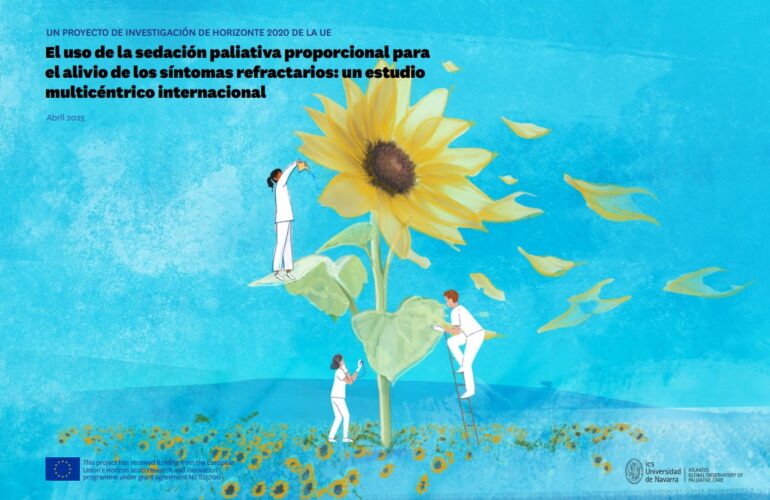
Discover the key findings from the project The use of proportional palliative sedation for the relief of refractory symptoms: an international multicenter study. Access the interactive PDF here.
Refractory Symptoms at End of Life
Symptoms like pain, delirium, and dyspnea can appear in patients nearing the end of life, causing significant distress. In some cases, they become refractory: treatment options fail, results aren’t available in time, or the risk-benefit ratio is no longer acceptable. That’s when palliative sedation emerges as a last-resort option.
Project Objectives
A key goal of this project was to provide a review and update of the EAPC (European Association for Palliative Care) framework for palliative sedation, following a comprehensive multicenter observational study in a European context. The research focused on improving assessment methods within the project framework and addressing refractory symptoms and the appropriate use of palliative sedation, taking into account differences across Europe in both clinical and ethical aspects.
Contents
This five-year project conducted a clinical study on proportional palliative sedation in five European palliative care centers, using patient comfort as the primary outcome measure. It also analyzed the decision-making process during and after refractory symptom evaluation and introduced an innovative method to facilitate and support medical and ethical discussions through the case dilemma approach.
It included an analysis of economic implications and a policy workshop with national palliative care associations. The project’s impact is strengthened by a review of the current EAPC framework for palliative sedation, based on expert input. To support dissemination and communication, it developed an open-access online educational program and an e-book.
Purpose of the Spanish Translation
The ATLANTES Global Observatory of Palliative Care (University of Navarra, Spain) led the creation of this interactive dissemination PDF, translated into Spanish, to share the project’s main results. Its goal is to widely disseminate in Latin America and Spain key outcomes from the European project, especially the e-book “The Role of Palliative Sedation in the Context of Palliative Care” and the “Guide for the Clinical Application of Palliative Sedation.” It also includes information on the Sedation Course (available in English), as well as other materials like infographics, multicenter prospective studies, and publications from the European H2020 project.
=?UTF-8?Q?Sedaci=C3=B3nPaliativa=5FAbril_2025.pdf?=



Leave a Reply