


Every year, more than 4 million people die in Europe with severe health-related suffering, including more than 60,000 children. Suffering that, in many cases, could be alleviated with adequate access to palliative care. However, access remains unequal, inadequate and geographically determined.
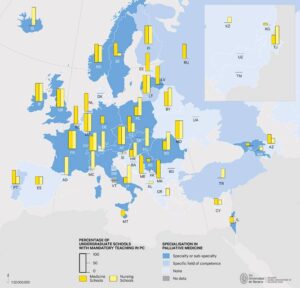
One of the most worrying barriers is the lack of training in palliative care in European universities. Although suffering associated with serious illness is on the rise, in many countries health professionals finish their studies without having received a single lecture on how to alleviate it. Only 15 European countries teach palliative care in all their medical schools. In other words, almost 60% of European countries have little or no palliative care training in their curricula for doctors and nurses.
Services that grow little and unevenly
There are now more than 7,000 specialised palliative care services in Europe, spread across 50 countries. However, growth since 2019 has been modest, at just 10%.
In addition, strong regional inequalities persist. The wealthiest countries have twice as many services per capita as the European average (approximately one per 100,000 people). In contrast, many low- and middle-income countries, especially in Central and Eastern Europe, have rates well below the average, or even close to zero.
Access to medicines: another painful gap
The availability of essential pain relief medicines also varies dramatically. While in Western Europe its use is widespread, with countries with high opioid use ( Israel, Germany and the Netherlands, to name a few), Central and Eastern Europe can be up to ten times lower, resulting in an unacceptable inequality in the relief of suffering, marked simply by place of birth.
These data come from the new European Atlas of Palliative Care, a joint publication of the Global Atlantes Observatory of the University of Navarra and the European Association for Palliative Care (EAPC). This tool aims to provide a rigorous assessment of the situation in order to promote fairer and more equitable public policies.
Download the full Atlas (pdf) to your computer or tablet University of Navarra repository (Free, 21 mb)
Explore and share communication materials Press release, media kit, images, videos, infographics. 1

Order a printed copy anywhere in the world via your local Amazon store Print on demand.


I totally agree. Palliative medicine in my country is really low concerning education and practicing. I am a medical oncologist in Greece and try to apply it, without a proper education or recognition of this specialization in my country. We have to act on this. It really helps our patients and shows respect till the end of life