

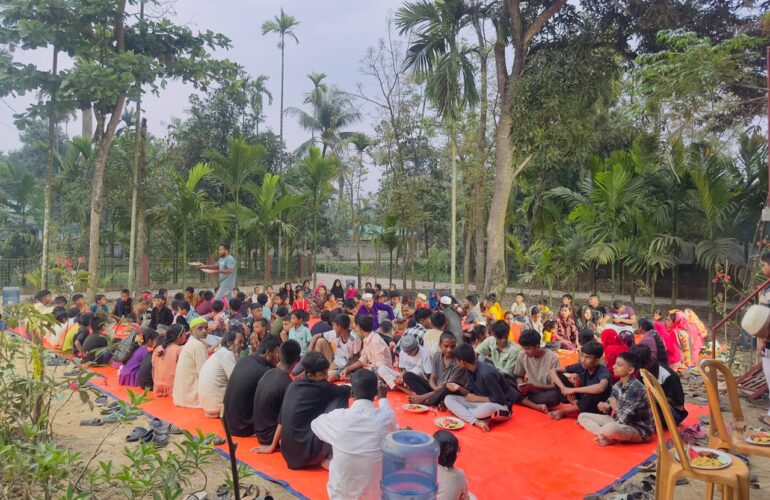
Life embraces its own simplicity in a quiet village of Habiganj in Sylhet, far away from the hustle and bustle of the chaotic capital Dhaka. Instead of being lit up with bright city lights and having crowded streets, this village breathes in silence with an open sky above it. Being inhabited by simple minded people, this rural area finds its solace in its refreshing greenery.
In recent years, something quite beautiful has found its roots in this village. Although it’s a small idea, a significant amount of caring and conscious effort has been put into it.
A project called “Adopt a Grandma” has been developed by the local volunteers. This initiative emphasizes that grandparents also need love and care. Despite having no higher education or knowledge in medicine, grandparents have always been with us showing kindness and holding onto old humane values.
The Interpersonal Dynamics Between Children and Their “Nanu-Dadu”
For school going children and students who are in their adolescence, lonely elderly people aged above sixty have been a real source of friendship.
The majority of these elderly people are not financially stable and most of them live alone since their own children could not take care of them or moved somewhere else due to work purposes.
The most beautiful thing about this project is that the young children lovingly call them ‘Dadu’ (grandpa) and ‘Nanu’ (grandma). Visiting them barefoot, these young minds sit and have great conversations with them, listen to their stories with required attention, bring food, and spend a considerable amount of time with them
These children have no training in nursing or caring for elderly people. They are simply a bunch of playful children, who could only think about playing games and having fun; instead of that they show concern about these elderly persons asking “Has my Nanu eaten today?”
Two Different Worlds Connected Within One Thread
Another caring project has been launched in Dhaka’s Korail slum named “Compassionate korail” primarily originated by Worldwide Hospice Palliative Care Alliance (WHPCA); after the external funding stopped taken care of by the Palliative Cre Society of Bangladesh with small public donations. The world’s largest and developed cities like New York or London sound like fairy tales to the children living in this Korail informal settlement (slum) area. Even the developed side of Dhaka seems like a dream to these children growing in informal settlement (slums). They have not got the opportunity to come across tall buildings or fast-paced cars on the roads. Their lives revolve around muddy roads, green paddy fields, and freshness of air. Despite living in a ‘not-so-developed’ area, they have hearts filled with compassion and simplicity.
Compassion Stemming from their Own Roots
The primary aim was not to provide theoretical definitions of kindness from Western cultures. The goal was to let these children grow compassion in a natural manner, as it was always the case in rural Bengal.
In rural communities, caring gestures are not something that are taught in the classrooms. It is practiced in the daily lifestyle of the rural people through sharing food, stretching hands out to help others, and looking after the elderly people.
Upon examining the situation, the organizers took a step back by allowing these rural people to lead the project. Something magical happened through the participation of these people.
A Simple Meal in the Holy Month of Ramadan
As part of the project, on one of the last ten days in Ramadan, all the adopted grandparents were provided with enough food for the whole day’s meal; they received food for themselves and for all of their family members. It was because the organizers had it in their minds that when one person suffers, the entire family suffers as well.
The food was delivered by none other than the little children.
Going from one door to another, they distributed food with a sweet smile on their faces, checking up on the elderly people whether everyone was doing well or not. At sunset, as the call to prayer was heard, they sat together to have an iftar with all. The entire ambience became lively as it was filled with their laughter and sessions of sharing stories. It all felt like a much overdue family gathering.
A Lesson Learnt that is Powerful
This particular moment holds a great significance which says that an entire village can take good care of its elders without having huge monetary support, foreign experts, or complex planning outlines.
Wrapped up with love, kind presence and an essence of old traditions, they made it happen.
In fact, this care project did not cost as much as it would cost to provide one month’s food support in city slum projects. This project proves that the villagers survive with very little, since they still nurture values that the city has almost forgotten.
The Spirit of Being Together
What actually does the village remember?
It remembers the importance of unity. It holds on to the fact that neighbours should also be treated like family members. And most importantly, these villagers put emphasis on the fact that no one in their surroundings should be left alone.
Here, life is not about any individual; rather it is about living together. It emphasizes the word ‘ours’ more than the word ‘mine’.
Rooted in Our Own Soil
Having been able to watch the children being adored by their grandparents beneath the open sky reminds us of a beautiful truth:
Real sort of humanity and real kind of beauty lie in our own land, our own traditions, and our shared feelings. They are not to be copied or imported from somewhere else.
These are some basic human values finding their places within ourselves.
Simple. Authentic. Sufficient.
Showing care for the elderly people is not any kind of a special program for these children of this quiet village.
It simply represents who they really are.
Prof. Dr. Sunjida Shahriah
Secretary General
Palliative Care Society of Bangladesh (PCSB)
sshahriah@yahoo.com


A very good initiative to serve our senior citigen. Well done. Hats Off to the team.