

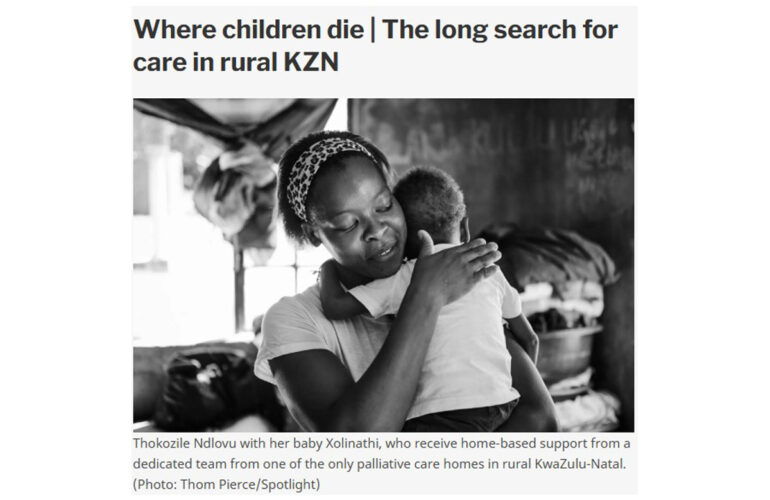
Spotlight, a South African online publication producing in-depth, public interest health journalism, has recently published an excellent article that takes the reader on a journey documenting the reality of coping with a child’s life-limiting diagnosis and just how paediatric palliative care changes lives and can bring specialised care and hope to families living in rural KZN. The compelling article, written by Sue Segar, follows the journey of Thokozile Ndlovu and her son Xolinathi, diagnosed with a life-limiting condition, and the role of Butterfly Palliative Home in providing palliative care and bringing them comfort and hope.
When Thokozile Ndlovu found out that her baby had a life-limiting illness, she went from pillar to post looking for medical help. Her journey took her to one of the only places offering hope, the Butterfly Palliative Home in Ingwavuma in KwaZulu-Natal.
About eighteen months ago, Thokozile Ndlovu, realised something was seriously amiss with her six-month-old baby, Xolinathi. “He was having seizures, his body was weak, and I could tell his development was very slow,” says Ndlovu.
Ndlovu, 25, who lives about an hour’s drive from the town of Ingwavuma in rural northern KwaZulu-Natal, decided to seek medical help.
The nearest clinic at Ndumo is a 45-minute drive from her home. She bundled up her sick infant and started walking in the sweltering heat of the area, hoping to hitch a ride.
Bush taxis are not common in this community in the Lebombo Mountain range where few cars pass by. When Ndlovu finally reached the clinic, after walking for many hours, she says the staff told her they couldn’t help and advised her to take the baby to Mosvold Hospital, another hour’s drive away.
“I walked out of the clinic and started hitchhiking to Mosvold. Hitchhiking is costly – you ask people for a lift, but you still need to work out a price,” she tells Spotlight.
Several hours later, at Mosvold Hospital, they X-rayed the baby and found his heart was “on the wrong side of his chest”. Ndlovu adds: “They said they couldn’t do anything to help us and referred us to Queen Nandi Regional Hospital in Empangeni (another three and a half hours away by car).”
Ndlovu had to then make her way from Mosvold to Queen Nandi, and again she says she was told there was nothing they could do. “They booked an ambulance to take us to Inkosi Albert Luthuli Hospital in Durban,” she says.
By this stage, Ndlovu and her baby had not been home for several days and she says his health was deteriorating.
She says specialists at Inkosi Albert Luthuli Hospital, a tertiary hospital, were unable to help. “They said if they operated on his heart, he might die because he was too weak,” she says. “We waited at the hospital, where lots of doctors examined my baby. They kept us there for the whole of December.”
In late December, she says doctors told her that Xolinathi was deemed palliative. That was when the doctor told her about the Butterfly Palliative Home in Ingwavuma, she says.
Support from the Butterfly Palliative Home
Founded in 2018 by husband-and-wife team Tarryn and Dr Christof Bell, the Butterfly Palliative Home is a children’s hospice providing end-of-life care to babies and young children with life-limiting conditions. They provide both home-based care services and in-house care at two children’s hospices in Ingwavuma and Empangeni. They say these are the only such registered children’s hospices in rural KZN, and just two of five in South Africa.
After consulting with Tarryn Bell, a qualified social worker, Ndlovu decided to care for Xolinathi at home, with Butterfly’s support. Xolinathi has Dextrocardia, a condition in which a child’s heart is on the right side of the chest instead of the left, along with associated heart disease.
“They introduced me to the staff, taught me how to take care of my baby, and said they would visit regularly to see how I was doing,” she says.
A visit to Thokozile Ndlovu’s home
The Butterfly team visits twice a month to check in with her and Xolinathi.
“We’ve reassured her that, as soon as she’s not coping, we can take the baby to stay at our hospice,” says Doris Ntuli, director and house mother of Butterfly’s hospice site in Ingwavuma.
Ntuli, and social worker Nokwazi Ndlovu (no relation to Thokozile), go along with Spotlight to visit Ndlovu. Butterfly’s maintenance manager, Nhlanhla Ndlovu, is at the wheel.
To get to Ndlovu’s homestead involves a long drive, through the lush, dense bush which characterises this part of rural KZN, and along bumpy narrow red-dirt roads which are impassable without a four-wheel drive vehicle.
It’s heatwave hot. On arrival, we are greeted by a group of women sitting under trees. Chickens roam around the yard. Ndlovu, who lives with her mother and sisters, emerges from a small room carrying Xolinathi, who is clearly miserable. She greets Ntuli and Ndlovu but is fraught as she says her baby has picked up a bad cold and is struggling to swallow.
The Butterfly duo unpack the bags they’ve brought along, including some staple food for the family, cleaning materials and a blender. “This will help to make the baby’s food soft and easier to swallow,” says Ntuli.
On their regular visits, she and Ndlovu make sure the baby is getting proper nutrition and that he has the correct medications. They give tips on keeping the home clean and sterilised, to prevent infection, and they check to see how the young mum is coping, emotionally and otherwise.
“Thokozile knows that, as soon as she feels she is not coping, we can take the baby for two weeks or longer to give her some relief. It might get harder from here,” reiterates Ntuli.
In isiZulu, with some translating help from driver Nhlanhla Ndlovu, Thokozile describes how Butterfly has helped her on this difficult journey.
The baby boy is one of several outpatients who the women are currently visiting regularly. One has a brain tumour and has picked up infections, another with cerebral palsy has developed a chest infection resulting in the child being unable to swallow food or saliva and thus needs to be suctioned every hour and fed through a tube.
“It’s difficult for these parents, but that’s what we are there for,” says Ntuli. “We see how hard they are working to look after their children, and we do whatever we can to support them.”
The article goes on to describe the incredibly important work of the teams from the Butterfly Palliative Homes in both Ingwavuma and Empangeni illustrated with stunning black and white images.
Read the full article here.




Leave a Reply