

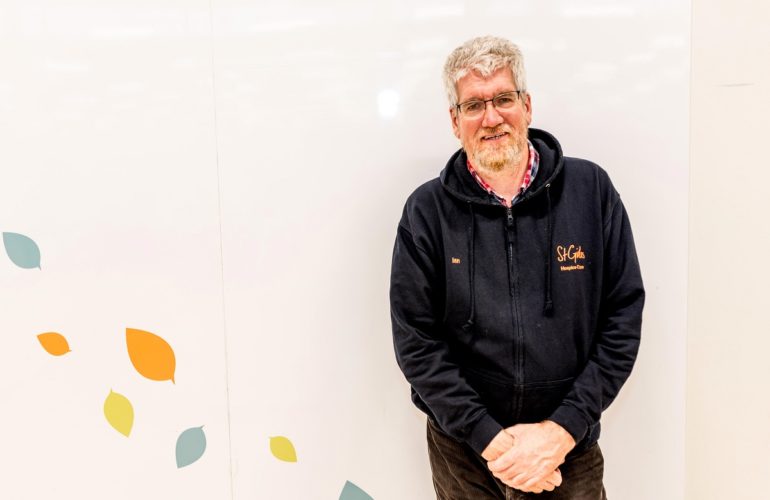
Since the death of his daughter ten years ago, Ian Leech has been avidly campaigning to improve end of life care and promote open discussions about dying. Here he talks to ehospice about his involvement with People in Partnership and Dying Matters, and why the school curriculum is the starting point for society to become comfortable talking about death.
You’re the Community Engagement Manager at St Giles Hospice, what does this involve?
My role is to engage with groups, individuals and organisations to promote end of life care and bereavement support. No two days are ever the same and the word is so varied. I can be discussing Advance Care Plans with a group of elderly people in the morning and discussing bereavement with students in an afternoon. A large part of my role is around partnership working, bringing together the best people to provide the best service.
I deliver Understanding Bereavement workshops to groups and organisations and health and social care students. These sessions give people a basic understanding of grief, how you can support a grieving person, what to say/not to say and how it is important to look after yourself too. These sessions are tailored to each individual audience and the Understanding Bereavement in the Workplace has helped to develop the Hospice UK Compassionate Employers programme.
I have been instrumental in setting up a series of Bereavement Help Points, a drop-in service for anyone who is bereaved and helps to support bereaved adults in our community. We currently operate 10 help points in all major towns across our catchment area, helping to provide a safety net of bereavement support to our communities.
How did you become involved with People in Partnership (PiP)?
Following the death of my daughter Melissa from non-Hodgkin’s Lymphoma in May 2008, I discovered that her end of life care was excellent. I had always thought it average, that everyone received the level of care Melissa had. Hearing other people’s experiences of their care made me realise that Mel’s care was very special. I wanted to share this with health professionals, organisations and groups, after all, I knew what good looked like. In 2009 I ‘googled’ End of Life Care and top of the page was the National Council for Palliative Care. I rang them, explained my story and asked if I could help. I spoke to Jo Black and was asked to visit NCPC in London, which I did and the rest is history!
What do you want to achieve with your role at PiP?
My aim has always been to improve end of life care and that includes bereavement support too. I want everyone to receive the same level of care Melissa did. I want to promote what good end of life care looks like as well as promote bereavement support, particularly in our communities. I want to empower people to ask questions and not take everything as read.
What does your role as Dying Matters champion entail?
It involves helping to promote conversations related to death, dying and bereavement. Often in society, those who wish to speak about these subjects do not feel they can or they feel they need permission. I believe that often we deny those who wish to talk about death, dying and bereavement a voice because we are scared of upsetting those who do not. It is about choice, if someone does not wish to talk about the subject that is fine, but if they do, they should not be denied that opportunity. As a Dying Matters champion I present the case for why I believe they should discuss things like wills, funeral wishes, Advance Care Plans, etc.
How did you approach the subject of death and dying before losing your daughter?
Very uncomfortably I have to say, I would usually joke about it or shy away from talking about it. However being with my daughter at the end of her life made me realise that this moment will come to us all, and it is important to have conversations, if you feel comfortable in doing so. The conversation I had with Mel about her funeral wishes and her care was probably the richest conversation I have ever had. It is a conversation that no parent should have to have with their child, but having it made organising Mel’s funeral a lot easier than it could have been, and made me realise the importance of such conversations.
What needs to happen for society to be more comfortable with death and dying?
First and foremost bereavement awareness should be on the school curriculum. No two ways about it. We teach our children about sex, about drugs, why are we not having conversations with them about grief and bereavement? The feedback from delivering our Understanding Bereavement workshops and Coping with Loss lessons at St Giles demonstrates that children and young people are willing to talk about this subject. Death is a part of life and that should be explained within the curriculum in a sensitive and honest way.
I also believe that educationally we are missing a trick with health and social care. I deliver workshops on bereavement to health and social care students at a local college. The feedback again demonstrates the need for this, both from a professional and personal viewpoint. How can someone study health and social care and there not be a module that covers death, dying and bereavement? If you go in to a career in health and social care and do not encounter death , dying or bereavement you are hiding, but we shy away from including it in our health modules.
Government have to wake up and start looking at the effect bereavement and a lack of acknowledgment of grief have on our society. How much anti-social behaviour is due to a lack of bereavement support? How many people are sleeping on the streets because of unacknowledged grief? How many children are behaving badly in school due to a lack of support following bereavement? You educate the young and you change a generation, and in my opinion that is what needs to happen.
What was your aim with writing the book One Day at a Time: Mel’s Story?
Initially, the aim was to give myself a project that kept me busy, which in turn helped my own grief. Also I wanted to raise a few quid for some of the charities that had helped us. Both Mel and I had written these blogs recording our day to day life during her illness, I felt I had to do something with what we had written and this seemed a good project.
What I love personally about the book, as well as the collaboration of it was also that it was written in real time. This was our life recorded on a day-to-day basis, and not me looking back retrospectively a few months or years later. I would get home from the hospital and write about our day that evening, and Mel would do the same from her hospital or home bed.
I remember going in to the hospital one day to visit Mel, and one of the staff saying the consultant had said to read our blogs as they were the best insight they would ever get for what someone at the end of life and someone caring for them were going through. They had the same day through two very different pairs of eyes. Up until that point I did not really think of the impact and that was what ultimately inspired me. My “I Can’t Imagine” presentation is basically the story that is told in the book.
For more information visit People in Partnership and Dying Matters


Leave a Reply