

It’s the intersection of disciplines that often leads to the greatest learning. So it was with great expectation that I arrived at Smock Alley, the ancient theatre on Dublin’s waterside, for the dotMed Conference.
The conference agenda promised a meeting of medicine, the arts and technology – and no one was disappointed.
Data visualisation
First up was Professor John Greally, an Irishman working in New York in the field of paediatrics and epigenetics (invented since I qualified!).
He took us on an amazing journey, demonstrating how we have always sought ways to share complex information in visual ways, and how art helps us to decode and understand. From cave paintings to Napolean’s route to Moscow (where the width of the line showed the size of the army) to the Venn diagram in 1880 to beautiful maps of chromosomal data.
He talked of the four-way collaboration he now creates with researchers, data visualisation experts, programmers and artists – a very rich world. His thesis is that these artistic transformations of big data allow the ambiguity of evidence to be appreciated, that we need to tolerate ambiguity alongside our desperate search for accuracy in medicine.
Social media
Then Dr Joel Topf (@kidney_boy) showed us the power of social media as a ‘major game changer for medical education’, in sharing learning and building a democratic academic community. He described a framework of tweetchats to discuss journal articles (#NephJC) – the key themes are then captured in blogs which Joel sees as the social media backbone.
‘NephMadness’ is an annual competition of online concepts and debates on current themes in kidney medicine, based on a famous US knock-out basket ball contest, March Madness. Maybe we need to create PallMadness! (But first do join our inaugural Hospice UK tweetchat on 2 March, looking at person-centred advance care plans).
Medicine as performance
Professor Deborah Bowman, professor of bioethics at St Georges and editor in chief of the BMJ Journal of Medical Humanities, gave a theatrical performance on the concept of medicine as performance.
She talked of medical school as a place of rehearsal, and reminded us that we all see the stage differently, depending on where we are sitting – and that some of us have an obstructed view as we are sitting behind a pillar!
“Theatre demands attention. The space between the words, before the words and after the words is critical.” This is just the same in medicine. She reminded us of the great play Wit – a soliloquy of a patient dying of ovarian cancer and the great quote “Now is the time for simplicity. Now is the time for, dare I say it, kindness.”
Apps and gadgets
Next was a ‘dragons den’ competition with four teams pitching new digital products and apps. Each could have won and will make a difference to the lives of patients.
There was a metronome cueing app to help people with Parkinson’s Disease to walk with more rhythm, a bereavement app allowing the creation of mood music as a grief journal, an app to share medical team data more efficiently and, finally, the winner, a small gadget to count our breathing rate – a vital sign that predicts deterioration that we are still counting badly and manually!
The accidental activist
Dr Panti Bliss (Rory O’Neill when not in drag) spoke with passion and honesty about his HIV positive (actually, quite a negative) experience in the 90s and how his medication has now shrunk from 38 tablets to 1 tablet.
He is known as the Queen of Ireland, a gender celebrity and an ‘accidental activist’. He spoke passionately about secrets and stigma which lead to depression and death – lessons for us all. He is the face of new Irish tolerance to difference – he received a standing ovation.
Graphic medicine
Dr Ian Williams, GP cartoonist also known as the Bad Doctor, shared the power of graphic medicine (comics!) Ian founded the Graphic Medicine website which explores the interaction between medicine and comics – the educational and literary potential.
He talked of his own obsessive problems as a medical student, now captured vividly in his best seller The bad doctor. Ian reminded us of the W.J.T Mitchell quote “Images do not just mirror the world, they help to build it.”
Relational medicine
Dr Samuel Shem (the pseudonym of author and psychiatrist Dr Stephen Bergman), the irreverent hero of so many doctors of my generation came last. He is now a professor of medical humanities and psychiatry at Harvard Medical School and his messages from 38 years ago still ring true.
He remains passionate about the power of connection with our patients and with each other as survival mechanisms in medicine. He talked of ‘relational medicine’ – the sense that each is being ‘seen’ by the other. This fits in with Harvey Chochinovs view of what underpins dignity and identity.
His book House of God was a necessary medical text for housemen and interns around the world and his 13th rule: “The delivery of good medical care is to do as much nothing as possible” is surely a lesson that means even more in the 21st century than when he coined it in 1978.
Music, cartoons and photography
Alongside all this magical thinking was art and music. Music from Colm Mac Con Iomaire, haunting ancient Irish folk, serenading us after lunch. (I now have the CD.)
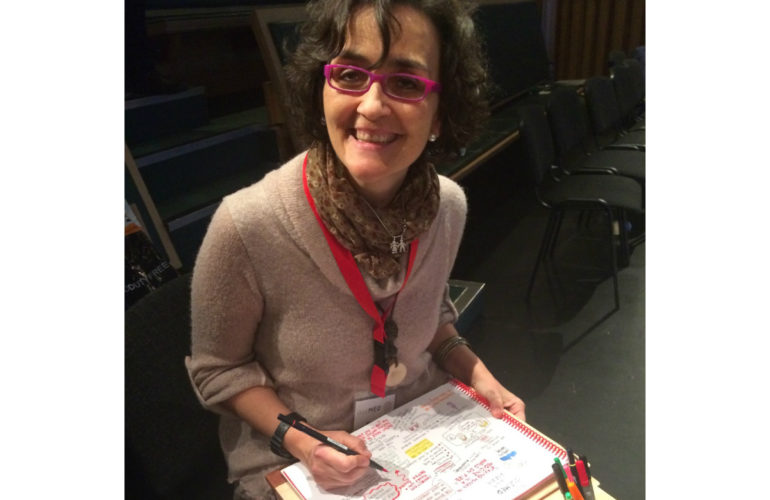
Gifted cartoonist and emergency doctor Monica Lalanda captured the whole conference with sketch notes. They can all be viewed on her twitter feed @mlalanda and will soon be on her website. Monica is now using cartoons to teach medical ethics in a pilot course to third year medical students – it’s currently in Spanish but I am hoping to get it translated!
Dr Leticia Ruiz Rivera, a palliative physician also from Spain, showed some poignant and rather shocking photographic portraits of doctors after 24 hours on call. Her exhibition was called Limits. These couldn’t be more topical as we debate doctors’ working hours.
The conference was conceived and curated by Dr Ronan Kavanagh, a rheumatologist, and Dr Muiris Houston, a medical journalist for the BMJ and Irish Times. My thanks go to both of them for refreshing and provoking me. The sessions were filmed and should soon be on the conference’s website.
What did this conference have to do with hospice and palliative care – everything! Don’t miss next year!


Leave a Reply