

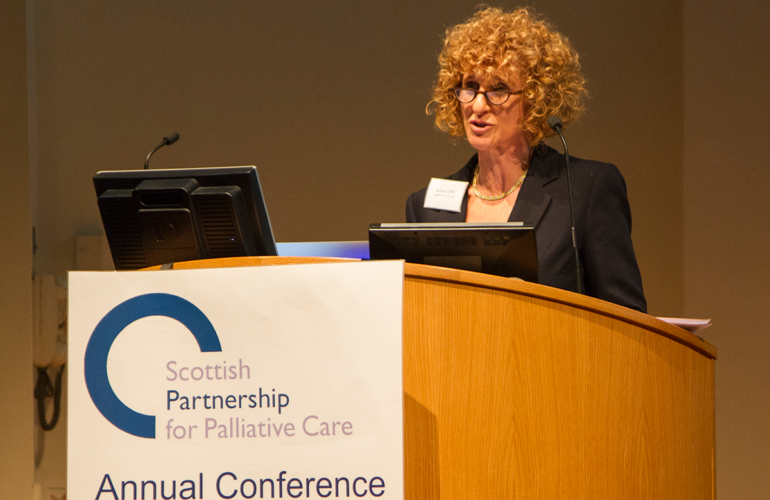
Entitled ‘Palliative Care in Many Guises’, the day was an opportunity to consider this subject in relation to the final report of the Commission into the Future of Hospice Care. The report describes a future where “hospice care is dynamic, innovative and responsive” and high quality palliative and end of life care is “provided to all, across the many different settings, where it is needed.”
An impressive line up of speakers attracted an attendance 17% higher than last year and this was accompanied by a record number of poster submissions too, according to Mark Hazelwood, director of the Scottish Partnership for Palliative Care.
He said that the event had enticed a broad range of disciplines from a variety of settings, including members of the government, commissioners, NHS employees and social care representatives.
To absent friends
The conference opened with a welcome message from Mark himself and he took the opportunity to launch a new concept from Good Life, Good Grief, Good Death called: ‘To absent friends’.
The idea, set to launch in November 2014, will revive historic Scottish traditions of storytelling and also create new ones.
Mark said: “‘To absent friends’ will be a new festival of storytelling and will support those aims of Good Life, Good Grief, Good Death about acknowledging our own mortality and each other’s losses, about reducing isolation and increasing opportunities for support.”
“Not quite a Mexican day of the dead,” he continued, “more a Scottish weekend of saying the unsaid.”
The future of hospice care
Dame Barbara Monroe then took the stage for the opening plenary to present the findings of the Commission into the Future of Hospice Care, to an audience keen to hear how the recommendations could influence their practices within Scotland.
Barbara said that although that some of her talk may feel “England-centric” she emphasised the “wonderful advantages in Scotland” and urged delegates to “hold on to” those advantages.
She said: “You have a government who are prepared to care and it seems you have a much more integrated and intact healthcare system … you have a functioning GP service.”
Barbara told delegates that lessons from the Commission can be applied to different settings and geographical locations and was passionate to push the research message, suggesting hospice care is “insufficiently self critical.”
“We need to develop evidence base”, she urged, “it is no longer sufficient to do a ‘good thing.”
Telemedicine and social media were highlighted as being more advanced in Scotland and Barbara described some physicians in England as being “very cynical” about Skyping.
And she told the audience that the Scottish GP service was “one of the golden stars in your crown”.
She went on to say that we have been guilty of de-skilling GPs and yet they are going to be responsible for caring for the majority of palliative care patients.
Partnership working
Next up in the main lecture theatre was an informative and very relevant talk by Yvonne Millerick, lead nurse for the Caring Together programme and Jackie Wright, a palliative care clinical nurse specialist at the Glasgow Royal Infirmary.
Using the Caring Together programme as an example, the session explored how partnership working between cardiology and palliative care is improving the care management of people with advanced hart failure.
The programme is a collaboration between Marie Curie, British Heart Foundation, NHS Glasgow and Clyde and Glasgow Caledonian University, which is piloting integrated models of heart failure and palliative care across three areas within Glasgow and Clyde.
The pair began by showing a powerful and emotional film about a young couple: Ian died from heart failure and his wife, Anne-Marie, speaks openly in the film about the poor care that she experienced both at the time of Ian’s diagnosis and at the time if her husband’s death.
Yvonne and Jackie extracted the factors that led to poor care from the couple’s experience, which included a lack of partnership and poor communication.
They said it is essential that palliative care and cardiac failure “come as one” and that the uncertainty of cardiac patient’s illness trajectory should not be used as a barrier accessing palliative care service. And that health professionals must move away from a medial to a holistic approach.
The Care Together programme is tackling these problems with a number of research, education and practical initiatives, including a thorough holistic assessment tool for identified patients, which is subsequently distributed to the multi-disciplinary team and uploaded to an electronic system.
The processes of death
Dr Jo Hockley was the third plenary speaker of the day, who led delegates through an emotive session, which explored case study examples of patient deaths and asked the attendees to consider the visible, as well as the invisible, processes of death.
After addressing some very practical nursing care issues, her session reiterated the need for holistic care and particularly the importance of spirituality.
Using literary references and personal experiences, Jo held the attention of the audience throughout, asking challenging questions about why some people can’t let go at the end of life, and asked: “What are they waiting for?”
The session emphasised the need to consider patient’s wishes and what they might need before they are able to let themselves die – perhaps a final goodbye from a family member of a prayer from the priest.
Lunch saw a touch of Scottish tradition, with delegates consuming hot meat pies whilst furiously networking. They then broke off into four individual ‘break out’ sessions, which covered a diverse range of subjects from social media to palliative care in acute hospitals.
Children and transition
Delegates returned to the main hall for a much-anticipated part of the programme: the first ever viewing of CHAS The Opera!
The film captures the words and thoughts of children, families and hospice staff which, in collaboration with Scottish Opera, have been transformed into music and song.
It was then the job of Barbara Gelb, chief executive from Together for Short Lives, to inform a predominantly adult service audience about the current landscape of children’s palliative care.
In what she described as a “whistle-stop tour”, Barbara referenced and supported the recent Commission findings, particularly in relation to one of the key themes: transition.
She said the need to attend to this group of young people has “never been more pressing.”
But Barbara was keen to acknowledge that transition needs to be a collaborative effort, between adult and children’s services. She boldly stated that she was at the conference to “motivate and mobilise” the adult palliative care services to “join forces.”
She said: “We are not dumping on you. We want to work with you to transform children’s palliative care. We cannot achieve it alone.”
Put on your patients shoes
A passionate presentation by Dr Euan Paterson closed a successful conference.
The GP, who confessed to being “petrified” of the specialist audience, describing himself as an “enthusiastic amateur”, took the stage with gusto and asked the audience to question: Who cares?
With snippets taken from the NHS Greater Glasgow and Clyde training course, ‘Rapport – who cares?’, delegates were offered a dynamic mix of anecdotes, personal stories and case study scenarios – as well as being asked to participate themselves.
Euan urged delegates to meet people in their world and empathise with their vulnerability, “because we are all vulnerable.”
With a heartfelt message, he said: “We should all put on our patients shoes and walk about in them. Feel what they might be thinking.”


Leave a Reply