


People are beginning to write their Wills earlier in life, with charitable gifts most commonly added when supporters reach their 50s, according to new consumer research from Remember A Charity.
- Benchmarking study* shows 22% of charity supporters aged 40+ have taken action and written a charitable gift into a Will – or 32% of those with a Will
- 35% of those who haven’t yet left a gift in a Will are open to it
- Younger Will makers more likely to include charitable gifts (35% of those with a Will aged 40-59 have pledged a gift vs 30% of those aged 70+)
The research, carried out by independent research agency OKO, surveyed more than 2,000 UK charity supporters aged 40+ and forms part of Remember A Charity’s long-running consumer benchmarking study* tracking attitudes towards legacy giving.
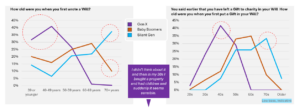
The latest data shows that, while the average age to first make a Will is 50, almost three quarters of respondents from Generation X with a Will had written it before the end of their 40s (73%). These figures highlight how planning for the future is starting earlier, even though major life milestones such as home ownership, marriage and children are often happening later.
Among those who have left a charitable gift in their Will, the most common age to first do so is in their 50s (31%). For Gen X, this drops to their 40s, for Boomers it’s their 50s and 60s, and for the Silent Generation this rises to their 70s.
Overall, 22% of people* (or 32% of those with a Will) say they have included a charitable gift, up from 14% in 2010. While older generations are more likely to have a Will, the figures reveal that legacy giving is more prevalent among younger Will-makers: 35% of those aged 40–59, compared with 32% of 60–69-year-olds and 30% of those aged 70+ have pledged a gift.
[Fig 1]
Generational shift in charitable Wills
The research highlights notable generational differences in how people approach writing their Wills.
While professional advisers continue to play a central role, with 66% of those with a Will writing their Will via a solicitor and 18% a professional Will-writer, younger generations especially are increasingly open to a broader range of Will-writing services. 28% of Gen X-ers saying they would make a Will online or have already done so, compared with around 10% of Boomers and Silent Generation respondents.
At the same time, there is a growing reliance on professional advice overall. The proportion of people seeking financial advice has increased from 42% in 2021 to 53% in 2025, with younger and wealthier audiences particularly likely to seek guidance. Those aged under 55 years with assets over £250k are most likely to seek professional wealth advice.
Professional advisers also appear to play an influential role in charitable giving decisions. Among individuals with a Will who have discussed leaving a charitable gift with a professional adviser, 60% have gone on to include one. This compares with just 20% of those who have not had such a conversation.
Jeremy Rix, Managing Director of the independent research agency OKO, says:
“People like to feel like that they’re exerting some control in uncertain times by planning ahead. Given an easier process and a wider range of options available, making a Will is one practical way they can do this.”
Opportunities when Wills change
The study highlights that Wills are not static documents and often evolve over time. While half of respondents had never changed their Will (49%), more still expect they will need to do so (53%).
Importantly for charities, when people do update their Wills, they are far more likely to add a charitable gift than remove one. Around half (47%) of those with a charitable Will say they added a charity when making updates, compared with just 8% who removed one.
Life events such as bereavement, changes in family relationships, inheritance and retirement are among the most common triggers for updating a Will, creating key moments when charitable gifts may be considered.
Charity relationships driving giving
It’s clear that charity relationships drive gifts in Wills, with the research showing that supporters who have interacted with a charity recently are more likely to include a gift in their Will. Legacy giving is most prevalent for volunteers (34%), those raising funds for good causes (30%), regular givers (29% donating weekly and 27% monthly) and beneficiaries of charitable services (24%).
But those relationships can look different across the generations. Boomers and Silent Generation are more likely than Gen X to be regular givers, whereas Gen X are more likely than older generations to have volunteered, fundraised or accessed charitable services (personally or someone close to them).
Despite strong engagement with legacy giving, many charities remain unaware of the gifts supporters have pledged. Two thirds (66%) of people who have included a charitable gift in their Will say they have not told the charity about it.
Positive long-term trend for legacy giving
The research forms part of Remember A Charity’s long-term tracking study, which uses the Stages of Change behavioural model* to monitor public attitudes towards leaving gifts in Wills.
The latest results show continued positive movement over the past 16 years, with fewer people (only 9%) rejecting the idea of leaving a gift, and more progressing towards or taking action (15% contemplating, 12% preparing to take action and 22% already having pledged a gift)*.
The research also highlights that, although those who are aware of the tax incentives are more likely to leave a gift in their Will, the fiscal benefits are rarely the primary motivation. Instead, people are typically driven by a desire to support causes they care about after providing for family and friends.
Awareness of tax incentives remains relatively low. Among people with assets of £1 million or more, around 30% are still unaware that leaving a charitable gift in their Will can reduce Inheritance Tax.**
Lucinda Frostick, Director of Remember A Charity, says:
“Legacy giving has seen steady, long-term growth in the UK, becoming an increasingly vital source of income for charities of all sizes. Yet there remains significant room for growth. And this is particularly important at a time when other forms of giving are under real pressure.
“By deepening our understanding of how different generations think about and engage with legacy giving, we have a powerful opportunity to bridge that gap, opening up new conversations and inspiring more people to take action and leave a gift.”
A summary report is published on the consortium’s website, with a full report available for Remember A Charity members.
———————-
Remember A Charity
Remember A Charity was established in the year 2000 as a consortium of charities working with a network of legal advisers, partners and Government to grow legacy giving all year round and now has almost 200 charity members. The campaign’s flagship event Remember A Charity Week takes place in September each year, running 7-13 September in 2026.
Find out more about Remember A Charity’s work to grow legacy giving all year round at rememberacharity.org.uk.
Remember A Charity is part of the Chartered Institute of Fundraising, which is incorporated by Royal Charter (RC000910) and is a charity registered in England and Wales (No. 1188764) and Scotland (No. SC050060).
OKO, Legacy Giving Consumer Benchmark Study
Commissioned by Remember A Charity, the consumer benchmark study explores the public’s attitudes to legacy giving, with regular surveys carried out since 2009. The latest survey was carried out by OKO in November 2025; an online survey of 2,000+ charity supporters across the UK, aged 40+. The research has been carried out by OKO since 2021, and nfpSynergy before that.
Footnotes
*The tracking study, which follows Prochaska’s Stages of Change model, shows forward movement over the years from donors’ active rejection of leaving a gift in their Will and lack of awareness through to awareness, contemplation, preparation and action (leaving a gift). The Stages of Change model features six levels: rejection of leaving a gift in their Will; pre-contemplation unaware – those who have never thought about it and are not sure if they would consider it, pre-contemplation aware – those who have thought about it and given it low consideration; contemplation – those who know about it and would consider leaving a gift; preparation – those who intend to give; and action – those who have already included a gift in their Will.
- A small number of respondents don’t fall into any group (i.e. those who say they’re not sure if they’ve thought about and wouldn’t consider leaving a gift in their Will, plus those who haven’t thought about it but say they would consider leaving a gift and/or intend to do so) and are excluded from the analysis and results from the other groups prorated to 100%.
** Gifts to charity are exempt from IHT and donations of 10% or more reduce the rate of IHT from 40% to 36%.
Images
Fig 1: Gen X are making Wills younger than previous generations; gifts in Wills also happen earlier.




Leave a Reply