

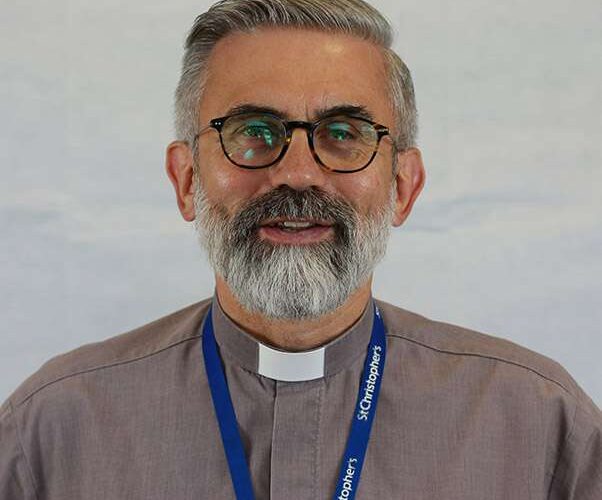
and the progress St Christopher’s hospice has made in addressing inequalities. “The further we develop, the more we see the people we’re not recognising”
Nearly twenty years after becoming St Christopher’s Chaplain, Rev Dr Andrew Goodhead, takes the opportunity this LGBTQ+ History Month, to reflect on his own journey and the progress the hospice has made in addressing inequalities.
It took St Christopher’s chaplain, Rev Dr Andrew Goodhead, fully 20 minutes to realise that he was being offered the role of Chaplain and Spiritual Care Lead when he was called back the day after his interview back in 2004.
Almost two decades on, Andrew says he’s delighted he did eventually twig and didn’t miss the chance to take up the role.
“I think the fact I’ve been here at St Christopher’s for nearly 20 years, tells you what I think of the role and the place. It’s been very interesting and challenging and my colleagues have been amazing.”
When Andrew, who is gay, reflects on his own achievements in the job, and the progress of St Christopher’s and the wider hospice movement in tackling issues of equity and equality, he’s overwhelmingly positive, but stops well short of complacency.

He adds: “The role and the organisation have changed just as society has. But we always need to keep changing and to change more.
“There are undoubtedly inequalities that still need addressing, whether they are around cultural or religious beliefs. And when it comes to gender diversity, there are people who find it difficult to access healthcare and who are therefore not receiving the end of life care they could be because they’re worried about how they will experience it and be treated.”
It’s in the words Andrew uses to describe what being chaplain means, that he truly encapsulates his approach to inclusivity and extending access to end of life to all.
“It’s about meeting people where they are and for who they are. And while we absolutely should recognise difference, we don’t want to be talking about supporting difference as a badge of honour.”
It’s that focus on being with people that drew Andrew to St Christopher’s in the first place, after more than a decade working as a Methodist Minister in a number of locations across England. He recalls feeling bogged down in relentless admin, rather than providing the spiritual and pastoral support that had motivated him to join the ministry in 1987 after a period as Legal Executive in his home city of Plymouth.
“I wanted to leave behind the aspects of being a Methodist Minister which were not fulfilling and come to a place where I knew I could work with people pastorally.
“It’s such a varied job with a massive number of functions. As well as supporting patients and their families there’s a staff support role too.”
Providing training for colleagues around trans diversity is one example of how the hospice is changing and moving forwards, Andrew adds.
Among many high points since joining St Christopher’s in 2005, Andrew picks out a single event and a recurring one.
“Soon after the Same Sex Marriage Act came in in 2013, there was a man in the in-patient unit with his partner and they were talking about having a civil partnership. I suggested they get married. They were surprised they could, but we got the registrar in and made a real event of it. They were so pleased and then when he died, I took the funeral and I was able to talk freely and openly about him.
“Then, I also love the thanksgiving memorial services we do because in a society that says, ‘we don’t want you to grieve’, we bring people together every year and they can come and be sad together. The grief is theirs but they’re not alone. It gives people permission in a gentle way to engage in grief and to step back.”
Any resting on self-satisfied laurels is certainly not something you’ll find Andrew doing. He’s always looking for more ways for the hospice to be more accessible and equitable.
“The further we develop, the more we see the people we’re not recognising or reaching. An example of this would be around hospices’ initial approach to HIV and AIDS. We could have responded more proactively and thoughtfully. I think today we’re probably better on these issues, but we mustn’t give ourselves a pat on the back for caring for someone who is trans or gender diverse. We should be treating them as a patient like everyone else, recognising the need to be more sensitive about pronouns and family relationships.
“Generally, things are moving forward as society becomes more tolerant and I would love to see a time when LGBTQ+ people are not seen as a minority but as part of the whole.”
While he remains fully committed to supporting everyone at the end of life and doing everything he can to make the experience a good one, there is an important skill Andrew has learned – to compartmentalise his work so that when he walks out of the hospice at the end of day he leaves his work behind.
“It’s about meeting people where they are and for who they are. And while we absolutely should recognise difference, we don’t want to be talking about supporting difference as a badge of honour.”
——————————
ehospice is proud to be working in partnership with St Christophers and this article is republished with permission.




Leave a Reply