

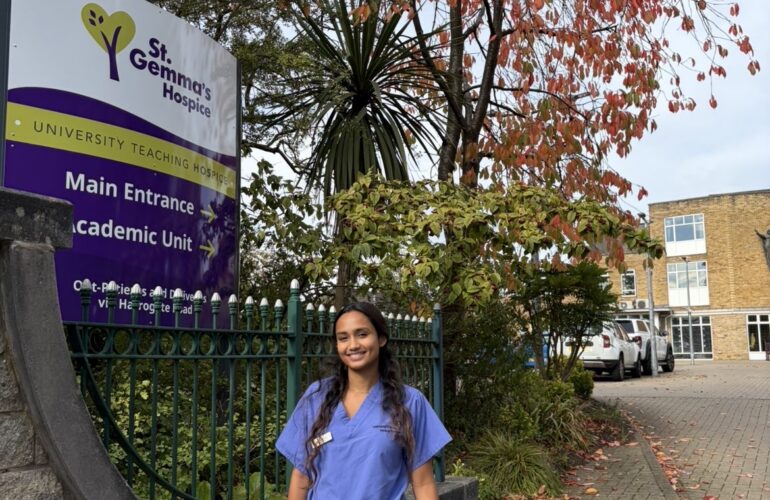
My experience at medical school so far generally followed the patterns of disease presentations, history and examination, investigations, differential diagnoses, and treatment. This is what we are generally taught and applies to many areas and specialties within medicine. There are multiple medications and treatments for each disease and various guidelines to combat illnesses and certain presentations.
I had become accustomed to thinking about medicine in terms of what could be done next for my patients and essentially treat them and improve their quality of life.
My week at St Gemma’s Hospice challenged me to think about medicine in a very different way.
For the first time, I spent an extended period in an environment where the priority was not always to prolong life, but to maintain comfort and dignity for these patients. Initially, this felt very different from the other areas of medicine I had experienced. Over the course of the week, I began to understand that choosing not to pursue further life prolonging treatment does not mean nothing is being done. In many ways the opposite is true.
I saw how much thought and communication went into deciding whether an intervention would benefit a patient. Rather than thinking what treatment can be given next, the focus lied on what will actually help this person now. Sometimes this meant managing pain, breathlessness, nausea or agitation. Sometimes this meant reviewing medications and stopping those which weren’t providing meaningful benefit. At other times, it meant recognising that further investigations or treatment may add burden, rather than improving quality of life.
This was one of the biggest lessons I learnt from my time at the hospice. Medicine is not always about doing everything that is technically possible, it can also be about recognising when further intervention may no longer be in a patient’s best interests.
I was also struck by how openly death was acknowledged in a hospice environment. Coming from placements where death is the outcome to be prevented at all costs, it was interesting to see in a hospice environment it was recognised as a natural part of life. The hospice team were able to focus on what mattered most to each patient. Their comfort, priorities, family and where a patient wished to spend their remaining time.
There was still a huge amount of active clinical care taking place. Symptoms were reviewed carefully, medications prescribed and adjusted, and plans were made to anticipate future problems. The aim was simply different, success was not just known as recovery or prolonged survival, it was a patient experiencing less pain and remaining comfortable in a place where they wanted to spend the last days of their lives.
The care of the hospice was not just limited to the walls of the building, they were able to care for multiple patients all over Leeds. As beds are limited this allows more patients to experience palliative care from the comfort of their own homes. Spending time in the community with the nurses showed how diverse the population of Leeds is and how much of an impact palliative care has on the community as well.
This placement also showed me what holistic care really looks like. Patients were not treated as a diagnosis or a list of symptoms. Their physical problems did matter, however so did their spiritual, psychological and family needs as well. Patients worries were not just limited to pain, they could be losing independence, leaving family behind or an uncertainty to what dying may look like.
Another aspect that stood out greatly to me was the importance placed on families. In many clinical settings, we quite rightly focus on the individual patient, however I saw more clearly that serious illness affects an entire family. Supporting these families remains a fundamental part of care. Towards the end of life, families were given support in ways such as food or being able to stay the night.
The pace of the hospice was also noticeably different from many other clinical environments I have experienced. That does not mean the work was any less demanding, however their seemed to be greater space for conversation. Everyone sat down on a ward round, there was time to listen to patients properly and allow time for silence when necessary. This was particularly powerful for me as a student, as in busy hospital environments it is easy to become focused on completing tasks and moving onto the next patient, but at St Gemma’s I was reminded how important listening is.
Across my placement I learnt Palliative care is not about doing less for patients, it is about recognising what matters most to them and making sure that the care they receive reflects those priorities.
As I continue my medical training, I hope to carry these lessons into every specialty I experience: the extensive holistic care, to be more comfortable discussing death, to remember the impact of illnesses on families and making time to understand what matters to each patient.
It taught me that when medicine can no longer cure, there is still an enormous amount medicine can do.
===============
ehospice is proud to help promote individual, local, national and international voices in Hospice & Palliative Care
We are on target to have over One Million page views this year.
To stay in touch with colleagues and news around the world subscribe to our free Newsletter


Leave a Reply