

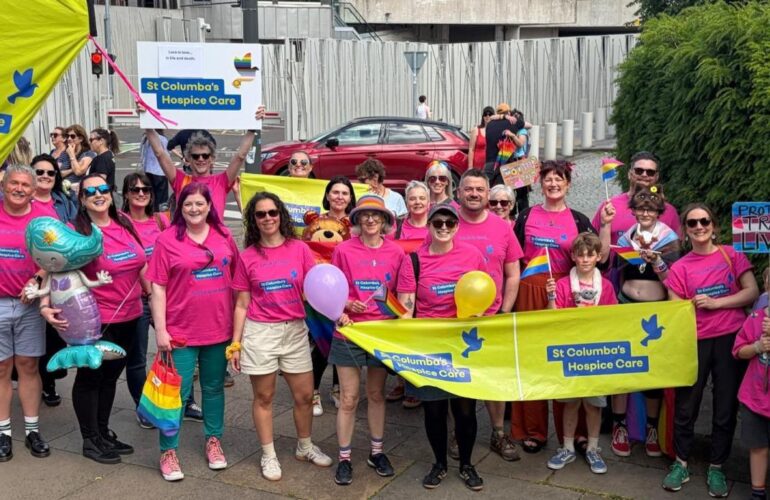
This year, our staff, and the wider Hospice community came together to celebrate Pride, and one of our amazing team put together this article explaining why Pride is so important, and why it’s especially important within care environments.
Every June, St Columba’s Hospice Care is proud to show our support for the LGBTQ+ community. If you’ve visited the Hospice or our shops this month, you might have noticed our flags and information outside the Iona Café, our badges at reception, or the window displays put together by our wonderful shop managers and volunteers.
Visibly celebrating Pride is a way for the Hospice to support and celebrate our LGBTQ+ patients, visitors, staff and volunteers, and to demonstrate our commitment to showing everyone who accesses our services – regardless of identity or background – the same level of compassion and support whilst in our care.
A key part of providing supportive, person-centred care is acknowledging that not everyone is able to access care in exactly the same way, and that certain communities are more likely to have negative experiences in care environments.
Almost a quarter of LGBTQ+ people have witnessed discriminatory behaviour or remarks against LGBTQ+ people from healthcare staff, one in eight have experienced unequal treatment due to being part of the LGBTQ+ community, and one in seven avoid seeking healthcare due to fear of discrimination1.
Research by LGBT Foundation revealed that 40% of trans people who had accessed or tried to access public healthcare services reported having had at least one negative experience because of their gender identity2.
Negative experiences – combined with a long community history of healthcare-related discrimination, including the pathologisation of LGBTQ+ identity itself3, lack of care and intense stigma around HIV and AIDs4, and traumatic practices aiming to “cure” homosexuality and gender dysphoria – can lead to a sense of fear and mistrust around accessing care in general; this has implications for those of us who are involved in providing any kind of care.
Marie Curie and Hospice UK have both published research on how these anxieties might manifest in a palliative care environment specifically5,6. LGBTQ+ patients, families and visitors report:
- Assumptions being made about family structure – e.g. that a partner is a sibling or friend; automatically assuming that someone’s partner is of a certain gender – leading to less sensitive and compassionate care
- Lack of awareness around potential family tensions
- Lack of knowledge around gender-affirming care, and how it might interact with other ongoing treatment
- Being referred to by the wrong name or pronouns, or denied access to gender-affirming clothing and similar
- Concerns about post-death care (e.g. being referred to by the wrong name and pronouns after death; friends, partner or chosen family not being involved in funeral arrangements and/or not being able to publicly grieve)
- Harassment and discriminatory language from staff, volunteers, visitors, or other patients
- Discomfort accessing care due to past adverse experiences
Providing equitable care for everyone means acknowledging that not all communities have historically been able to take their inclusion for granted. As such, when we celebrate Pride at St Columba’s Hospice, it is not only a way for us to show our support for our LGBTQ+ patients, visitors, staff and volunteers; it is also a way for us to demonstrate our awareness that not everyone has always felt included in care environments, and that this history of exclusion may have an ongoing impact on an individual’s ability to access care.
Our Pride celebrations are part of broader, ongoing work around equality and inclusion, including the establishment of our EDI working group and working towards Equality Network’s Scottish LGBTI Rainbow Mark. We are committed to ensuring that everyone receives the very best in compassionate, equitable Hospice care, and our Pride celebrations are a reflection of this commitment; a way for us to demonstrate that everyone truly is welcome here.
——————
Sources
1 https://www.stonewall.org.uk/resources/lgbt-britain-health-2018
2 https://lgbt.foundation/help/hidden-figures-lgbt-health-inequalities-in-the-uk/
4 https://www.nls.uk/collections/stories/society-and-politics/the-evolution-of-hiv-and-aids-awareness/




Leave a Reply