

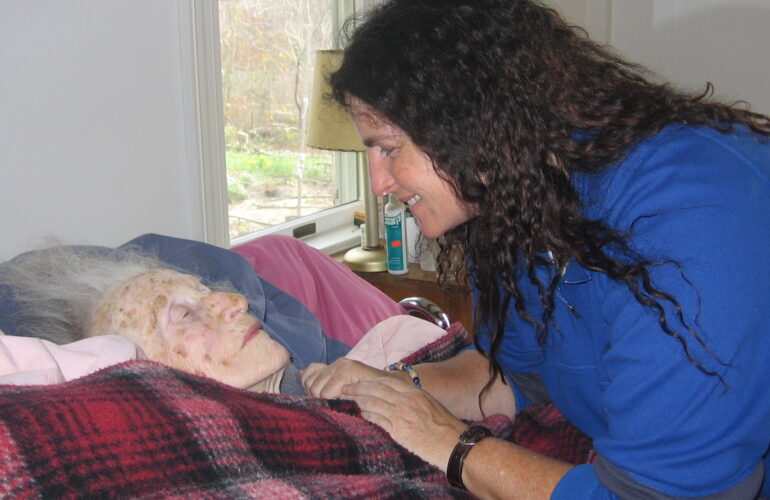
“Do you make a noise when you die?” Such a strange question, coming from my intellectual mother, nicknamed “Bea” and bedridden at 96, determined to stay alive because she believed nothing comes after death.
“I don’t know,” I replied, busy applying lavender lotion to the skin on her forearm. The skin felt like vintage leather, thick, flaking, in urgent need of lubrication.
Five months into our hospice journey, I was still learning what to say and when to say it. Emotion would well up in my chest: indignation, anger, frustration, occasionally even rage. Caregivers shouldn’t feel guilty about these emotions, but it is wise to learn to control them. To do so, whenever I entered my mother’s bedroom, I imagined myself wearing emotion-absorbers. They fit snug over my brain and allowed me to function in the upside-down world created by extreme old age.
Before my decision to leave Europe and move into Bea’s old house on Cape Cod, I had consulted what I’ll call an “elderly-parent-solution” guide. It recommended visiting nursing homes unannounced to form an impression of what life might be like for a loved one. People who follow this advice will probably react as I did. I turned up my nose and not only because the corridors smelled faintly of urine. The idea of my mother ending up in such a place did not compute. For Bea, home care seemed the best alternative since we could not afford assisted living. Still, home care does not work for everyone. A caregiver finds his/her own active years shortened by the burden he/she has assumed now that modern medicine prolongs life. Sometimes my husband Sven and I missed our freedom. Sometimes I simply felt overwhelmed, stymied, limited in what I could achieve besides home care and my profession at the time, innkeeping.
In May 2006, my son’s girlfriend gave birth to a baby. I wanted to fly out to California and meet my granddaughter, but that was impossible. Who would step in and care for Mom? Upon entering the office for another peek at the grandbaby photos, I happened to notice my reflection in the wall mirror. Deep circles ringed my eyes. New worry lines creased my face. My T-shirt was on backwards and my short red hair hadn’t seen a comb in days. Homecare had derailed the stylishness I cultivated so assiduously when I lived in Paris. My husband found me curled up on the daybed, attempting to suppress tears.
“Her mind was crystal clear at breakfast. She described this dream in vivid detail and now she’s like a lump. She just sits there in bed. Inarticulate. Dim-witted. Totally out of it. No trace whatsoever of her exuberant personality.”
“You expect too much from Beatrice,” Sven said. “She’s one very old lady.”
“Enough already.” My voice was ripe with annoyance. “Everyone can escape except me. You’re going on vacation to Sweden in a month. Lisa is spending the weekend with her grandson. And I’ve got to stay here and play nursemaid to my decrepit old mother.”
So, yes. Resentment. It was present too.
We were fortunate to have dedicated hospice helpers. Health aide Lisa Olson and hospice nurse Jane Otis worked for Hospice and Palliative Care of Cape Cod, a company that merged with Hope Hospice shortly before the pandemic. Lisa came Monday through Friday at 10 a.m. and stayed for an hour. Jane showed up every other Thursday. These two wonderful women were instrumental in making my home care experience a success. They were my teachers, my friends, my guides. Without Lisa and Jane, I would have fallen flat on my face.
Once a week Bea would stay awake for two days in a row which meant my own sleep would be seriously impaired. Sleep deprivation does not faze the mothers of newborns. When you are the middle-aged caregiver of an elderly parent, it’s hard not to come unglued at being awakened over and over during the night. The resentment can bubble up and be detrimental if not contained. For me, visiting my flower garden provided solace. Prayer, too, can help.
I’m glad to say it was the positive emotions that dominated. The joy of seeing love in my mother’s eyes or simply sharing a meal at her bedside. I had the conviction that I was doing something right, so I also felt incredible fulfillment.
One evening, we celebrated life together. I had omelet with mushrooms. She had mushrooms with a spoonful of omelet. Bea flashed a proud grin as her shaky hand lifted the stem glass from her tray. We clinked glasses. Despite the lapses into senility and living in the shadow of death, all felt so right. I toasted my mother with champagne and knew it was a moment I would cherish forever.
Toward the end, Bea told me she was worried about a lost purse: “I wish there were some way I could find my handbag. It’s hard for me to accept having lost it because I have the responsibility for it. And I need to pay for this room.”
Relinquishment of responsibility! No one wants to be beholden to others. Since the bedridden depend on caregivers, those caregivers must become illusionists. The Road to Dignity passes through Comfort, Reassurance, and Deception. We made pit stops along the way.
My mother passed on November 29, 2006. I don’t know whether there was a noise when she died. I had stepped out of the bedroom for five minutes to fetch the mail. Upon my return, she was no longer there. I felt relief, but also anguish and grief. As I adjusted to my new orphaned state, I also realized how lucky I had been to have been present at her end of life. It was such a blessing.
————————-
Bio: Alexandra Grabbe is the author of Seeing Joy, A Story of Life, Death, and What Comes Next, out from Koehler Books in March and available online from bookshop.org.

CONNECT WITH THE AUTHOR ONLINE
Official Website: AlexandraGrabbe.com
Facebook: /alexandra.grabbe
Lead photo caption: “Alexandra with her mother in hospice”





I am a hospice nurse and have been for many years. Why do people use a death doula’s instead of hospice. I am interested in becoming a death doula.