

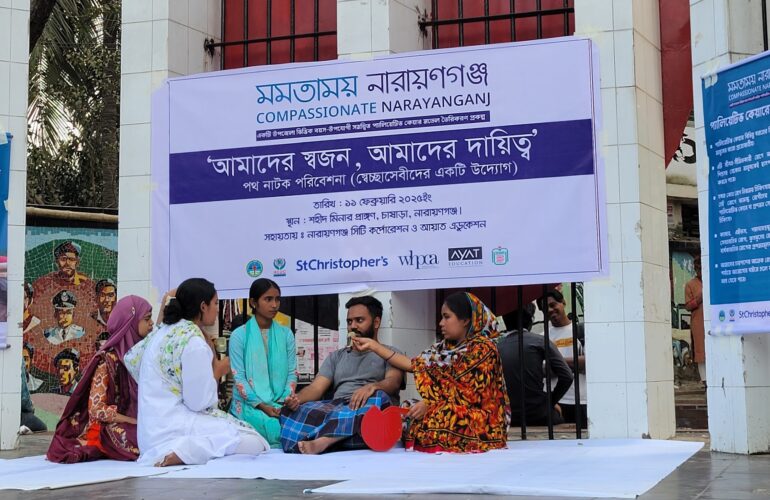
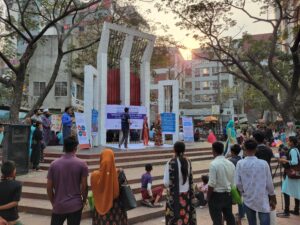
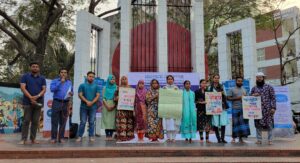
In a compelling attempt to raise awareness about palliative care and its role in ensuring dignity and comfort for terminally ill patients, volunteers from the Compassionate Narayanganj project staged a street drama titled “Our Loved Ones, Our Responsibility” at the Shaheed Minar premises in Chashara, Narayanganj.
Supported by Narayanganj City Corporation and AYAT Education, this initiative sought to educate the community about the necessity of palliative care services and to inspire a collective sense of responsibility toward patients and their families.
Street dramas, as a form of community engagement, have long been an effective medium for social awareness. They bring critical yet often overlooked issues into public spaces, challenging conventional narratives and stimulating discussions. By selecting a bustling location such as Shaheed Minar (A monument honoring linguistic freedom, cultural pride, and sacrifice), the organizers ensured that the message of palliative care reached a diverse audience, making the concept more relatable and less clinical.
A Story of Compassion and Support
The drama unfolded through the poignant story of a mother suffering from cancer. Initially, she underwent prolonged hospital treatment, but as her condition worsened, a doctor advised the family to transition her to home-based palliative care. The family, though committed to her well-being, soon became overwhelmed by the emotional and physical toll of caregiving. This representation resonated with many spectators, as caregiving burdens often fall disproportionately on family members, many of whom lack the necessary support and resources to provide comprehensive care.
The turning point in the narrative came when a neighbor, noticing the family’s distress, introduced them to the Compassionate Narayanganj project. This intervention underscored a crucial reality: communities play a vital role in bridging gaps in healthcare services.
Additionally, the drama wove in the role of faith in caregiving, depicting a religious leader who encouraged the act of service and compassion. This inclusion highlighted the moral and ethical dimensions of caregiving, reinforcing that supporting the ill is not just a medical duty but also a social and spiritual obligation.
The story culminated in a demonstration of palliative care in action. Volunteers from Compassionate Narayanganj stepped in to support the family, offering emotional and medical care. Even after the patient’s passing, the volunteers continued to stand by the grieving family, reinforcing the idea that palliative care extends beyond the patient—it is a holistic approach that supports families in navigating loss and bereavement.
The Power of Community Engagement
The audience response to the drama was profound. Students, local residents, and professionals in attendance engaged deeply with the narrative, recognizing the challenges of caregiving and the urgent need for accessible palliative care services. Many expressed that they had little prior knowledge of palliative care but, through the performance, gained an appreciation for its importance.
By blending education with entertainment, the drama successfully transformed a traditionally sensitive subject into an accessible and thought-provoking conversation. This aligns with the ongoing efforts of Compassionate Narayanganj to use creative methods such as storytelling and performance arts to challenge societal taboos around illness, aging, and death.
The success of this initiative also speaks to the broader need for sustainable models of community-led healthcare. In many countries, particularly those with strained healthcare infrastructures, integrating palliative care into community networks is not just an option—it is a necessity. The involvement of the Narayanganj City Corporation and AYAT Education in this initiative demonstrates the potential of public-private partnerships in driving meaningful change.
A Call for Awareness and Action
At its core, the drama conveyed a simple yet powerful message: palliative care is not just about medical treatment—it is about love, respect, and dignity. It ensures that patients live their last days with comfort and peace while also providing families with the emotional and practical support they need.
The initiative challenges us to reconsider how we view terminal illness and end-of-life care. It calls on policymakers to integrate palliative care into mainstream healthcare systems, ensuring that services are not just available in hospitals but are extended to homes and communities. It also urges individuals to reflect on their roles—whether as family members, neighbors, or community volunteers—in supporting those in need.
As Compassionate Narayanganj continues its mission, initiatives like this street drama serve as a testament to the power of community-driven change. By fostering empathy and awareness, such efforts pave the way for a society where no patient feels abandoned and every family receives the support they need during life’s most challenging moments.
From March 2018 to June 2021, the Department of Palliative Medicine of Bangabandhu Sheikh Mujib Medical University (BSMMU) ran “Compassionate Narayanganj,” a community palliative care initiative in partnership with the Worldwide Hospice Palliative Care Alliance (WHPCA) and Narayanganj City Corporation (NCC). After a 9-month interim period with fundraising, in March 2022, the project received a 3-year grant for the second phase. AYAT Education, a Bangladeshi social enterprise, and St Christopher’s Hospice, one of the UK’s pioneer hospices, have joined as partners. The second phase focuses on developing an integrated age-attuned model of supportive palliative care in Bangladesh and integrating PC into the government’s primary healthcare system.

Mr. Sumit Banik, a dedicated Public Health Activist and Writer, focuses on health system strengthening and public health programs, particularly in palliative care. As Project Coordinator at AYAT Education, he works in the Compassionate Narayanganj initiatives in Bangladesh. Starting his public health career at icddr,b in 2009, Sumit has extensive field experience within Bangladesh’s healthcare landscape. Advocating for increased government healthcare funding, stronger rural facilities, and equitable healthcare access, Sumit advocates for a visionary and dynamic policy approach to achieve sustainable and impactful improvements in public health.


Leave a Reply