

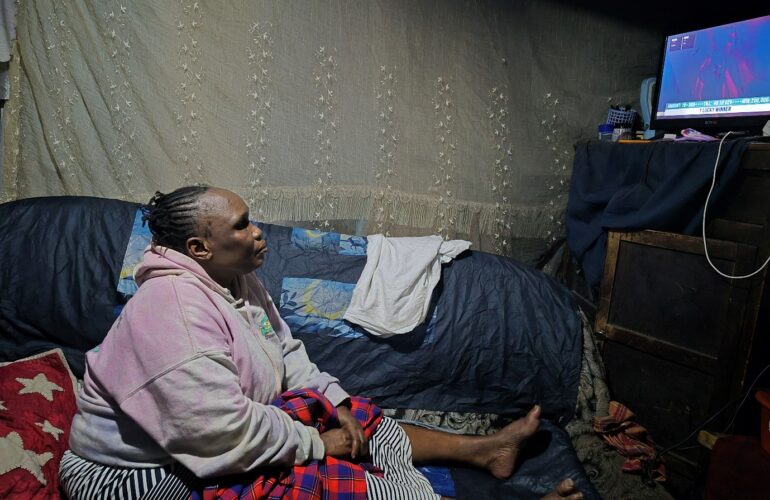
When the KICOSHEP team arrived at Mary’s home in Kibera, she turned down the television.
It had been playing in the corner of the small room, one of the few ways she could stay connected to a world she could no longer easily enter. But as the nurses and counsellor settled into conversation with her, the television became less important.
Mary was chatty and quick to laugh, moving easily between conversations with the team.
For a while, she had something that a television could not give her: people to talk to.
Outside, clouds were gathering over Nairobi and the light entering through the doorway was beginning to disappear. Rain was coming. Inside, the KICOSHEP team had resolved to stay with her through it.
It was an ordinary home visit, but it captured something important about what palliative care can make possible.
Sometimes care begins with pain relief or treatment for physical symptoms. Sometimes it begins with a conversation, advice for a caregiver or simply having someone willing to sit with a patient.
And sometimes it begins with bringing care to someone who cannot easily make their way to it.
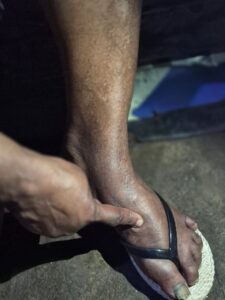
Mary lives with HIV and is confined largely to her home. Her lower body is paralysed, she has lost sight in one eye and she depends on her 20-year-old son for care. She longs for sunshine. She longs to go to church. Both have become difficult to reach.
For her, the distance between home and healthcare is shaped by disability, dependence, poverty, mobility and the practical difficulty of moving through a crowded city when her body no longer allows her to move independently. A health facility can exist, but its existence does not automatically make it accessible.
When the KICOSHEP nurses and counsellor visited Mary, they were able to see not only her medical needs but the circumstances in which she was living. They could engage her son, understand the realities surrounding her care and provide support within the environment where her illness was being experienced every day.
Just as importantly, they could sit with her.
For Mary, the longing to attend church again is not simply about travelling to a building on Sunday. It is about returning to a part of community life that illness has taken from her. Her longing for sunshine is similarly ordinary and profound: a desire to experience something most people barely notice.
Her television helps bridge some of that separation. It gives her a view of the world she cannot easily enter.
Taking care beyond the facility
Mary’s experience reflects a wider challenge for community-based palliative care: how do you reach people who are least able to reach care?
 Through a small grant from the True Colours Trust (TCT) and the African Palliative Care Association (APCA), KICOSHEP implemented a project in Kisumu East Constituency between July 2022 and July 2023, targeting people living with HIV and patients with life-limiting illnesses.
The project enrolled 208 patients and provided palliative care and psychosocial support. Clinicians visited all 208 households, while 118 home and community visits were conducted as part of follow-up and care. KICOSHEP also mentored 30 family caregivers in pain management, referrals, counselling, case history taking and other aspects of palliative care.
The grant supported five palliative-care support groups for children and adults, creating spaces where patients and families could receive information and share experiences around issues including adherence, pain management, nutrition, malaria prevention, sexually transmitted infections and positive living.
Through partnerships with Miwani Health Centre and Kisumu County Referral Hospital, patients were linked to antiretroviral therapy, pain-relieving medicines, chemotherapy, surgery and other forms of treatment. Another partnership helped secure one year of National Hospital Insurance premiums for palliative-care patients, reducing some of the financial pressure on their families.
The figures show the reach of the project, but they become more meaningful when translated back into people’s lives.
Two hundred and eight households visited means clinicians entering homes where illness is being lived rather than waiting for patients to overcome the barriers between those homes and a health facility.
Thirty caregivers mentored means people gaining practical skills to support relatives when symptoms become difficult to manage.
The project also revealed something important about what palliative care involves.
Of the 208 patients enrolled, 109 received non-opioid pain relievers and five were placed on opioids because of severe HIV-related conditions and cancer. The remaining 94 patients had mild or manageable pain and did not require pharmacological intervention. Their needs were instead addressed through other forms of care, including counselling, psychosocial support and follow-up.
That distinction matters because palliative care is not simply about controlling pain at the end of life. It is about responding to the wider consequences of serious illness, supporting caregivers, connecting patients to treatment and helping people maintain as much comfort, dignity and participation in life as their circumstances allow.
The form of care may differ from one patient to another, but the underlying principle is simple: care has to be reachable to be useful.
What remains when the grant ends?
KICOSHEP’s Kisumu project formally ran from July 2022 to July 2023. Yet when we visited Mary in Kibera, the organisation was still sending nurses and a counsellor into people’s homes, providing community-based support and reaching patients who might otherwise struggle to access care.
That matters because serious illness does not follow grant cycles.
Pain does not wait for a funding agreement to be renewed. A family caregiver does not stop needing support because a project has reached its reporting deadline.
For patients living with conditions that may require prolonged care, continuity is part of the care itself.
This is also where the longer-term value of a small grant can become difficult to capture in a conventional project report.
 A grant has a beginning and an end. The knowledge, relationships and experience developed through the work can continue.
Caregivers can retain the skills they have learned. Community health workers can continue recognising patients who need support. Referral relationships with health facilities can remain useful. An organisation can carry forward the experience of learning how to reach people who might otherwise remain outside the health system.
The legacy of a small grant, therefore, may extend beyond the activities completed during the grant period. It can include the capacity and connections left behind.
Across the wider APCA small-grants programme, the scale of the need is immense. APCA estimates that 17.5 million people need palliative care every year in Africa, with approximately 70 percent of that need associated with HIV/AIDS. Since 2009, the programme has awarded 305 grants to institutions in 29 African countries from 2,135 applications received from organisations in 39 countries. Supported services have reached more than 32,000 adults and 2,700 children.
These figures provide the scale.
Mary’s room provides the human consequence.
Her circumstances cannot be solved by a home visit. KICOSHEP’s nurses cannot remove her paralysis or restore the sight in her eye. They cannot guarantee that she will return to church or change everything that poverty and serious illness have taken from her family.
What they can do is respond to the part of the problem that is within their reach.
They can come to her.
When the clouds thickened over Nairobi that afternoon, the room where Mary sat grew dim. The television continued playing softly in the corner, but she remained engaged with the KICOSHEP team.
She laughed. She talked. She listened.
Her circumstances had not changed during that visit. The paralysis remained. The church she longs to return to was still beyond the doorway, and the sunshine she misses would still have to wait.
But for a while, she was not facing those things alone. The KICOSHEP team was there with her.


great work