

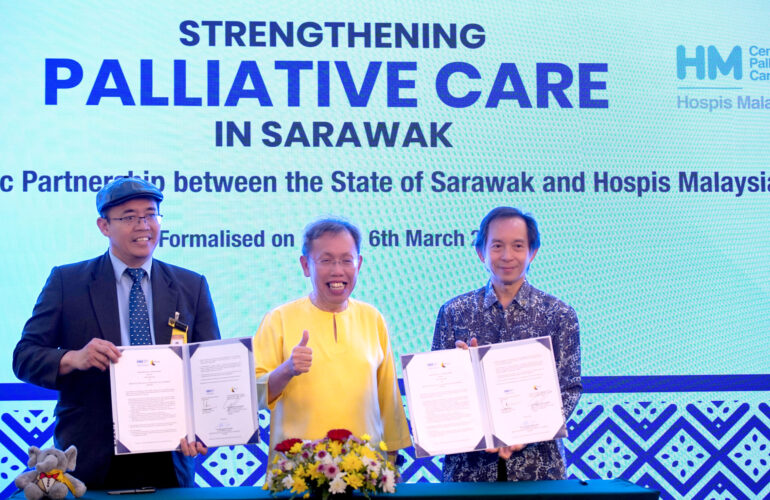
As Malaysia faces a growing need for palliative care, partnerships to build capacity are becoming increasingly important to improve access, so as to ensure patients and families receive the support they need. A recent collaboration between Sarawak and Hospis Malaysia marks a significant step towards strengthening services and building capacity across the state.
The partnership was formalised on 6th March 2026 with the signing of a Memorandum of Understanding (MoU) between the Ministry of Public Health, Housing and Local Government Sarawak and Hospis Malaysia at the Sarawak Club in Kuching. The agreement comes in response to the needs of an ageing population and the growing burden of non-communicable diseases across the nation, and in Sarawak, where the need is even more pressing.
With more than three decades of experience in community-based palliative care, education, and advocacy, Hospis Malaysia has long worked to strategically develop services through partnerships with other healthcare services, government agencies and local providers.
“This partnership represents a meaningful step towards ensuring more Malaysians — particularly in Sarawak — can access and benefit from palliative care,” said Dr Ednin Hamzah, Chief Executive Officer of Hospis Malaysia. “By sharing expertise, strengthening training and supporting system development, we hope to build sustainable services that truly meet the needs of patients and families.”
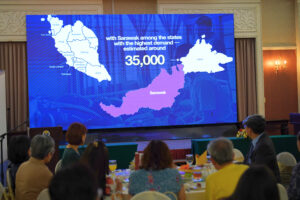
Sarawak is among the states expected to face particularly high demand in the coming years. By 2030, national demand for palliative care is expected to exceed 200,000 people, with Sarawak alone estimated to have around 35,000 individuals requiring such care.
Speaking at the ceremony, YB Datuk Amar Prof. Dr Sim Kui Hian, Deputy Premier of Sarawak and witness of the MoU signing, highlighted the state’s commitment to advance palliative care. “Sarawak recognises the growing need for palliative care and remains committed to strengthening services statewide. Collaborating with Hospis Malaysia enables us to accelerate capacity-building, enhance professional expertise, and ensure patients and families receive dignified, compassionate care,” he said.
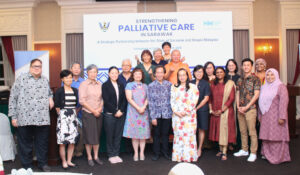
The MoU was signed by YBrs. Desmond Douglas Jerukan, Deputy Permanent Secretary of the Ministry of Public Health, Housing and Local Government Sarawak, and Dr Ednin Hamzah. The ceremony was attended by representatives from the Sarawak Health Department, hospitals and clinics, medical institutions, non-governmental organisations and social organisations.
At the heart of the collaboration is a shared focus on building local capacity and strengthening the integration of palliative care in the healthcare system. Key areas of cooperation include professional training and education through workshops and clinical attachment programmes, knowledge exchange, and research driven programmes to measure outcomes, all with the aim of supporting the development of palliative care services across the state. The MoU will remain valid for five years, providing a framework for collaboration, shared learning and long-term development.
For Hospis Malaysia, the collaboration reflects a broader commitment to ensuring that palliative care becomes an integral part of the healthcare system across the country. By working alongside government partners, healthcare providers and community organisations, the goal is not only to expand services, but also to build a sustainable ecosystem where patients with serious illnesses — and their families — can receive compassionate, holistic care wherever they are.
Learning and Sharing Across Teams for Better Palliative Care
Alongside the MoU signing, Hospis Malaysia’s clinical team visited Sarawak General Hospital (SGH) to learn more about its palliative care services. The team toured the palliative care ward and exchanged insights with the SGH team on practices in pharmacy, physiotherapy and nursing. The visit highlighted the importance of multidisciplinary collaboration in supporting patients and families across care settings.
Learning Beyond the Hospital: Sarawak Doctors Attach with Hospis Malaysia
Sometimes, the most meaningful lessons in medicine happen outside the hospital.
For two doctors from Sarawak, stepping into patients’ homes with the Hospis Malaysia (HM) team offered a new way of understanding care — one that goes beyond clinical treatment to include family dynamics, daily realities and the deeply human side of serious illness.
Their visit is part of the Memorandum of Understanding (MoU) between the Ministry of Public Health, Housing and Local Government Sarawak and Hospis Malaysia, which aims to strengthen palliative care capacity through training, knowledge exchange and shared learning. The first two doctors to take part in the initiative are Dr Charles Chun, a physician from Bintulu Hospital, and Dr Aiman Zawani Salleh, a palliative care doctor from Sarawak General Hospital.
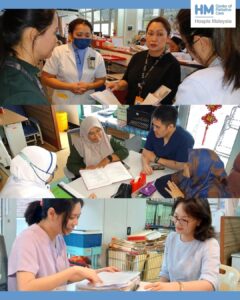
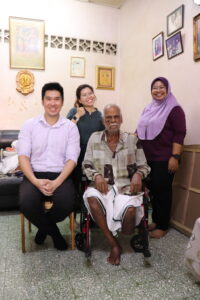 Dr Charles (left) during a home visit with Hospis Malaysia’s Nurse Nadiah and Dr Shin Yi.
For Dr Charles, the attachment offered a meaningful opportunity to see how palliative care unfolds in the community. Through home visits with the Hospis Malaysia team, he observed how symptom management, care planning and emotional support can take place within the patient’s own environment.
“I strongly encourage my peers to consider an attachment with Hospis Malaysia, as it offers another lens of perspective to patient care that we are not usually exposed to, allowing us to develop goal-concordant care plans for our patients.”
The experience reinforced for him that palliative care is not confined to a single medical discipline, but rather a way of approaching care — one that places patients and families at the centre. Reflecting on the collaboration, Dr Charles also emphasised the importance of building confidence and capacity within the community.
“The collaboration between Sarawak state and Hospis Malaysia provides structured training and opportunities to share skills. It is very much a two-way learning process where we add value to each other. What we learn will need to be adapted and localised to our community.”
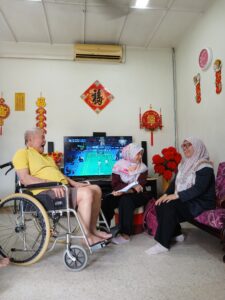 Dr Aiman (middle) consulting a patient, together with Hospis Malaysia’s Nurse Mastura.
For Dr Aiman, the attachment allowed her to see another dimension of patients’ lives — one that is often hidden in clinical environments.
“My attachment with Hospis Malaysia has been an exciting experience because it takes place in the community setting. I meet patients in a very different context from the hospital, and it allows me to connect with them more deeply and understand another side of their personhood in their own environment. Coming from a hospital background, it has made me think more about what happens after patients are discharged and return home, and how we can provide more integrated care that truly supports their quality of life.”
For both doctors, the attachment highlighted the importance of strengthening the link between hospital and community care — particularly in a geographically large state like Sarawak, where expanding palliative care services remains an important priority.
Through initiatives like these clinical attachments, Hospis Malaysia continues to advance its Education and Training pillar, equipping healthcare professionals with the knowledge, skills and confidence needed to support patients and families facing serious illness.
————————
This article was published in the Hospis Malaysia newsletter and is republished here with permission.
ehospice is proud to help promote individual, local, national and international voices in Hospice & Palliative Care
We are on target to have over One Million page views this year.
To stay in touch with colleagues and news around the world subscribe to our free Newsletter


Leave a Reply