

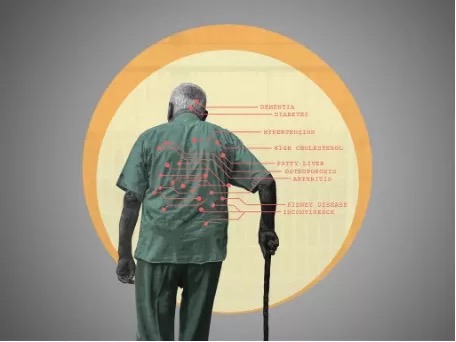
by Barry R. Ashpole: THE LITERATURE ON ADVANCE CARE PLANNING IN CORRECTIONAL SERVICES is sparse, focussed for the most part on the U.S. experience; for example, prison inmates in the U.S. have little say over the care they receive at the end of their lives. (1)
That’s despite a broad consensus among standards boards, policymakers, and healthcare providers that terminally ill people in prisons should receive treatment that minimizes suffering and allows them to be actively involved in care planning. But such guidelines aren’t binding. State policies on end-of-life care vary widely, and they generally give much leeway to correctional officers. (2)
Incarcerated people lose many of their rights, and international law does not necessarily protect a person’s right to choose a particular medical treatment. According to standards set by the U.S. National Commission on Correctional Health Care, however, incarcerated people have the right to end-of-life care decisions, including whether to receive measures to prolong life. (3)
Autonomy in medical decision-making is essential at end of life, though often sits in contradiction to priorities or policies in correctional settings.
A Canadian perspective mirrors the situation in the U.S., but also in many other countries. Prison inmates experience significantly poorer health than the broader population. While incarcerated individuals are legally entitled to healthcare, the reality is often inferior treatment with rampant systemic concerns. From limited access to treatment options to correctional staff involvement in medical encounters, incarcerated patients face unique constraints to their autonomy.
Most troubling is the role of correctional officers, who frequently and inappropriately become involved in healthcare decision-making, despite lacking any legal authority to do so. (4)
A critical issue regarding advance care planning within the prison environment concerns the appointment of a substitute decision maker in the event that the patient has lost the capacity to communicate. As established, prison inmates are less likely to be offered or participate in advance care planning or to document their treatment preferences, and therefore might not have a surrogate if one is needed.
An internal medicine physician with a special interest in correctional healthcare at Massachusetts General Hospital in Boston has taken a close look at medical decision-making for patients who are incarcerated and unrepresented and considers the many advantages and disadvantages of different classes of decision-makers for them. He points out a potentially appealing option for unrepresented patients who are incarcerated is for a member of the prison “family” – that is, a close friend who is also incarcerated – to serve as surrogate.
People who are incarcerated serve health-related roles in some facilities – as prison hospice volunteers, for example – and can develop an intimate relationship with others who are incarcerated and nearing the end of life. Many states’ surrogate decision-making statues allow, in specified circumstances, a friend to serve as a decision maker, which can be helpful and humane consideration. (5)
Rarely discussed in correctional healthcare is the issue of do-not-resuscitate decisions. This was recently the focus of a report in an Irish newspaper. The Irish Prison Service had been told to ensure that do-not- resuscitate decisions for prisoners reflect “the free and informed consent” of the persons involved following the death of an inmate at a Dublin prison. The instruction came from the Office of the Inspector of Prisons after an investigation into the circumstances surrounding the death of a 63-year-old inmate. The Inspector of Prisons recommended that prison staff should “take active steps” to verify that any prisoner returning from hospital with such a decision had given “free and informed consent” to that decision, and that all information relating to the issue “should be fully documented” within the prison healthcare medical system.6
The controversial issue of medical assistance in dying or voluntary assisted death for prison inmates is gaining considerable traction in the literature, but also in the lay press. In corrections, the guiding principle for healthcare is the principle of equivalence of care, meaning healthcare offered to prison inmates should be equivalent to that received by individuals in the community. Following this principle would entail making medical assistance in dying or voluntary assisted death available to prisoners. (7)
Recent research indicates that many prison inmates were supportive of medical assistance in dying or voluntary assisted death, some seeing it as an option for people serving life sentences who might want to end their life rather than complete a life sentence. (8)
Patient autonomy is highly prized in today’s society, yet is neglected, overlooked or ignored when it comes to the rights of one of society’s most marginalized, vulnerable communities.
The individual rights of prison inmates, particularly when approaching end of life, are no less deserving than the population-at-large. Personal autonomy, freewill and consent, however, simply do not thrive in the prison environment.
References:
- Rayasam, R. ‘Prisons routinely ignore guidelines on dying inmates’ end-of-life choices,’ KFF Health News (May 2025). https://bit.ly/4jnlN0t
- Helmly, V., Garica, M., Williams BA., et al. ‘A review and content analysis of U.S. Department of Corrections end-of-life decision making policies,’ International Journal of Prison Health, 2021;18(2):165-175. https://bit.ly/3R7gkPD
- ‘Care for Aging Patients in the Correctional Setting,’ National Commission on Correctional Health Care (2024) https://bit.ly/3VF9DpN
- Raabis, A. ‘Rethinking autonomy in healthcare for incarcerated patients,’ Memorial University Centre for Bioethics (April 2025) https://bit.ly/3YFlPcf
- Tobey, M., Simon, L. ‘Who should make decisions for unrepresented patients who are incarcer- ated? American Medical Association Journal of Ethics, 2019;21(7):617-624. https://bit.ly/4eGGV0U
- Brennan, C. ‘Prison service told to ensure do not resuscitate decisions reflect “consent” of prison- ers,’ Irish Examiner (March 2025). https://bit.ly/3Fpzrl3
- Gacek, J., Jochelson, R., Trask, B., et al. ‘Morbid matters: Medical assistance in dying in federal corrections,’ Manitoba Law Journal, 2025;47(4):143-180. https://bit.ly/4fnDNr7
- Shaw, J., Driftmier, P. “Dying with a smile, just knowing that somebody’s listened to me”: End-of- life care and medical assistance in dying in Canadian prisons,’ Omega – Journal of Death and Dying, 2024;88(4):1290-1313. https://bit.ly/4i6vLD8
Additional Recommended Reading
O’Conner-Von, S., Shlafer, R., Berry P. ‘A survey of state correctional healthcare providers on advance care planning: Opportunity for collaboration with corrections,’ American Journal of Hospice & Palliative Medicine, 2025;41(9):1051-1057 (U.S.). https://bit.ly/44ZCNWC
Comer, A. ‘Addressing the ethical and legal complexities of hospital visitation restrictions for patients who are incarcerated,’ Journal of Hospital Medicine (March 2025) https://bit.ly/4iIcsA2
Santiago, TA., Stout, J., Lapid, MI., et al. ’Medical decision making in correctional facilities: Highlighting gaps and advocating for policy change,’ Community Mental Health Journal (July 2024) https://bit.ly/4c79H83
Kitt-Lewis, E., Zheng, N., Loeb, SJ. ‘Advance care planning: Perspectives of people living in prison,’ Jour- nal of Hospice & Palliative Nursing, 2024;26(4):E115-E123. https://bit.ly/3UF5liM
_________________________
Lead photo: Source: Teresa Tauchi, Prison Journalism Project: https://bit.ly/3Jp29Vj
BARRY R. ASHPOLE is an educator and communications consultant living in Ontario, Canada. Now semi-retired, he has been involved in palliative and end-of-life care since 1985. He established the End of-Life Care Behind Bars website (https://bit.ly/4dU4qmi), an advocacy, teaching and research “tool” to inform and, hopefully, affect a seismic shift in society’s attitudes towards the health and well-being of the incarcerated. Regular postings include annotated listings of current articles, reports, and so on, culled from the professional literature, the news media and other sources.
Republish This Article
The author believes in the free flow of information. Republish this article for free, online or in print, under Creative Commons licence, with due credit to the author and source. https://bit.ly/3B9EK6n



Leave a Reply