

Palliative care started out as a revolution – breaking away from established norms to champion the rights of the most vulnerable people in society. As a palliative care doctor, I hope my community will now rekindle this original, radical spirit to find new ways to care for marginalised people who remain under-served in current palliative care practice.
My Churchill Fellowship report, Palliative and End-of-Life Care at the Deep End, calls for radical change by integrating trauma-informed, social justice, and inclusive approaches into palliative and end-of-life care.
Until the mid-20th century, dying people were largely neglected by society. In response, the modern hospice movement was born, aiming to prevent and relieve suffering at the end-of-life, promote dignity and agency, and allow the dying person to stay connected to their community. Over time, this led to the development of palliative care – care encompassing the values of the hospice movement, delivered in any setting, including hospitals, hospices, and the community. Although the goals of palliative care are now widely endorsed, at the time of its emergence it was revolutionary, placing compassion and autonomy at the centre of care for those most often ignored.
Today, however, the people who are most likely to receive palliative care when they need it are the most privileged in society. In contrast, the most disadvantaged people – including racialised minorities, homeless people, and people in prison – frequently lack access to high-quality palliative care.
There are major barriers for marginalised people receiving the care they need. For example, for homeless people, there can be lack of available care spaces, and no recognition by others of when a homeless person may be dying. For people in prison, barriers may include lack of care training for prison staff and inconsistent access to specialist support. Furthermore, trauma is extremely common among marginalised people and is often a significant barrier to care, reducing an individual’s health-seeking behaviour and ability to trust healthcare professionals.
“I hope my report will spark reflection, conversation, and new action so that… we can build a system where everyone can get the palliative and end-of-life care they need.”
Although palliative care is said to be available to all, these issues tell us the reality for marginalised people is very different: palliative care has an inequity problem. Through my own practice as a UK palliative care physician, I have been frustrated at times when I have seen our current systems failing people who fall outside of mainstream society. This motivated me to devise my Churchill Fellowship research, exploring how UK palliative care can achieve greater equity and inclusivity for marginalised patients.
I had the privilege of spending six weeks learning from centres of care for marginalised people in the USA and Canada. Meeting practitioners and visiting services first-hand showed me that care can be adapted to overcome the barriers faced by excluded groups. I also learned how important it is for inclusive care to be trauma-informed – to integrate knowledge about trauma into procedures and practices.
Trauma-informed approaches involve moving from asking ‘What is wrong with you?’ to ‘What happened to you?’
Through my findings, I developed ten recommendations for inclusive approaches to palliative care and end-of-life care in the UK, which are presented in my report. Although there is no one-size-fits-all approach, these recommendations suggest ways to integrate trauma-informed, social justice, and inclusive approaches into everyday practice. The report encourages cross-collaboration between all those involved in supporting the rights and welfare of marginalised people – across healthcare, prisons, homelessness, and the charity sector – and those providing palliative and end-of-life care.
The report outlines key principles for improving access to and quality of care for marginalised people, including explaining the need to:
- pro-actively initiate contact with marginalised patients rather than await external referrals, e.g. through outreach work in shelters, on the street, or in prisons
- involve marginalised people as peer workers and co-designers in new models of care
- recognise the importance of housing as healthcare
- improve communication and referral processes across sectors
- undertake cultural change within organisations to reduce power disparities
I am aware some of the recommendations in my report challenge established ways of working in the UK. However, given the huge – and growing – unmet palliative care needs of marginalised people, I believe we must do better. I hope my report will spark reflection, conversation, and new action so that, inspired by the revolutionary spirit of palliative care, we can build a system where everyone can get the palliative and end-of-life care they need.
——————-
Author: Shaun Peter Qureshi
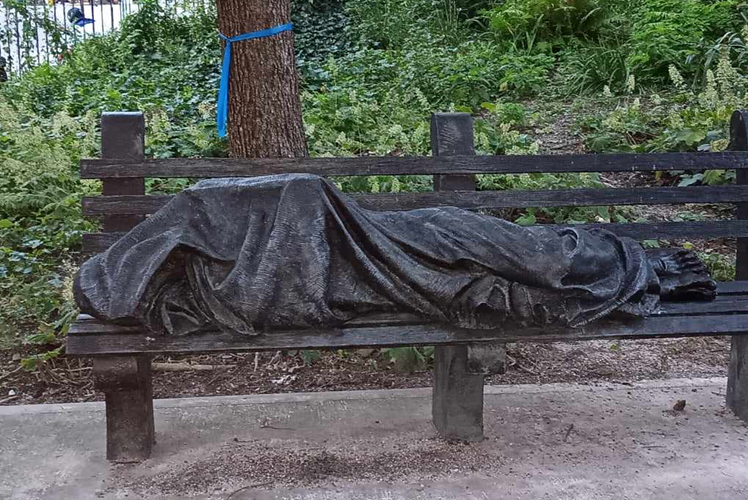
Lead Photo: Homeless Jesus, a sculpture by Timothy P. Schmalz, outside the Cathedral of St John the Divine, Amsterdam Avenue, New York City, USA
DISCLAIMER
The views and opinions expressed by any Fellow are those of the Fellow and not of the Churchill Fellowship or its partners, which have no responsibility or liability for any part of them.
—————-
This article was first published on the Churchill Fellowship website and is republished here with permission of the Churchill Fellowship and the author.




It’s so vital to remember palliative care’s radical roots. I’m particularly struck by the call to rekindle that spirit to address the needs of those currently left behind. What specific systemic barriers do you see as the most urgent to dismantle to achieve this renewed focus on the marginalized?