

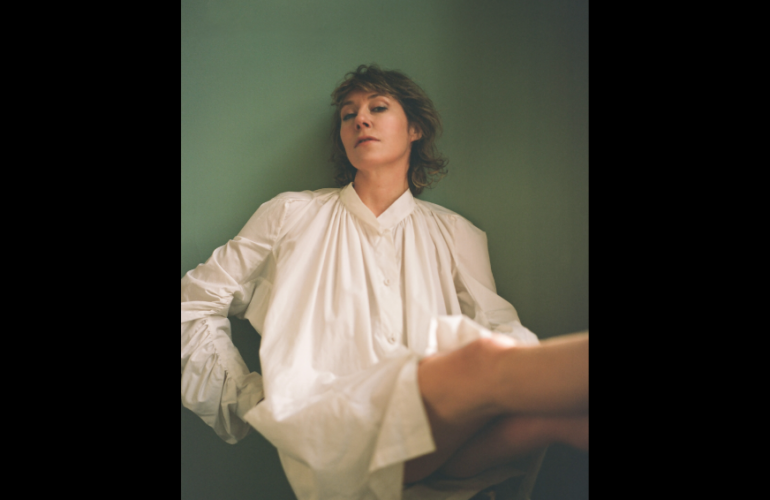
Elle Flanders | 8 Sep 2026 – Martha Wainwright has spent her life inside songs: writing them, singing them, inheriting them, and carrying them across stages around the world. At this fall’s Kappy Lecture, she will take the stage in the language she knows best: song. Her performance will open a space where love and loss, birth and death, memory and inheritance can be heard not as abstract subjects, but as experiences carried in the human voice.
The Kappy Lectures was created to deepen public conversation about palliative care, illness, caregiving, and what it means to live fully until the end. For Wainwright, that conversation is not theoretical. Music has accompanied her through the most intense passages of her life, including the death of her mother, the singer Kate McGarrigle, and the birth of her son. Coming from a folk tradition, she sees the songwriter as a kind of troubadour: a teller of people’s stories. And those stories, she says, cannot leave death out.
Elle Flanders (EF): You’re in such an active period right now: writing songs, thinking about touring, raising children. How does this moment feel to you creatively?
Martha Wainwright (MW): I’m trying to write songs, which at 50 is harder than it was at 25. I’m also distracted by basketball practices, high school applications, exams, and all
the things that come with being a parent. Raising kids at the same time as having a music career does pull away from the potential of a bigger music career. But the music is also how I support my family. Those things are completely intertwined.
EF: This invitation for the event on October 6th also had a personal dimension for me, because The Kappy Lectures grew out of my mother’s work in palliative care. You’ve written and spoken so powerfully about your own mother, Kate McGarrigle, and the way her life and death shaped you. Did that connection between mothers, legacy, and music affect your decision to say yes?
MW: I was interested in talking to you more. That was the main reason. But also, the deaths I’ve experienced in my life have been some of the most changing moments of my life. My grandmother, other relatives, my mother’s illness and death, all these things shifted me greatly. They made me who I am. They make me think about my own mortality, of course, but death is also one of the most life-defining things.
EF: In your memoir, you write about grief, family, and the complicated relationships between mothers and daughters. How did those experiences begin to enter your songwriting?
MW: My mother died about 15 or 16 years ago, and at the time it was shocking. I was also thrown into needing to work more. I wrote songs about her and about her death on the album Come Home to Mama, and there was the song “Proserpina,” which is essentially about death. But now, all these years later, I feel it even more. My songwriting is becoming less about love or my great life and more about death, or what’s coming. It has gestated. It has changed the subject of my songs.
EF: Your mother died in 2010, not long after your son was born prematurely. That is such an extraordinary convergence: birth and death arriving together. How did that affect you?
MW: When my mother died, I also had this new child who needed a lot of care. In a way, thank God, because I didn’t have to focus only on my mother’s death at 63 or only on my son’s prematurity and what that could mean for him. I had to do both. It was all jumbled together. It was incredibly difficult, but there was also something about having this new life there that kept me going.
EF: Was music a refuge then?
MW: Singing was. My brother Rufus and I did tribute concerts of our mother’s songs, so I was singing her music. It was about her death, but it was also a way to be with her. I’ve been singing for so long that it’s a place I can go. It’s physical. It’s emotional. It’s a way of moving through something when you can’t necessarily explain it.
EF: Has your relationship to your own voice changed as you’ve gotten older?
MW: Definitely. As a singer, your instrument is your body. You have to take care of it. If you don’t take care of your body, it’s not just the end of your musical career or your ability to sing. It’s also connected to aging, to mortality. I don’t think about it all the time, but it’s there. The voice changes. The body changes. You have to listen to that.
EF: You’ve spoken about the way death is hidden in contemporary life, even though it’s everywhere. What do you think we’re missing by not talking about it more openly?
MW: Death is everything, but we don’t talk about it. We’re obsessed with youth and strength and keeping going. Earlier generations had more rituals around death. They had religion, or family structures, or ways of being around older people and dying people. I’m not saying we should all go back to church, but I do think we’ve lost some language for it.
EF: Music has accompanied people through birth, love, heartbreak, and death for centuries. What do you hope your songs can offer people gathered to think about mortality and caregiving?
MW: The role of the songwriter, the troubadour, the folk artist, is to tell the story of the people. Death is part of that story. Music can carry it. Artists should address it more, because it would help tremendously. We can’t take death out of the story.
EF: When you perform at The Kappy Lectures, what do you hope music can do in the room that conversation alone cannot?
MW: I hope it opens people up. I hope it gives them a chance to feel connected. That’s what music does at its best. It reminds us that these experiences are shared. We’re all going through them, even if we don’t always know how to talk about them.
Wainwright’s appearance at The Kappy Lectures will be an evening of song as much as conversation. With discussant Andrea Creech also helping frame the role of music in aging, connection, and well-being, the event brings together performance and reflection. This is a chance to hear an artist whose voice has carried love, loss, family, rage, tenderness, and inheritance.
If death is part of the story, Wainwright reminds us, then music is one of the ways we learn how to tell it. Not as an ending only, but as part of the long human song.
——————
For more information about the McGill Council on Palliative Care and the Martha Wainwright concert on October 6th, please visit the Council website. Purchase your tickets here.
Image by Gaëlle Leroyer.


Leave a Reply