

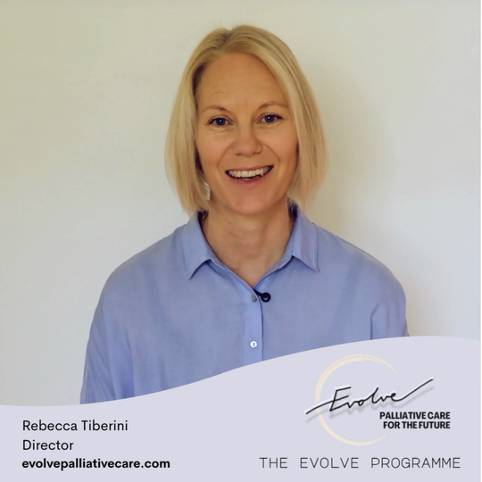
The EVOLVE Programme is a practice transformation initiative developed by Rebecca Tiberini, international thought leader in Rehabilitative Palliative Care, to implement interdisciplinary solutions that both enable people to live as fully as possible until they die and help future-proof palliative care provision.
It offers a fresh vision for evolved palliative care that is fit to respond to the challenges of an aging population, workforce and funding issues, whilst upholding and championing person-centred support.
The EVOLVE Programme empowers professionals and organisations to implement real change across the palliative care system; in their own palliative care practice, within their team, across their organisation and between their partner services.

The Challenges Facing Palliative Care Now and in the Future
We know the challenges facing palliative care well. Palliative care services internationally are responding to sustained growth in demand associated with population ageing, multi-morbidity, frailty, advanced illness and increasingly complex care needs.
The lived experience for older people approaching the end of life is frequently characterised by increasing periods of disability, with functional dependence and escalating care needs preceding death (Murray et al 2024).
Despite this, research tells us that peoples’ priorities are to live a normal life, participating in meaningful activities and relationships and maintaining autonomy for as long as possible (Sandsdalen et al 2015).
Hospices, palliative care services, hospitals, geriatric services and care homes are already feeling the pressure of an increased demand on their services. Grappling with the challenges related to funding and staffing, they face tensions between responding to these growing needs and ensuring person-centred palliative care. We know palliative care provision needs to evolve to meet the challenges, but what does this look like and how do we make it happen in real-world practice?

Function-orientated Care to Support Peoples’ Goals and Priorities at the End of Life
As illness trajectories lengthen, care systems must evolve to support peoples’ goals, with a dual focus on optimising a person’s function over time and enabling them to adapt to deterioration, rather than treating advanced illness as a series of discrete clinical episodes, heavily directed toward symptom management.
A shift to rehabilitative palliative care with a focus on goals and function (Tiberini and Richardson 2015) is key to support people to remain as independent as possible, to live at home for as long as possible and to return home from hospital as quickly as possible (Pryde et al 2024).
Maintaining function, participation and quality of life must become an active shared priority, not just for individuals and their families but for all healthcare teams, services and systems that support them – including palliative care.
Integrating Rehabilitation and Palliative Care as Best Practice
Contemporary policy and practice guidance emphasises the importance of integrated, interdisciplinary and rehabilitative approaches to palliative care to support function, independence, participation, person-centred goal setting and quality of life across the illness trajectory.
Integrating rehabilitation in palliative care is recommended by the World Health Organisation to improve quality, accessibility, effectiveness and cost-effectiveness for people approaching the end of life (WHO 2023).
In a recent White Paper, the EAPC call for a radical shift in healthcare systems to implement an integrative approach for palliative, geriatric and rehabilitative care as best practice for older people living with frailty and their family carers (Van den Block et al 2025). Hospice UK endorse Rehabilitative Palliative Care as ‘an important next step in preparing hospices for the challenges and opportunities of the 21st century (..). It has potential to reduce disability and dependence, both on families but also on hospices and health and social care services, which on a wider scale translates into important cost economies’.
However, although interdisciplinary rehabilitative palliative care is increasingly recognised as best practice, the translation into routine clinical practice remains inconsistent.
Implementation is shaped by professional understanding, workforce capacity, organisational culture, professional boundaries, service structures, leadership, workload and local readiness for change.
In practice, both professionals within teams and services across the system continue to work within disciplinary or organisational silos, with fragmented communication, unclear role boundaries, variable shared goal setting and duplication of care. These are not simply knowledge deficits; they are implementation challenges embedded in everyday systems of care.
The EVOLVE Programme – an Interdisciplinary Rehabilitative Solution
The EVOLVE Programme was developed as a solution to enable professionals, teams and organisations to translate interdisciplinary rehabilitative palliative care concepts into real-world, everyday palliative care practice.
The year-long programme is underpinned by evidence and implementation science, with ongoing coaching to ensure new rehabilitative thinking is implemented in practice across the interdisciplinary team. Every participant is supported to create a bespoke EVOLVE project and strategic action plan to address a challenge in their own work setting and to lead the change they want to see to impact on palliative care provision at patient, team and service levels.

Evolving from Multi-disciplinary to Inter-disciplinary Working
Interdisciplinary working, as opposed to multidisciplinary working, is a central tenant of the EVOLVE Programme.
Whilst the two words are frequently used interchangeably in palliative care they do not mean the same thing – interdisciplinary working represents the gold standard that goes beyond having the right professions in the team.
Interdisciplinary working ensures teams have a shared purpose, shared plans, shared decision making and a clear understanding and respect for each other’s roles. This foundation enables integrated working, the blurring of boundaries across and between roles to become a highly effective, flexible team that plays to each profession’s strengths and is optimally coordinated and efficient.

The EVOLVE Programme – what difference does it make?
Rather than a stand-alone education course, the EVOLVE Programme is best understood as a year-long workforce development and implementation initiative with a strong focus on culture change.
The EVOLVE Programme is evaluated by an ethics approved research study and early findings show positive impacts on participants’ understanding of interdisciplinary rehabilitative palliative care, confidence to lead change and implementation of change projects in practice.
The wider impacts include adoption of an interdisciplinary culture between colleagues and partner services that optimises collaborative working, reduces unnecessary duplication with potential for time efficiencies and cost-savings and streamlines the experience for patients and families.

The EVOLVE Programme is available for both organisations and individuals wishing to evolve their palliative care practice and can be tailored to international settings.
To find out more about upcoming EVOLVE Programmes or to enquire about having a bespoke EVOLVE Programme at your organisation or in your country visit EVOLVE Palliative Care for the Future evolvepalliativecare.com
References
- Murray SA, Boyd K, Moine S, Kendall M, Macpherson S, Mitchell G, et al. Using illness trajectories to inform person centred, advance care planning. BMJ. 2024 Mar 1;384:e067896. doi:10.1136/bmj-2021-067896.
- Sandsdalen T, Hov R, Høye S, Rystedt I, Wilde-Larsson B. Patients’ preferences in palliative care: a systematic mixed studies review. Palliat Med. 2015 May;29(5):399-419. doi:10.1177/0269216314557882.
- Tiberini R, Richardson H. Rehabilitative palliative care: enabling people to live fully until they die. A challenge for the 21st century. London: Hospice UK; 2015.
- Pryde K, Lakhani A, William L, Dennett A. Palliative rehabilitation and quality of life: systematic review and meta-analysis. BMJ Support Palliat Care. 2026 Aug 28;16(5):1043-53. doi:10.1136/spcare-2024-004972.
- World Health Organization Regional Office for Europe. Policy brief on integrating rehabilitation into palliative care services. Copenhagen: WHO Regional Office for Europe; 2023. Licence: CC BY-NC-SA 3.0 IGO.
- Van den Block L, de Nooijer K, Pautex S, Pivodic L, Van Den Noortgate N, Nicholson C, et al. A European Association for Palliative Care White Paper defining an integrative palliative, geriatric, and rehabilitative approach to care and support for older people living with frailty and their family carers: a 28-country Delphi study and recommendations. EClinicalMedicine. 2025 Aug 12;87:103403. doi:10.1016/j.eclinm.2025.103403.
————————–
ehospice is proud to help promote individual, local, national and international voices in Hospice & Palliative Care
We are on target to have over One Million page views this year.
To stay in touch with colleagues and news around the world subscribe to our free Newsletter




Leave a Reply