

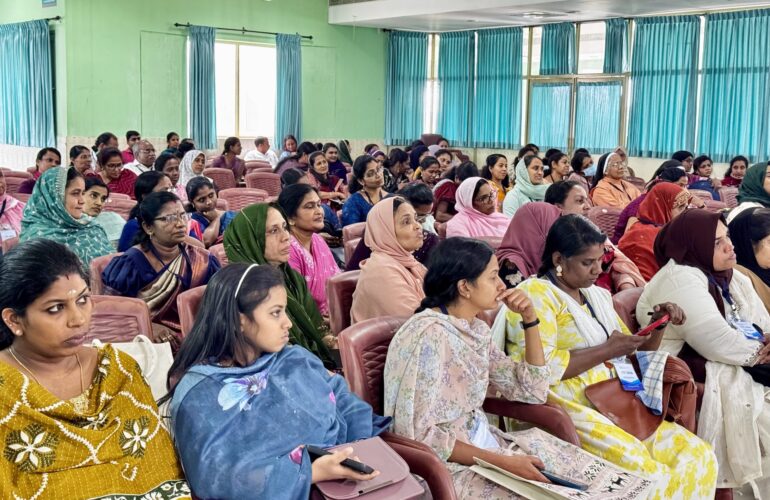
The two-day nurses’ conference organised by the Institute of Palliative Medicine (IPM) – NURSEPALCON 2026 – brought together nearly 200 community palliative care nurses from across Kerala. These nurses—most of them women—are not a marginal workforce.
They are the backbone of Kerala’s decentralised, community-led palliative care system: a system that reaches people’s homes in every nook and corner of the state through primary health centres, local self-governments, and more than 600 community-based organisations.
This nurse-led model has contributed significantly to Kerala achieving nearly 80% palliative care coverage, in stark contrast to the approximately 4% coverage across India. Yet, paradoxically, while nurses deliver the bulk of care, they remain largely absent from leadership spaces where decisions are made.
One of the most powerful moments of the conference was a panel discussion titled:
“Nurses as Leaders – Current Realities and Future Possibilities.”
What followed was not merely a discussion; it was a collective unpacking of a long-standing discomfort within palliative care systems.
This article is written from the conviction that the opinions and arguments raised during that panel are not limited to the palliative care landscape of Kerala. They likely resonate across many settings where nurses play a central role in care delivery, yet remain unheard and underrepresented in leadership spaces. This is not an argument about who should lead, but rather a critical question: Are nurses being given meaningful roles in leadership—not only at clinical levels, but also in organisational and policy-making spaces?

The Paradox: Backbone Without a Voice
A recurring question echoed through the hall:
If nurses provide most of the clinical care and significant emotional support to people with palliative care needs, why do they occupy such marginal leadership roles?
Panellists and participants spoke candidly. Nurses are often positioned as “isolated islands,” expected to implement decisions without being part of the thinking that shapes them. Organisational leadership—management committees, boards, and policy spaces—is frequently occupied by individuals who may not fully understand the philosophy or practice of palliative care, yet hold decision-making power.
One organisational office bearer admitted, with visible discomfort, that even in his own clinic there were no nurses in leadership roles—and that this left him morally uneasy.
So the uncomfortable question emerged: Who is responsible for this?
Patriarchy, Power, and “Knowing One’s Place”
Several voices named what is often left unspoken: patriarchy.
Nursing remains a predominantly female profession in societies where leadership is still implicitly male. Nurses spoke of internalised hierarchy—“I am a woman, a nurse; I am lower in the system”—a belief shaped by years of conditioning.
In many hospitals and palliative care units, nurses operate under the authority of doctors, expected primarily to ensure obedience rather than to shape policy. Performance appraisals, promotions, and even access to continuing education are sometimes linked less to competence and more to compliance.
The message is subtle but powerful: Do your work well, but do not ask too many questions.
Obedience vs. Leadership
Historically, nursing evolved in many parts of the world as mission work—rooted in service, sacrifice, and unquestioned obedience. While obedience can coexist with discipline and care, toxic obedience stifles leadership.
As one speaker noted:
“If a surgeon performs well, people say, ‘I am alive because of the surgeon.’ But could that surgery happen without nurses?”
Yet recognition—and authority—rarely follows.
Is the System Ready—or Are Nurses Hesitant?
In a striking moment, a panellist asked nurses directly:
If the system created space for leadership, how many of you would step forward?
Only about 40% raised their hands.
This revealed another uncomfortable truth: exclusion has been so normalised that many nurses hesitate to imagine themselves as leaders. Some do not raise issues because they believe they have no voice. Others fear repercussions—job insecurity, loss of income, or subtle punishment—especially when they are the sole breadwinners for their families.
Leadership, it became clear, is not just about opportunity. It is also about confidence, safety, and belief.
When Nurses Lead: What Changes?
Those who had experienced nurses in management roles described tangible differences. Organisations became more grounded in the realities of care delivery. Resource use became more conscientious. Decisions were more compassionate—yet also more disciplined.
One nurse-manager described the tension of balancing clinical duties with organisational responsibilities, but also how leadership deepened her accountability to patients, colleagues, and public funds.
Another speaker noted that some management committees feel threatened by nurses in key roles—perhaps because nurses see too clearly what is happening on the ground.
The Missing Piece in Palliative Care Education
Leadership is often taught as a concept in nursing curricula, but rarely practised or encouraged. Conflict resolution, organisational decision-making, and policy engagement remain largely theoretical.
An important observation was that many palliative care institutions—especially in low-resource settings—enthusiastically adopt Institute of Palliative Medicine’s clinical and community participation models, yet fail to replicate its organisational model, where nurses are visibly present in leadership spaces.
If models are meant to be holistic, why is this aspect not disseminated?
Compassion for Whom?
Palliative care proudly upholds compassion—but usually for patients and families. Rarely is the same compassion extended to those who deliver care: nurses and other frontline workers operating within rigid systems, low pay, high emotional burden, and limited agency.
As one moderator observed, compassion must also flow inward—to teams, to nurses, to the paid caregivers of care.
A Call for Discomfort
If palliative care truly believes that much of suffering is psycho-social and spiritual, then leadership structures must reflect that reality. Nurses—who witness suffering across all domains of patients’ and families’ lives every day, during home care visits, outpatient clinics, and inpatient care—cannot remain peripheral to organisational decision-making.
The future of palliative care demands a shift:
- From obedience to participation
- From hierarchy to shared leadership
- From symbolic inclusion to real power-sharing
Nurses do not need permission to lead.
They need space, trust, and systems willing to change.
And perhaps the most provocative question remains:
Can palliative care claim to be compassionate if it continues to marginalise the very professionals who hold it together?

Author:
Saif Mohammed
Consultant, WHO CC – Institute of Palliative Medicine





a fabulous commentary on a completely unacceptable situation and one which perpetuates inequity and poor quality care despite skills, aspirations and values on the part of nurses who could transform. thank you Saif for acting as the voice for this largely unheard group of vital professionals
Excellent article. Unfortunately, this is pervasive internationally. I felt quite upset as I read this, as everything that is written about these nurses in India is reflected here in palliative care sector/hospice in NZ. Nurses are not recognized for their experience and skill and from my experience – actively undermined. The field is medically dominated and this is perpetuated by the organizations that provide PC (govt and NGO’s). Nurses are not provided opportunities for leadership training.
We intuitively and compassionately work and provide ‘over and above’ to our patients/families. However do not get to influence strategic matters, funding, service design etc.
All of this probably is a major cause of burnout in nurses.
It seems we are the ‘work-horses’ that get worked to death.
Thank-you for expressing your insights Saif and i will share this with my colleagues and reflect some more.
Great job, Saif! This article names the paradox powerfully — nurses as the backbone of community palliative care, yet largely invisible in leadership spaces.
The way you bring together real voices, lived realities, fear, and more is deeply human and hard to ignore.
Yes, it is essential to involve Nurses of Palliative Care not only in decision making but also allowed to lead or share the leadership inorder to effectively implement the care in the best interest of the patients and the organization.