

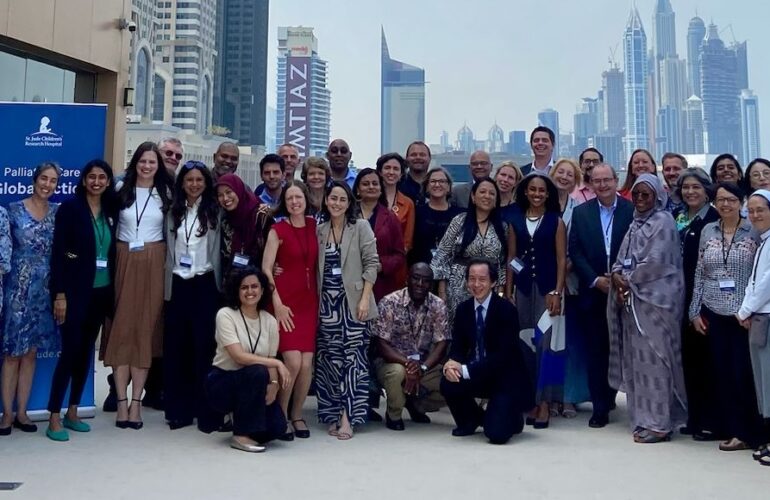
Leading Global Action for a World Where Palliative Care Reaches All – Leaders, experts, and partners from 23 countries gathered in Dubai on Sept 8 and 9, for the Palliative Care Global Action Forum, hosted at the St. Jude Global – Dubai Hub.
The meeting marked an important milestone in collective action to expand global access to palliative care, bringing together 42 participants representing WHO Collaborating Centres, civil society, and leading regional and global organizations.
“Now more than ever, we must act—we know the burden of suffering, and we know the comprehensive approach needed to relieve it.”
— Emmanuel Luyirika, African Palliative Care Association
The Forum aimed to shape a unified vision and shared commitment to advancing equitable, compassionate palliative care through collective leadership and global coordination.
“When we work and lead together, we tap into a collective creativity that opens doors to new possibilities. Leadership is not a position—it’s about showing up and leading from where you are.”
— Lacey Ahern, Global Partners in Care
Setting the Stage
Opening the Forum, Prof. Justin Baker challenged participants to “lead with purpose” by asking how innovation and equity can transform global palliative care. Early discussions focused on clarifying the complementary roles of WHO, civil society partners, and WHO Collaborating Centres—and on how best to align these unique strengths for maximum impact.
Designing for Action
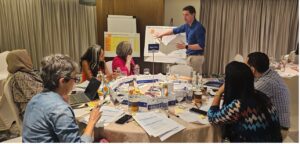
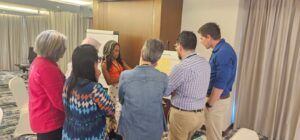
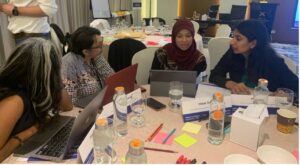
Using human-centred design methods, participants co-created four workstreams in key areas: Country Support, Advocacy, Research, and Technology. This approach placed people at the center of solutions, encouraging empathy, innovation, and practical solutions. Each workstream developed an elevator pitch and designed a magazine cover to illustrate their vision, later refined with group feedback.
Advocacy Workstream Pitch for a Minister of Health (excerpt):
“Only 1 in 10 people in your country receive appropriate care as they near the end of life. Palliative care is not only for the dying—it is for anyone living with serious illness. Integrated into universal health coverage, it transforms quality of life for patients and families. Under your visionary leadership, we can achieve a Good Life, Good Death, and Good Grief for all.”
[Watch Jim Cleary (WHPCA) present this pitch here]

Picture caption: Magazine cover created by the Advocacy group to represent their workstream
During the workshop, groups worked to prioritize workstream activities for the next twelve months, developing a work plan with timeline and identifying key team members for each workstream.
The Four Workstreams
- Country Support: COMPASS (Collaborative Movement for Palliative Care Access and System Strengthening)
- This online program will provide country teams with practical tools and guidance for national policy, program planning, implementation, and monitoring, through structured mentorship and interactive learning.
- Live sessions and tailored resources will guide countries to integrate palliative care into universal health coverage.
- Research
- Continuing their work conducting collaborative research through WHO Collaborating Centres, this workstream focuses on strengthening the evidence for system-level integration of palliative care
- 3 manuscripts from systematic and scoping reviews on palliative care education are expected to be published by year-end.
- New research is planned for 2026 which will focus on palliative care outcomes and indicators in primary care in low- and middle-income countries.
- Advocacy
- This workstream will focus on developing culturally appropriate tools, messaging, and policy briefs to support global and regional advocacy.
- The group will increase knowledge-sharing through quarterly advocacy network meetings, fostering South-South collaboration
- A series of policy briefs are planned for key topics for palliative care with associated knowledge dissemination activities, including webinars, social media assets, infographics and podcasts
- Supporting the establishment of a Group of Friends for Palliative Care is another key activity planned for the next year
- Technology
- This workstream will continue to develop digital tools for health workers through the WHO–International Telecommunications Union (ITU) partnership.
- The workstream is focused on supporting countries to develop and implement these digital communication tools to strengthen primary care delivery of palliative care
The workstream activities finished with participants sharing their personal commitment to the group’s work over the next year, by completing a commitment card and sharing it with the group.
Looking Ahead
Concluding the forum, Smriti Rana shared closing reflections, where she noted that access to palliative care has long been seen as a “wicked problem”—complex, context-dependent, and hindered by fragmented perceptions and resources. She drew on emergence theory, describing how migrating birds, by adjusting to one another, form patterns that conserve energy and enable long journeys. Similarly, she emphasized that compassionate leadership must be emergent and distributed—rooted in inclusivity, humility, courage, and ethical action. These qualities were evident in the Forum, where established leaders and new change-makers alike created a safe space to listen and learn together.
The next face-to-face Global Action Forum will take place in South Korea in 2026.
——————–




.


One small correction- to watch Dr Jim Cleary’s elevator pitch, the correct link is:
https://youtu.be/fAeTugwLwb4?si=xwxpqUZczwdYNoEr