

No this is not another Barbie review, but a political analysis of the Netflix series Painkiller, a pop culture portrait of the Sackler family’s pernicious role in the ongoing US opioid epidemic, which according to official sources has claimed tens of thousands of lives.
Catastrophe
The film portrays the Sacklers as the villains, and the Food and Drug Administration (FDA) — the US government agency charged with safeguarding public health — as effectively MIA, missing in action, understaffed, and for sale to the highest bidder, which in this case was Purde Pharma.
When key official gatekeepers and public servants such as those at the FDA are bought and paid for by industry, the public has no protection against the “false, misleading, and dangerous marketing campaigns,” the charge that eventually convicted the Sackler family in court.
Bottom line: the government failed to discharge its core, some might even say ‘sacred,’ responsibility to protect the life and health of its citizens.
Painkiller shows what happens when corporations, rather than citizens, govern; when officials ignore standard setting regulations for approving or rejecting new applications for medicines if the price is right. In theory at least, such bureaucracies and rules safeguard the public good from the profit maximizing goals of industry. In practice, they failed.
Consequences
That US government failure to prevent the opioid epidemic before it started is now having a chilling effect on global efforts led by medical professionals in palliative care, surgery, mental health, obstetrics, and treatement of substance use disorder, to improve the rational availability of generic opioid medicines such as oral morphine, currently inaccessible in countries that are home to more than 85% of the world’s population.
Patients in those countries who need strong opioids for the relief of severe pain and terminal breathlessness among other distressing symptoms, simply can’t get thembecause governments are afraid of having an opioid crisis similar to that affecting the US, on their hands.
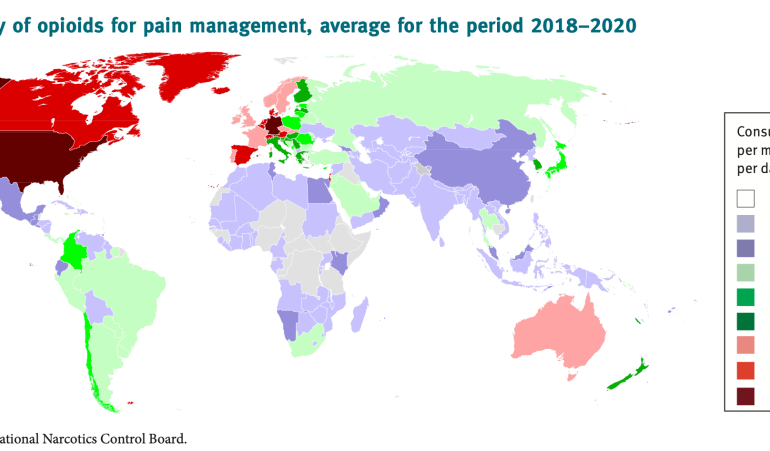
It’s worth noting that that global heat map of what the European Society of Medical Oncologists called the pandemic of untreated cancer pain back in 2012, encompasses almost all the lower- and lower-middle income countries, the former colonies of the Western world, and what used to be called the Soviet bloc.
Their governance and bureaucratic structures tend to be more fragile, less regulated, and just as vulnerable to the predatory machinations of global corporations as the US government now is, with its eviscerated and polarized public sphere.
Reparations to those countries from the societies that benefited from their colonization, in the form of regulatory consultancies and subsidies for workforce and health system strengthening, are in order. Reparations in the form of education about how governments can regulate medical opioids to prevent diveresion and non-medical use, and how health workers can prescribe them safely to relieve severe pain and other symptoms.

An indirect consequence of the Northamerican opioid epidemic is that governments in the green and purple countries on the map are now much more reluctant to improve their low to inadequate levels of opioid availability for medical purposes per their commitments under international law.
This growing global health catastrophe makes the US government indirectly complicit in the suffering of millions of people whose public servants — elected and appointed officials — lack the resources and political will to ringfence generic opioid based medicines with the evidence based regulations that will ensure their availability while preventing diversion and misuse.
Collective response
The approprate collective response is not simply to scapegoat Purdue pharma for the opioid crisis, which will not solve the underlying governance problem, but for the European Union countries with adequate (not excessive) opioid availability as a result of good governance, to support global civil society efforts to train health workers and drug regulators in the purple and green countries to prescribe opioids safely so that patients in severe pain can get effective relief rather than just paracetamol and tramadol, if they are lucky.
This entails rebranding generic morphine as the gold standard medicine WHO has always said it is, and distingushing it from the designer drug OxyContin, which Sackler and Co’s marketing team said was perfect to treat the chronic pain of otherwise healthy patients.
This made Oxy the gift that keeps on giving, for Purdue’s bottom line, unlike the morphine, which the marketing professionals ensured was associated with death rather than terminal cancer pain. Unlike Oxy though, generic oral morphine prescribed by properly trained health workers to patients with cancer pain can give them their lives back, if only temporarily, as this short film from Malawi shows.
Rather than fearfully preventing morphine procurement and prescribing at the expense of people who need it, the relevant regonal and international public health agencies still free from corporate capture can, in partnership with academia and professional organizations with good opioid track records, learn from the cumulative ethical sinkholes and policy mistakes that led to the crurrent Northamerican crisis of opioid overconsumption.
The UN agencies can convene all relevant stakeholders who usually work in silos, including drug regulators and prescribers (physicians, nurses and pharmacists) with public servants and political scientists in the purple and green countries to strengthen the regulatory infrastructure in ways that will improve opioid availability for their populations experiencing serious unrelieved pain and untreated substance use disorder.
For a political theorist like me, Painkiller’s more political subtext is actually that the Sacklers should never have been indicted at all, not because they were innocent of the charges against them, but because the government should not have allowed them to market Oxycontin in the first place.
Indeed, the 2017 President’s Commission on Combatting Drug Addiction and the Opioid Crisis flagged “inadequate oversight by the Food and Drug Administration.” The revolving door between industry and regulatory agencies has been spinning wildly at the expense of public health since the Clinton presidency’s legislative moves led to pharma funding more than half the FDA’s budget. This legislative move transferred American citizenship duties to corruptible politicals and bureaucrats at the expense of people in pain around the world.
See this related article “Parallel Opioid Crises” for more information.
——————————
Katherine Pettus is a Palliative care paraclete advocating for the right of patients to receive internationally controlled essential medicines to relieve preventable pain and suffering.
This article is republished from Katherine’s blog with permission.
The following articles by Katherine Pettus have also been published in ehospice:
Palliative Care: the Pearl of Great Price
The grateful leper and the miracle of morphine
UN declared October 29 the First International Day of Care and Support




Leave a Reply