

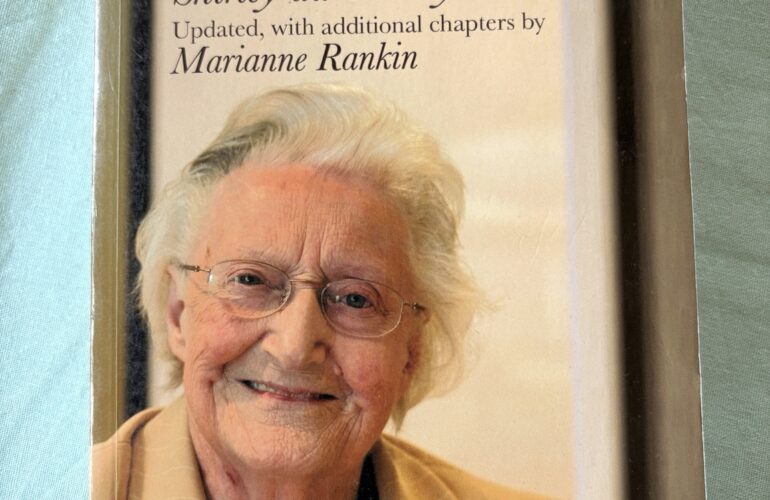
“You matter because you are you, and you matter to the last moment of your life.” — Dame Cicely Saunders. Today (June 22nd) is her birthday. She would have been 108 years old. And yet and this is the remarkable thing about certain lives, she doesn’t feel gone. She feels present in every room where someone sits beside a dying person and chooses not to look away. She feels present in every hospice corridor, in every conversation where a doctor pauses to ask not just where does it hurt but what does the pain mean to you? She feels present in each of that person, every single day that they show up for this work.
I never met Dame Cicely Saunders. I never shook her hand, never sat in her lectures, never walked through the doors of St. Christopher’s Hospice (wish to visit and want to feel her presence in the place that she put more than work, deeper than feelings), while she was alive. And yet, I feel with a certainty that is difficult to put into words, that I know her. Not as a historical figure. Not as a founder or a Dame or a recipient of the Order of Merit. I know her the way you know someone whose writing reaches through the page and touches something in you that you didn’t realise was waiting to be touched.
That is the gift she left. Not just a hospice. Not just a movement. But of all, A way of seeing
The Woman Before the Movement
She was born on this day in 1918 in Barnet, north London, the eldest child of a wealthy, emotionally complicated household. Tall, shy, awkward by her own telling, she struggled to fit in at Roedean, the elite boarding school her parents chose for her. She was an outsider. She would later say this made her sympathetic, constitutionally almost, to those who felt on the margins. I think about that often. The lonely child at boarding school who didn’t quite belong would grow into the woman who built a place precisely for those whom the medical world had quietly decided it was done with.
She wasn’t done with them.
She was also for much of her childhood and early life, a declared atheist. She grew up without church. Without formal faith. Without the language of the sacred. And yet she would become one of the most profoundly spiritual voices of the twentieth century, not despite this, but perhaps because of it. Her faith, when it came, was earned rather than inherited. It arrived not in a cathedral but during a seaside holiday in Cornwall in 1945, after years of reading C.S. Lewis, after years of quietly wrestling with questions she hadn’t been given permission to ask. It came to her through struggle. And when it came, it wasn’t a closed door. It was the widest possible window.
She made St. Christopher’s deliberately, defiantly secular, welcoming patients and staff of all faiths and of none. Because she had lived on both sides of that divide, and she understood that the need to be held, to matter, to not be abandoned, belongs to every human being. Not just the believing ones.
She Didn’t Just Think It. She Lived It First.
What moves me most about Cicely Saunders and I want to be precise about this, because I think it is the thing that separates her from so many visionaries is that she didn’t theorise her way to palliative care. She experienced her way to it. Every layer of her professional identity was also a human education.
She trained as a nurse when the war made her feel she had no right to merely study. As a nurse, she held the hands of dying patients on wards where the dying were routinely undertreated for pain, where no one spoke honestly about what was happening, where people screamed in back rooms because someone had decided that more morphine meant addiction. She saw this. She was appalled.
A back injury forced her out of nursing. She retrained as an Almoner, what we now call a medical social worker. In that role, she sat with families. She understood the economics of dying, the isolation of it, the way illness dismantles not just the body but the whole architecture of a person’s life, their roles, their relationships, their sense of themselves. She understood social pain not as a concept but as something she witnessed in kitchens and waiting rooms and on faces when someone received a bill they couldn’t pay.
And then because she was told plainly by one of her mentors, who she closely worked with as a Almoner, and witnessed her compassion towards working with patients and trying to ensure that they don’t suffer, that no one would listen seriously to a nurse or a social worker, she went to medical school. At St. Thomas’s Hospital. After formally studying nursing , medical social work, public health, She qualified as a physician in 1957. Not to replace who she had been. But To add to it. To speak to medicine in a language medicine would not be able to dismiss.
This is the thing that I find extraordinary every time I return to it: she held all of it simultaneously. The nurse’s capacity for presence. The social worker’s grasp of context. The physician’s command of evidence. And underneath it all, woven through every professional identity, a spiritual understanding of the human that refused to reduce suffering to symptoms.
She became the only kind of person who could have built what she built: someone who had actually inhabited the multiple worlds that dying people and their families move between.
David Tasma and the Window That Started Everything
There is a moment in Cicely Saunders’s life that I have returned to more times than I can count, because it is the moment where everything converges – professional, personal, spiritual, and human.
In 1948, she was an Almoner at St. Thomas’s Hospital when she met David Tasma. He was forty years old, a Jewish refugee from the Warsaw Ghetto, dying of inoperable cancer, working as a waiter in London, far from everything familiar. He had, in the truest sense, no one.
She visited him every day for two months. They talked, really talked, about what he needed, what was missing, what dying felt like when you were utterly alone. He was, she later said, the patient who taught her what a hospice needed to be. When he died in February 1948, he left her £500, his entire savings with this simple instruction: “I’ll be a window in your home.” This memory that got created when read about it, for the first time, with visuals , in black and white. Each time I think about it, brings tears with my heart feeling it. I wish to see that someday.
That window is still there. It stands at the entrance of St. Christopher’s Hospice to this day, etched with his name.
I think about David Tasma often. About the fact that this entire global movement, hundreds of thousands of hospices, palliative care teams in hospitals across every continent, entire academic disciplines, the concept of total pain, the field I have given my professional life to began with one woman refusing to stop visiting a dying man who had no one else. I often think what this feeling, can be named as ?
She didn’t build a movement and then go find its meaning. She found its meaning first, in a single human being, and then built the movement around it.
Total Pain: Seeing the Whole Person
She gave us many things. But perhaps the greatest intellectual gift she gave medicine was the concept of total pain.
In the early 1960s, when she had trained as a physician and was working with dying cancer patients, she began to document something that everyone on the wards knew intuitively but no one had named: that the pain a dying person experiences is never just physical. It is always also psychological – the fear, the loss of control, the anticipatory grief. It is always also social – the fractured relationships, the financial devastation, the sense of being a burden. It is always also spiritual – the questions that arrive in the night: Why me? What does my life mean? Is there anything after this?
She called this total pain. And she insisted, with the force of someone who had seen it from every angle, as a nurse, a social worker, a physician, a friend, a lover, a believer, that you could not address one dimension while ignoring the others. You had to meet the whole person.
This is why her legacy is not just hospice. It is the entire field of palliative care. It is the reason I do the work I do.
The Spiritual Journey: From Atheism to Anglican, From Church to Cosmos
Her spiritual life was not a clean arc. It was like the best spiritual lives, a series of honest searches, false starts, genuine doubts, and sudden, surprising arrivals.
She declared herself an atheist at school. She grew up in a household that did not go to church. And then slowly, through years of reading, through friendships with evangelical Christians, through the particular kind of exposure to suffering that her nursing work brought something shifted. Not dramatically. Gradually. The way understanding usually arrives.
Her conversion in 1945 was, by her own account, quiet and certain. But what is remarkable is what she did with it: she never made it exclusive. She never allowed her own faith to become a criterion for the care she offered. She welcomed agnostics and atheists and Hindus and Muslims with the same open hand. She understood that spiritual care is not about the religion a person holds but about the questions their illness awakens, questions about meaning, about belonging, about whether the life they lived will have mattered.
She wrote: “How people die remains in the memory of those who live on.”
She knew this intimately. She had been with enough people at the end to understand that what people carry from a deathbed is not the medical chart but the quality of presence, whether someone was there, whether someone listened, whether the dying person was made to feel, in their last hours, that they were not forgotten.
The Loves That Shaped Her
Cicely Saunders loved three men in her life, and each of them was a patient.
David Tasma, the Polish-Jewish refugee who bequeathed her a window and a vocation.
Antoni Michniewicz, another Polish patient, who died in 1960. She wrote about this loss with a grief that is neither sentimental nor composed, it is the grief of someone who knows, professionally, every stage of bereavement, and still finds herself undone by it. She was not immune. She was never immune.
And then, Marian Bohusz-Szyszko, a Polish painter, whom she had known since 1963 and married in 1980. She was 61. He was 79. He spent his last days at St. Christopher’s, cared for by the hospice she had built. He died in 1995.
She was widowed. She kept working.
I find something clarifying in this. She was not a detached professional. She was not the kind of visionary who theorises suffering from a safe distance. She suffered. She lost people she loved. She was held by the same fragilities she spent her career attending to in others. And she remained, through all of it, in the work. Not because she was inured to pain, but because she had decided, at some fundamental level, that pain was worth sitting with.
What She Said: Her Words as a Practice
Her quotes are not aphorisms. They are clinical instructions delivered in the language of love.
“You matter because you are you, and you matter to the last moment of your life.”
This is the one I carry closest. It is the sentence I think of when I sit with a patient who says, I am a burden. I am nothing now. I used to be someone. It is the answer to one of the cruelest lies that serious illness tells: that your value was contingent on your productivity, your independence, your ability to give rather than receive. Cicely Saunders refused that lie. She refused it institutionally, by building a place where people were cared for with expertise and tenderness right up to the last breath. She refused it philosophically, by insisting that mattering is not something you earn or lose. It is something you are.
“How people die remains in the memory of those who live on.”
This is her most important gift to the family. The reminder that the dying do not only die for themselves. They die for everyone who will carry that death forward. Good death, presence, honesty, comfort, dignity, is a gift that echoes outward, through generations.
“Watch with me.”
The title of her final collected lectures. Three words from the Gospel of Mark, Jesus in the garden of Gethsemane, asking his disciples simply to stay. Not to fix. Not to cure. To watch. To be present. This is what she asked of every nurse, every doctor, every volunteer who passed through St. Christopher’s. Not heroism. Presence.
“We need to recognise that patients have to live until they die.”
She fought against the idea, so common in medical culture then and, honestly, now that once curative treatment ends, the clinical task ends too. She said: no. There is still living to do. There is still love, and conversation, and art, and reconciliation, and sometimes yes, even joy. The work does not end. It changes.
What I Carry
I am a psycho-oncologist. I sit with people who are living with cancer, not only with their tumours but with their terror, their grief, their love, their anger, their unanswered prayers, their night sweats and their regrets and their sudden, unexpected moments of grace. I also sit with their families. And with the nurses and doctors and social workers who carry, day after day, the accumulated weight of other people’s last chapters.
I came to this work through several doors. But I stay in it because of her.
When I first encountered Cicely Saunders, not in a lecture hall but in a book, reading late at night with the particular feeling of encountering something that had already been true before you found it, I felt what I can only describe as recognition. Here was someone who had articulated what I had felt but not yet said: that to care for a person who is dying is not a lesser form of medicine. It is medicine at its most complete. It is the place where the body, the mind, the spirit, and the social world converge, and where the clinician is asked, finally, unavoidably, to be fully human.
I feel extraordinarily fortunate. I know this is not something everyone gets to say about their work. But when your work has a grandmother like Cicely Saunders, when the field you practice was founded by someone who had the moral imagination to see, and the extraordinary doggedness to build, and the personal courage to love, you do not take it lightly.
I think of her when I resist the urge to rush a consultation.
I think of her when I sit with a patient who is telling me something that has no clinical solution and needs only to be witnessed.
I think of her when a family member says, We don’t know how to do this, and I say, You don’t have to know. I’ll be here with you.
That is her. That is what she taught us. Not a protocol. A posture.
She Died Where She Lived
Dame Cicely Saunders died on July 14, 2005, at St. Christopher’s Hospice — the hospice she had built, the place she had given her life to. She was 87. She had cancer.
She had said, years earlier: “Everyone else would like to have a stroke on the golf course, but I’d rather have cancer, because it does give us a chance to say thank you, and I’m sorry, and goodbye.”
And so she died in the place she had built for dying with dignity. She was cared for by people who had learned from her, or from people who had learned from her, in an unbroken chain of taught tenderness that she had started with a single Polish refugee and five hundred pounds and a window.
There is a kind of completion in that which I find, I want to say beautiful, though the word feels insufficient. She knew the room she would eventually need, and she spent her life making sure it would be ready.
Happy Birthday, Dame Cicely
On the 22nd of June, every year, I do not want light a candle or lay flowers. I want to be able to go to work. To sit with someone who is afraid. To listen to a family that is exhausted. To ask a colleague how they are, really, not rhetorically.
This is how I want to celebrate her. This is how, I think, she would want to be remembered: not in eulogies but in the quality of presence we bring to the rooms she taught us to enter without flinching.
She changed what dying looks like for millions of people. She changed what it means to be a doctor, a nurse, a healer. She changed what it means to be human in the presence of death, which is to say, she changed something for all of us.
You matter because you are you.
She said this to the dying. But she showed it, with her whole life to the living too.
Happy birthday, Dame Cicely.
References
- du Boulay, S. (1984). Cicely Saunders: Founder of the Modern Hospice Movement. London: Hodder & Stoughton.
- Clark, D. (2018). Cicely Saunders: A Life and Legacy. Oxford: Oxford University Press.
=============
Keshav Sharma
Psycho oncologist & Grief Educator
Compassionate Leader
Clinical and Professional supervisor
Founder: oncopsychcare.com
Social Media : @keshavoncopsych
https://www.linkedin.com/in/keshav-sharma-24290b96
“You matter because you are you, and you matter to the last moment of your life.”
==================
ehospice is proud to help promote individual, local, national and international voices in Hospice & Palliative Care
We are on target to have over One Million page views this year.
To stay in touch with colleagues and news around the world subscribe to our free Newsletter


Excelente reflexión a quienes enseñamos a otros desde la educación a conocer y recordar a Cicely,un legado para compartir y vivir con otras personas que nos necesitan.
Ayer en la primera clases de cuidados paliativos,un grupo de estudiantes la representan y se quedará en esa misión como enfermeras.
Nice reading….
シシリー・ソンダースに関する素晴らしい記事です。
いろんなソンダースに関する文章を筆者の深い思いに共感することができました。
This is a wonderful article about Cicery Saunders. I found myself resonating with the author’s deep feelings as I read through the various passages about Saunders.