



Amrita Shrestha
MBBS, MD (Pediatrics), NFPM (Fellowship in Palliative Medicine), FRCP(Edin.)
Palliative Care Lead
INF Nepal Green Pastures Hospital, Pokhara, Nepal
Dr Amrita Shrestha is deeply committed to restoring dignity for children living with serious illness and for their families as they navigate the challenges of illness and care. She is a strong advocate for listening to and amplifying the voices of children and families, ensuring they are seen and valued as whole persons, not just as patients. Through her clinical work, teaching, and research, Dr Shrestha works to embed dignity-centered, compassionate care within health systems, with a particular focus on pediatric and family-centered care in resource-limited settings.
“Namaste. How are you doing today?” I lean forward, make eye contact, and smile at my five-year-old patient, who appears small for her age, comfortably tucked into her mother’s lap. Her mother stiffens, looks at me anxiously, and says almost apologetically, “Doctor, she cannot speak.”
Her words did not deter me. What mattered was that, in that moment, the child had my attention—the attention she deserved. I continued to speak to her, watching her tiny eyes try to follow my voice. To me, that was enough. In no time, the mum felt at ease.
That moment, seven years ago, has stayed with me. It was a routine, deeply human greeting, yet it quietly revealed a deeper truth: how easily children with serious illness—particularly those with communication difficulties—can be excluded from everyday conversations, not by neglect, but by habit.
My search for answers began then, and little did I know then that it would lead me to explore dignity in the lives of children with serious illness—children I care for deeply. Around the same time, a friend gifted me the book Dignity in Care. From that point on, it became impossible for me not to pursue this quest. The Children’s Palliative Care Leadership Fellowship Program provided the nudge I needed to transform this reflection into intentional inquiry.
With limited work on dignity in healthcare in Nepal, I reached out to experts both within and beyond the country. To my surprise, not long after I found myself in conversations with Dignity expert Prof. Harvey Chochinov himself, along with several other leaders in the field.
The stories I heard from children and their families often stopped me in my tracks—accounts of distress within healthcare encounters, and of families describing how illness and diagnosis had altered not only their child’s life, but their sense of who the child once was.
It was not enough to simply explore what influenced their dignity, or to understand what dignified care meant to them. What was needed was a systematic approach—and I knew that this journey could not be undertaken alone. My hospital supported this vision, and the provincial government recognized its potential to contribute to system-level change. Sharing the idea through leadership meetings, discussions with the health directorate, and conversations with like-minded organizations helped initiate the project.
Because the concept of “dignity” does not translate easily into Nepali, we chose to listen rather than begin with predefined definitions. Through in-depth interviews and focus group discussions conducted across three hospitals in Gandaki Province, children, parents, and healthcare providers were invited to share what made a child feel respected, valued, and heard—and what preserved or diminished that sense of dignity during illness and care.
Drawing on Chochinov’s dignity model and the framework described by Cai and colleagues, we developed a Nepal-contextualized dignity model for children with serious illness. This model wove participants’ voices with established frameworks, offering language for what had been expressed while also revealing important gaps shaped by cultural values of respect, family presence, and shared decision-making in healthcare.
 Following the focus group discussions, many healthcare providers described increased awareness of dignity in caring for children with serious illness and expressed a strong desire to provide more dignified care, despite limited time, training, and resources. In response, a dignity-focused training module was developed to support healthcare providers in reflecting on their own practice, equipping them with a child-centered dignity framework and practical skills to recognize and preserve dignity in routine care.
The module translates abstract concepts into practical guidance, including reflective questions, short case scenarios drawn from real clinical experiences, communication strategies, role play, and experiential activities such as the ‘dignity walk.’
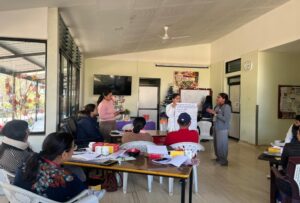 A pilot training was conducted on 19 December at Green Pastures Hospital with sixteen participants, including patient advocates, rehabilitation professionals, counsellors, nurses, doctors, and administrative staff. Participants described increased awareness of dignity, the relevance of real-life case discussions, and a growing recognition of small but meaningful lapses in their own practice.
Twenty-five days after the training, participants reported changes in their clinical approach, including greater empathy, more mindful communication, and prioritization of respect in patient and visitor interactions, and advocacy for dignified care within their workplaces. Several reflected on applying a “lens of dignity” not only in professional settings, but also in their personal lives.
I find myself returning to that encounter from seven years ago to the child on her mother’s lap. Did she appreciate me acknowledging her presence? Did she feel seen? Did she feel heard? Through this work on dignity for children with serious illness, I have come to believe that dignity in children’s palliative care is not something we add through policies and protocols alone; it begins with ensuring that the child seated in front of us is truly heard and seen.
“Are we ready to meet them where they are?”


Leave a Reply