

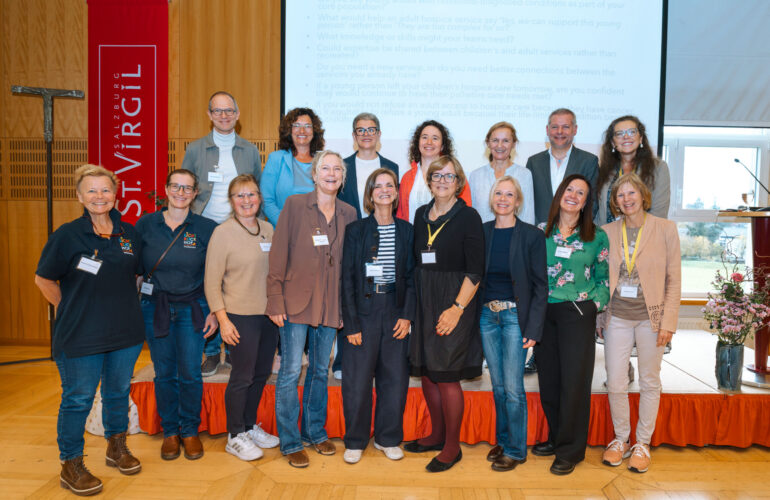
International expertise, professional exchange and practical approaches to supporting children, adolescents and young adults with life-limiting conditions and their families were at the heart of “Let’s talk about it!”, a conference held by HOSPIZ ÖSTERREICH in Salzburg on 9 November 2026.
 How can seriously ill children and young people and their families be best supported? When is the right time for difficult conversations? And how can the transition from children’s to adult services be managed well? These questions brought experts from Austria, Germany and the UK together at the St. Virgil Education Centre. At the center of the day was an approach that sees children and young people as individuals, taking account of their needs, wishes and quality of life, as well as those of their families.
Developments and challenges
Andreas Müller, Vice President of the German Society for Palliative Medicine, opened the program with a reflection on the development of hospice and palliative care for children and young people in Germany. He stressed that care must continue to be guided by the needs of those affected.
“Much has been achieved over the past decades. Today, we speak not only of curative and palliative care, but of life-prolonging care, care to enhance comfort and quality of life, and bereavement support. And all of this only works together, multi- and interprofessionally,” Müller said.
Martin Nagl-Cupal presented findings from an evaluation of specialist hospice and palliative care for young people in Lower Austria. In the subsequent panel discussion, Dr Martina Kronberger-Vollnhofer and Renate Hlauschek highlighted regional differences in provision, the importance of day structures and inpatient children’s hospices, and the need for strong networks — particularly during transition.
International perspectives
In a video message, Prof Julia Downing, Chief Executive of the International Children’s Palliative Care Network (ICPCN), highlighted the global need for pediatric palliative care. More than 21 million children worldwide need palliative care, around eight million of them specialist care. She pointed to barriers including limited access to medicines, workforce shortages, and policy constraints, while emphasizing the opportunities created by international collaboration, research, education, and innovative models of care. Her message was clear: palliative care must be accessible to all children and young people who need it.
Amanda Whateley, Clinical Advisor for Transition at Hospice UK, presented practical lessons from the UK’s national transition program. She described the move from children’s to adult services as a particularly challenging phase, shaped by differing service cultures, unclear responsibilities, gaps in adult provision and the complex needs of young people with life-limiting conditions. Flexible access routes, well-coordinated transition processes, reliable partnerships and a focus on individual needs, she argued, are key to sustainable care models.
Practical workshops

In the afternoon, parallel sessions explored advance care planning, animal-assisted palliative care, structured parent support, supported communication and advanced practice nursing. A particular focus was on holding sensitive conversations with seriously ill children and their families at the right time. Participants heard that advance care planning should not begin only in acute crises but should be understood as an ongoing process in everyday life.
Conversations that give support
“Talking about severe illness, dying and farewell takes courage, openness and empathy,” said Barbara Schwarz, President of HOSPIZ ÖSTERREICH. “As a society, we must learn to talk about these subjects, bring them out of the taboo zone and not leave those affected alone.”
The conference showed how important professional exchange and shared commitment are in supporting seriously ill children, young people and their families as well as possible.
Babsi Loisch is responsible for science and communication at HOSPIZ ÖSTERREICH, the Austrian umbrella organization for hospice and palliative care. She co-leads its Scientific Advisory Board and focuses on caring communities, health literacy and public communication, including the development of palliative care education for people with migration biographies.



Leave a Reply