

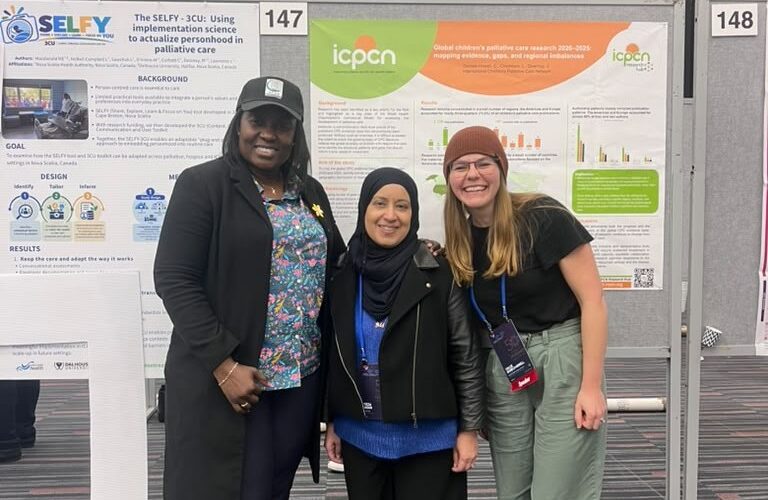
As the palliative care community gathered in Montréal for the 50th Montréal International Palliative Care Congress (6 to 9 October), there was a strong sense of both celebration and anticipation. Fifty years after Dr Balfour Mount convened the first congress, delegates came together to reflect on how palliative care has evolved, and to ask what the next 50 years should look like.
For those involved in children’s palliative care, the congress offered a dedicated paediatric track that ran throughout the week alongside the broader scientific and educational programme. Five paediatric sessions covered grief, bereavement and perinatal and neonatal loss; uncertainty, culture and end-of-life communication; education, training and partnership in practice; care pathways and communication in oncology and adolescent and young adult care; and, on the final afternoon, building the future of the field through precision, global capacity, quality and access. Across them, themes of equity, participation, humanism and multidisciplinary collaboration pointed towards a future in which children, young people and families play a more active role in shaping care, research and policy.
The opening-day seminar, “After Survival”, set the tone. It focused on the responsibilities owed to children with medical complexity and technology dependence, young people often described as too old for paediatrics but too complex for adult care. It began not with theory or service models but with the experiences of two Canadian families. Their stories of navigating healthcare systems, coordinating services and planning for the future were a powerful reminder that families are experts in their own lived experience. Throughout the day, speakers returned to transitions across services and stages of life, and to the need for systems that are responsive, coordinated and centred on the goals of children and families.
This focus on partnership continued across the track. Presentations explored parents’ experiences of navigating care, the social support networks families rely on, and whether taking part in research can help parents adapt after a child’s death. Speakers emphasised that children, young people and families are not simply recipients of care but active contributors to decisions that affect them, and that meaningful progress depends on incorporating their perspectives from the outset.
Equity resonated strongly across the congress. The paediatric seminar asked where families are still falling through the gaps, and the wider programme included a session on building national palliative care systems in Africa, as well as papers on Indigenous, racialised and cultural perspectives and on structurally vulnerable populations. Participants reflected on the progress made while acknowledging that access to high-quality care remains deeply unequal, with disparities in services, education, medicines, funding and research opportunities, particularly in low-resource settings. Alongside this ran a sense of optimism and shared responsibility, with many sessions focused on strengthening capacity, developing sustainable services and fostering equitable collaboration across regions and disciplines.
The congress also remained rooted in the humanistic values that have long defined palliative care. Compassion, dignity, presence and meaning-making ran through the programme, from workshops on psychotherapeutic skills and reflective practice to a Poetry as Medicine workshop, a storytelling exchange for professionals, and a memorial service followed by a cello concert. These sessions underscored the importance of attending to the emotional, social and spiritual dimensions of care, for professionals as well as for patients and families.
The multidisciplinary nature of the congress was equally striking. Physicians, nurses, psychologists, social workers, therapists, educators, researchers and spiritual care providers came together to share expertise and learn from one another. This matters particularly in children’s palliative care, where supporting children and families requires coordinated care across disciplines, settings and sectors.
A global reminder
On the final day, a morning plenary was followed by the launch of the third edition of the Global Atlas of Palliative Care, a landmark resource mapping the need for and availability of palliative care worldwide. For children’s palliative care, its message was a sobering one: the need remains vast, and access remains deeply unequal. After four days of discussion about partnership, humanism and equity, the Atlas was a reminder that these are not abstract ideals. For most children who need palliative care, access is still the first barrier. It also gives advocates, clinicians and policymakers a shared evidence base on which to build.
Looking ahead
As delegates departed Montréal, the significance of the anniversary extended beyond commemorating the past. The paediatric seminar closed with a question worth carrying forward: if we gather again in ten years, what must be different for children with medical complexity and their families? The conversations of the week suggested an answer: a future in which palliative care is more equitable, more collaborative and more responsive to the voices of those it serves. For children’s palliative care, that means strengthening collaboration across professions and regions while ensuring that children, young people and families are not simply included in the conversation, but help lead it.
By Dr. Callie Daniels-Howell, Research Manager, ICPCN.


Leave a Reply